
Public-Sign Japanese: Prohibitions, Requests, Warnings, and Polite Authority
The reader can read public-sign Japanese as a system of authority, politeness, warning, prohibition, and civic coordination.
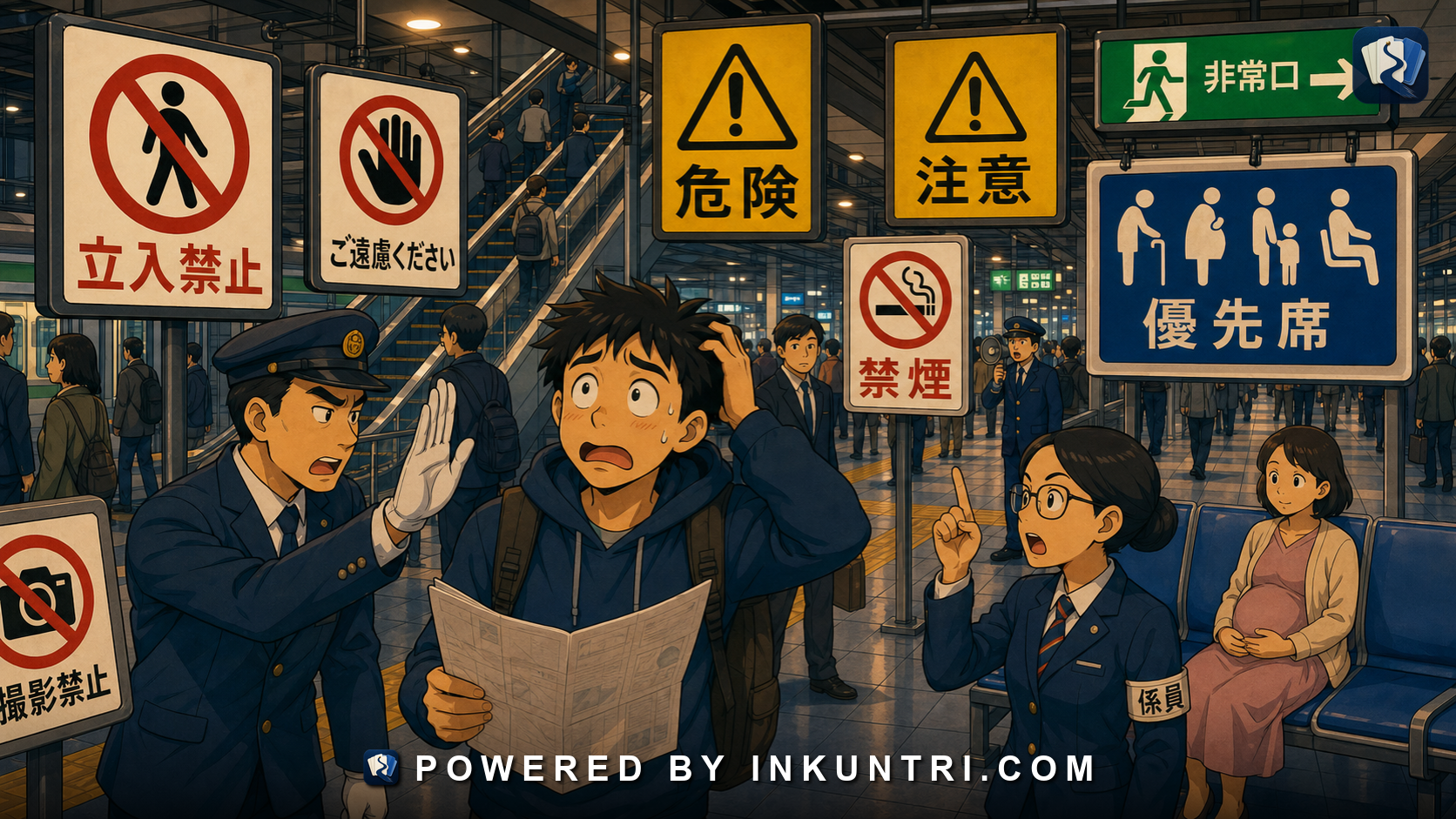
Core examples: 立入禁止, ご遠慮ください, 危険, 注意, 禁煙, 優先席, 係員, 非常口, 撮影禁止.
Public signs are not beginner sentences
Public signs often look simple. They use short phrases, large characters, icons, arrows, and repeated formulas.
That simplicity is deceptive.
A sign may be polite on the surface but firm in function. It may omit the subject. It may use a noun phrase instead of a full sentence. It may rely on honorific language to soften authority. It may combine Japanese, English, pictograms, colors, and layout. It may distinguish request, warning, prohibition, instruction, emergency guidance, and legal boundary.
A learner who translates only the words may miss the force.
The key principle is:
Public-sign Japanese is civic language: it tells people what to do, not do, notice, avoid, respect, or prepare for.
It is not just vocabulary. It is social control through concise writing.
Prohibition: 禁止 as a strong signal
禁止 means prohibition. When you see it, the sign is not merely making a suggestion.
Examples:
立入禁止 No entry / Entry prohibited
撮影禁止 Photography prohibited
禁煙 No smoking
駐車禁止 No parking
使用禁止 Do not use / Use prohibited
The pattern is often noun + 禁止. The sign may not include a verb or subject. It does not need one. The prohibition is the message.
Learner action: when you see 禁止, treat it as a hard boundary unless the context clearly says otherwise.
立入禁止: the classic boundary sign
立入禁止
This sign means entry is prohibited. It often marks dangerous, private, restricted, construction, railway, backstage, or staff-only areas.
The word consists of:
- 立入 — entering / going into
- 禁止 — prohibition
It may be accompanied by barriers, red signs, ropes, construction equipment, or warning icons.
Do not translate it weakly as “please avoid entering.” It is stronger than that.
ご遠慮ください: polite wording, real restriction
One of the most important public-sign phrases is:
ご遠慮ください
Literally, it asks people to refrain. It is polite. But on signs, it often functions as a firm instruction.
Examples:
撮影はご遠慮ください。 Please refrain from photography.
飲食はご遠慮ください。 Please refrain from eating and drinking.
携帯電話のご使用はご遠慮ください。 Please refrain from using mobile phones.
The phrase does not always mean “optional if you feel like it.” It is a softened prohibition.
This is where Japanese politeness can mislead learners. Polite language may reduce face-threat while preserving authority.
The social meaning:
We are telling you not to do this, but in a socially smooth way.
危険 and 注意: danger versus caution
Public signs often use warning words:
危険 danger
注意 caution / be careful
警告 warning
高電圧注意 high voltage — caution
足元注意 watch your step
危険 is stronger than 注意. 危険 marks danger. 注意 may mark caution, attention, or a warning about a specific risk.
Common patterns:
- 足元注意 — watch your step
- 頭上注意 — watch overhead
- 滑りやすいので注意 — slippery, be careful
- 危険 近づかないでください — danger, do not approach
Learner action: identify the hazard and the expected behavior.
Requests that are really instructions
Many public signs use request forms:
〜してください please do X
〜しないでください please do not do X
〜をお願いします please X / we ask for X
Examples:
靴を脱いでください。 Please take off your shoes.
ドアを閉めてください。 Please close the door.
ここに座らないでください。 Please do not sit here.
マスクの着用をお願いします。 Please wear a mask.
In private conversation, these forms can range from request to instruction depending on context. On public signs, they usually indicate expected behavior.
Learner action: signs do not negotiate. They coordinate.
Facility language: staff, exits, entrances, and equipment
Public signs often use compact facility nouns:
入口 entrance
出口 exit
非常口 emergency exit
受付 reception
係員 staff / attendant
関係者以外立入禁止 No entry except authorized personnel
使用中 in use
故障中 out of order
点検中 under inspection
These are not full sentences. They are labels. Learners should treat them as functional vocabulary.
優先席: social rules in two kanji compounds
優先席
This means priority seat. It appears on trains and buses. The sign may include images of elderly people, pregnant people, injured people, disabled people, or people with small children.
The word itself is compact:
- 優先 — priority
- 席 — seat
But the social instruction is larger: give this space to people who need it.
You may also see:
携帯電話の電源をお切りください。 Please turn off mobile phones.
or:
混雑時は携帯電話のご使用をお控えください。 Please refrain from using mobile phones when crowded.
Priority-seat signs combine language, pictograms, etiquette, and public coordination.
Emergency signs: directness increases
In emergencies, signs become more direct.
Examples:
非常口 emergency exit
避難経路 evacuation route
火災報知器 fire alarm
押す push
逃げてください evacuate / escape
津波避難場所 tsunami evacuation site
Emergency language prioritizes clarity over politeness. It uses large characters, arrows, icons, colors, and simple commands.
Learner action: memorize emergency sign vocabulary early. This is not optional tourism vocabulary.
Pictograms and Japanese text
Japan uses many pictograms, especially in stations, airports, public buildings, tourist sites, bathrooms, elevators, and disaster-prevention signs. Pictograms help, but they do not replace Japanese.
A pictogram may show a camera with a slash, but the Japanese text tells you whether the restriction is photography, video, flash, commercial use, or only in a certain area.
A pictogram may show stairs, but the Japanese text may say emergency stairs, do not use during normal operation, or use in evacuation.
Learner action: use pictograms as context, then read the Japanese for precision.
Passive and institutional phrasing
Some public signs avoid direct agents. They may use passive or institutional wording:
監視カメラ作動中 Security camera operating
防犯カメラ設置 Security cameras installed
係員の指示に従ってください Please follow staff instructions
清掃中 Cleaning in progress
点検のため使用できません Cannot be used due to inspection
These phrases create authority without naming a person. The institution speaks through the sign.
Learner action: identify status, cause, and expected behavior.
Example bank walkthrough
立入禁止
No entry / entry prohibited. Strong boundary language.
Learner action: do not enter.
ご遠慮ください
Please refrain. Polite but often firm.
Learner action: treat it as a restriction unless context clearly softens it.
危険
Danger. Strong warning.
Learner action: identify hazard and avoid it.
注意
Caution / attention.
Learner action: look for what the sign wants you to be careful about.
禁煙
No smoking.
Learner action: recognize it instantly in stations, restaurants, hotels, and public spaces.
優先席
Priority seat.
Learner action: understand the social instruction, not just the label.
係員
Staff/attendant.
Learner action: look for instructions involving staff: ask, follow directions, contact.
非常口
Emergency exit.
Learner action: memorize this for safety.
撮影禁止
Photography prohibited.
Learner action: do not take photos unless a narrower exception is stated.
A public-sign reading checklist
When reading a sign, ask:
- Action: What behavior is involved?
- Force: Is it prohibition, request, warning, instruction, label, or emergency command?
- Audience: Everyone, customers, staff, authorized personnel, passengers, residents?
- Place: Entrance, platform, bathroom, elevator, museum, park, construction zone?
- Reason: Danger, privacy, cleanliness, law, congestion, equipment, emergency?
- Politeness layer: Is polite language softening a firm rule?
- Pictogram: What does the icon confirm or clarify?
- Consequence: Is there a safety, legal, social, or access consequence?
A strong tool for this article would classify signs by force.
Suggested functions:
- Severity scale: Friendly request → firm request → prohibition → danger → emergency.
- Phrase cards: 禁止, ご遠慮ください, 注意, 危険, 非常口, 係員.
- Pictogram pairing: Show image + Japanese text + behavior.
- Context mode: Station, museum, hospital, park, hotel, construction site.
- Politeness decoder: Explain when polite wording still means “do not.”
- Emergency drill: Identify evacuation signs and actions quickly.
- Learner quiz: Choose the correct behavior from a real-looking sign.
Final rule
Public-sign Japanese is compact authority.
Do not be fooled by short phrases or polite wording. Signs tell you boundaries, hazards, duties, permissions, and expected behavior. Learn the formulas, read the pictograms, and identify the force.
In real life, good Japanese reading is not only about literature or conversation. Sometimes it is about knowing which door not to enter.
Related reading
National Language Policy and the Idea of Kokugo
The reader can understand kokugo as a national-language idea with educational, political, and cultural consequences.
Kanji Component Analysis Without Fake Etymology
The reader can use kanji components for memory and lookup while avoiding made-up etymologies that teach false history.
Bungo, Kōgo, and the Modernization of Japanese Prose
The reader can understand bungo and kōgo as competing prose norms whose modernization shaped the Japanese people read today.
The Social Life of Katakana in Modern Japan
The reader can analyze katakana as a social script that marks foreignness, emphasis, technicality, branding, species names, and voice.
Sentence Intonation in Japanese Questions, Requests, and Doubt
The reader can hear how sentence intonation changes questions, requests, doubt, surprise, and confirmation beyond the written particle か.
Japanese Internet Slang: Abbreviation, Kana Play, and Persona
The reader can understand Japanese internet slang as abbreviation, kana play, persona performance, and platform-specific writing.