
Japanese Numbers in Writing: Arabic Digits, Kanji Numerals, and Formal Forms
The reader can choose and interpret Arabic digits, kanji numerals, formal numerals, counters, dates, and addresses in Japanese writing.
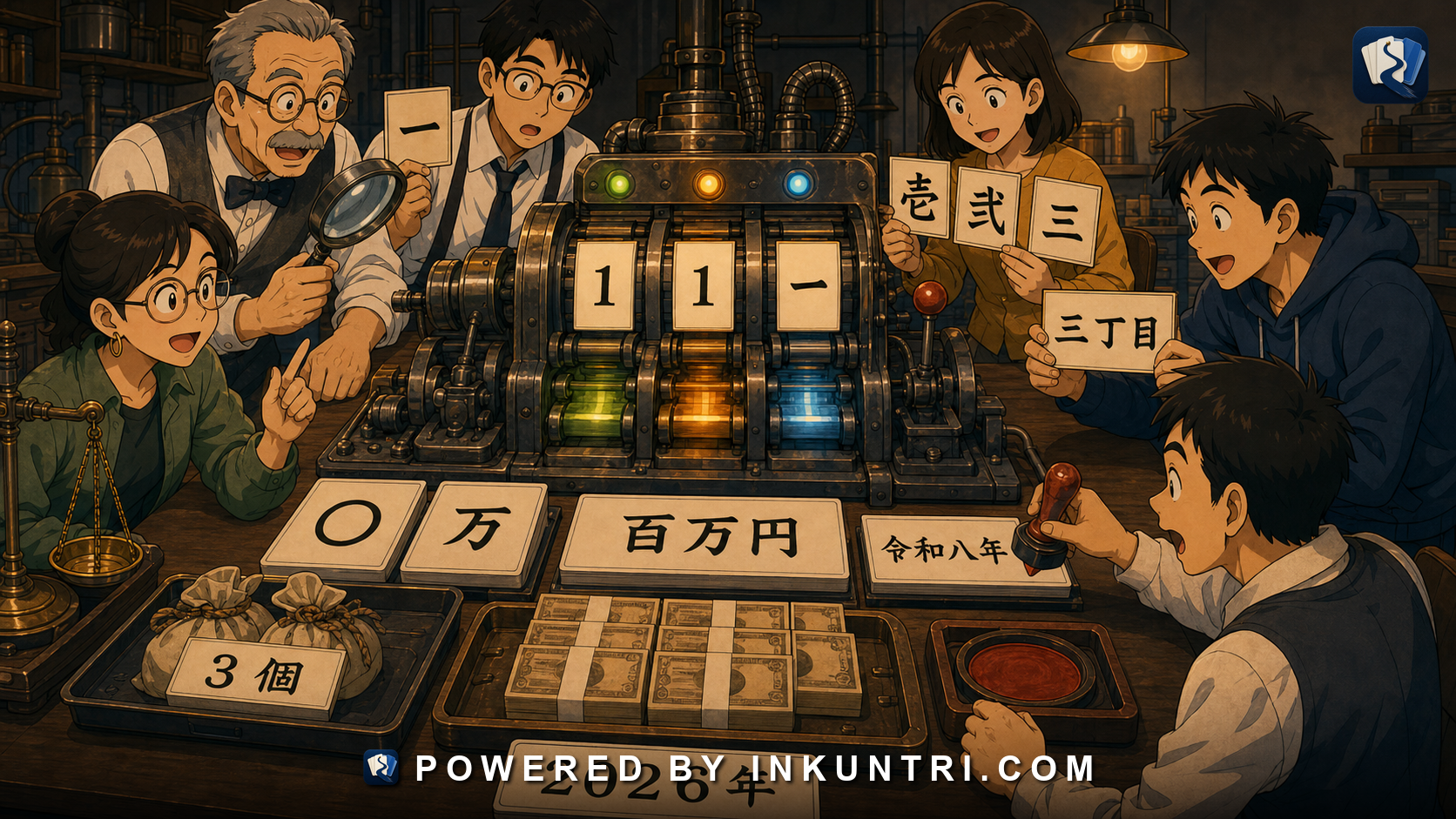
Core examples: 一, 壱, 弐, 三丁目, 2026年, 令和八年, 〇, 万, 百万円, 3個.
Numbers are not just numbers on a Japanese page
A learner sees “one” written several ways:
1 1 一 壱 ひとつ
These are not random variants. They belong to different writing systems, genres, layouts, and risk environments.
Japanese number writing sits at the intersection of language, typography, accounting, official documents, addresses, time, dates, counters, vertical writing, and everyday convenience. A restaurant menu, bank form, train ticket, legal contract, apartment address, school notice, and historical document may all write numbers differently.
The key principle is:
Japanese number forms are chosen by function: readability, layout, formality, fraud prevention, convention, and grammar.
A serious learner should not merely learn to count. They should learn how numbers appear in real written Japanese.
Arabic digits: 1, 2, 3 and 1, 2, 3
Modern Japanese uses Arabic digits constantly.
Examples:
2026年 3個 10時30分 500円 2階 080-1234-5678
In digital and horizontal writing, Arabic digits are often the default. They are compact, clear, and internationally recognizable.
But Japanese typography distinguishes half-width and full-width digits:
123 123
A form may require one or the other. A printed sign may use full-width digits to align with Japanese text. A web form may require half-width digits for phone numbers or postal codes.
For learners, the number may be correct while the width is wrong. That is why instructions such as 半角数字 and 全角数字 matter.
Kanji numerals: 一, 二, 三
Kanji numerals are common in formal, literary, vertical, traditional, and compound contexts.
Examples:
一月 二人 三丁目 四国 五十音 百円 千年 一般 一部
Kanji numerals are not only number symbols. They are also parts of words and names. 一 in 一般 is not just a count in the ordinary sense. 三丁目 is an address unit. 四国 is a place name. 五十音 is a term.
Learners should distinguish:
- pure counting,
- fixed words,
- dates,
- addresses,
- counters,
- names,
- idioms,
- formal writing.
A kanji numeral inside a word may not behave like a replaceable digit.
Formal numerals: 壱, 弐, 参
Formal numerals, often called daiji, are used to prevent alteration or fraud in financial and legal contexts.
Examples:
壱 弐 参 拾 萬
The logic is simple: 一 can be altered more easily than 壱. In checks, contracts, certificates, receipts, and formal financial documents, daiji reduce the risk of tampering.
A learner does not need to use these every day, but they should recognize them. If you see 壱万円, it is not a mysterious old word. It is a formal way of writing 10,000 yen.
The key idea:
Formal numerals are security typography.
〇 and zero
Zero can appear as:
0 0 〇 零
In dates and formal writing, 〇 is often used in kanji-style year notation:
二〇二六年
零 appears in words and formal contexts but is not the everyday default for writing years.
Examples:
零度 zero degrees
零細企業 small/micro enterprise
Learner action: learn 〇 as a written zero in kanji-number sequences, especially dates.
万: the unit that changes your number sense
Japanese large numbers group by ten-thousands, not by thousands in the way English speakers expect.
The key unit is:
万 10,000
Examples:
一万 10,000
十万 100,000
百万 1,000,000
千万 10,000,000
一億 100,000,000
This is one of the biggest number-processing challenges for English speakers. 百万円 is not “hundred yen times something vague.” It is:
百万 + 円 1,000,000 yen
Japanese financial and statistical writing depends heavily on 万 and 億.
Examples:
3万人 30,000 people
500万円 5,000,000 yen
2億円 200,000,000 yen
Learners must practice converting these quickly, especially for news, business, salaries, population, budgets, and prices.
Counters: numbers need the right unit
Japanese numbers often attach to counters.
Examples:
3個 three small objects/items
二人 two people
一冊 one book/volume
五枚 five flat objects/sheets
六階 sixth floor
七時 seven o’clock
The counter determines reading changes. 一, 二, 三 are not enough. You need the counter phrase.
Examples:
一人 ひとり
二人 ふたり
三人 さんにん
一冊 いっさつ
三冊 さんさつ
六冊 ろくさつ
Japanese written numbers are therefore partly grammatical. A digit plus counter is not just arithmetic; it is a phrase.
Dates: Western years and era years
Japanese dates may use Western calendar years:
2026年5月24日
or Japanese era years:
令和八年五月二十四日
Era years are common in official documents, government forms, certificates, school documents, and legal paperwork.
The current era is Reiwa. 令和八年 corresponds to 2026. But learners should not rely only on memory; forms may require conversion.
Date writing choices vary by context:
- 2026年 — common modern format.
- 令和8年 — official/administrative style.
- 令和八年 — more formal kanji style.
- 二〇二六年 — kanji-number year style.
- 2026/05/24 — digital or international style.
Learner action: always identify whether the date uses Western year or era year.
Addresses: numbers as location structure
Japanese addresses use numbers differently from many Western addresses. They often identify area, district, block, building, and unit rather than a street number in a linear street-address system.
Example:
東京都新宿区西新宿2丁目8番1号
This includes:
- 東京都 — Tokyo Metropolis
- 新宿区 — Shinjuku Ward
- 西新宿 — Nishi-Shinjuku
- 2丁目 — district subdivision
- 8番 — block number
- 1号 — building/lot number
The same address may also be written with kanji numerals:
二丁目八番一号
In ordinary modern contexts, Arabic digits are common:
2丁目8番1号
The words 丁目, 番, 号 are not optional decorations. They tell you how the numbers function.
Vertical writing and number choice
Vertical writing often favors kanji numerals or special handling of Arabic digits.
In a vertical novel, you might see:
二〇二六年
instead of:
2026年
In a modern vertical poster, you might see Arabic digits rotated or grouped. In manga, digits may be chosen for visual impact.
Layout affects number choice. This is why typography and number literacy overlap.
Prices and money
Japanese prices often use Arabic digits:
500円 1,200円 350円
But formal financial writing may use kanji or daiji:
金壱万円 金参拾万円
Business and news writing frequently uses 万円, 億円:
100万円 1億円 2500万円
For learners, the biggest challenge is not reading 円. It is processing 万 and 億 quickly.
Example bank walkthrough
一
Basic kanji numeral for one. Also appears in many compounds where it may not feel like a simple count.
Learner action: learn it as numeral, word component, and name element.
壱
Formal numeral for one used in legal/financial contexts.
Learner action: recognize it as fraud-resistant 一.
弐
Formal numeral for two.
Learner action: expect it in formal documents, not casual writing.
三丁目
Address subdivision. Can be written 三丁目 or 3丁目 depending on context.
Learner action: parse 丁目 as an address unit.
2026年
Western year notation. Common in modern horizontal writing.
Learner action: read 年 as year and check if the context also uses era years.
令和八年
Era-year notation. Official and formal contexts may use it.
Learner action: know how to convert or verify era years.
〇
Zero in kanji-style number sequences.
Learner action: recognize it in dates such as 二〇二六年.
万
Ten-thousand unit.
Learner action: practice converting 万 and 億 until automatic.
百万円
One million yen.
Learner action: parse 百万 as 1,000,000, not as “hundred ten-thousands” in slow English every time.
3個
Digit plus counter. The full phrase requires counter knowledge.
Learner action: learn number-counter readings together.
A number-reading workflow
When you see a Japanese number, ask:
- Form: Arabic digit, full-width digit, kanji numeral, formal numeral, or kana?
- Function: Count, date, time, price, address, phone number, ID, legal amount, or word component?
- Unit: 円, 人, 個, 冊, 階, 年, 月, 日, 丁目, 番, 号?
- Scale: Does 万 or 億 appear?
- Calendar: Western year or Japanese era year?
- Layout: Horizontal or vertical?
- Risk: Is this a legal/financial context requiring formal numerals?
- Reading: Does the counter change pronunciation?
This workflow turns number reading from guessing into parsing.
A strong tool for this article would convert and explain numbers across contexts.
Suggested functions:
- Arabic ↔ kanji: 2026 → 二〇二六 / 二千二十六 depending on context.
- Formal numerals: 一万円 → 壱万円.
- Money mode: 100万円, 2500万円, 3億円 with English equivalents.
- Counter mode: 1人, 2人, 3冊, 6階 with readings.
- Date mode: Western year ↔ era year.
- Address mode: 2丁目8番1号 breakdown.
- Width mode: 123 vs 123.
- Vertical-writing preview: Show numeral choices in vertical layout.
Final rule
Japanese numbers are not just arithmetic symbols. They are written forms shaped by typography, grammar, layout, official practice, and social risk.
Use Arabic digits when the context expects them. Recognize kanji numerals in compounds, dates, addresses, and vertical writing. Learn formal numerals for legal and financial documents. Master 万 and 億. Treat counters as grammar.
Once you understand what the number is doing, the form stops being confusing.
These drafts are written as publication-ready educational articles rather than academic papers. Useful technical/reference anchors for future source-linking include:
- Japanese kana and mora-timing references for long vowels, sokuon, yōon, and katakana loanword notation.
- Japanese dictionary and pronunciation resources documenting kana spellings such as おう/おお, long mark ー, and mora count.
- Japanese orthographic and typography references covering small kana, katakana combinations, full-width forms, and loanword adaptation.
- Japanese administrative and publishing conventions for Arabic digits, kanji numerals, daiji/formal numerals, era years, counters, addresses, and money expressions.
Related reading
Tracking Japanese Listening Progress With Real Audio
The reader can track Japanese listening progress using real audio, transcripts, comprehension targets, error categories, and repeated measurement.
Designing Japanese Anki Cards for Kanji, Vocabulary, Pitch, and Context
The reader can design Japanese Anki cards that train recognition, production, kanji, vocabulary, pitch accent, and context without creating bloated review debt.
The Sound of Japanese Newsreading vs Conversation
The reader can compare Japanese newsreading and conversation as different speech styles with different pacing, pronunciation, and information structure.
Polite Speech Prosody: Why 丁寧語 Has a Sound
The reader can notice that polite Japanese has prosodic conventions in addition to polite vocabulary and grammar.
How Kango Creates Formal, Technical, and Institutional Japanese
The reader can see kango as the backbone of formal, technical, legal, bureaucratic, and institutional Japanese.
Bungo, Kōgo, and the Modernization of Japanese Prose
The reader can understand bungo and kōgo as competing prose norms whose modernization shaped the Japanese people read today.