
Long Vowels in Kana: おう, おお, ー, and Romanization Trouble
The reader can read and pronounce long vowels by distinguishing kana spelling, romanization, katakana length marks, and actual mora timing.
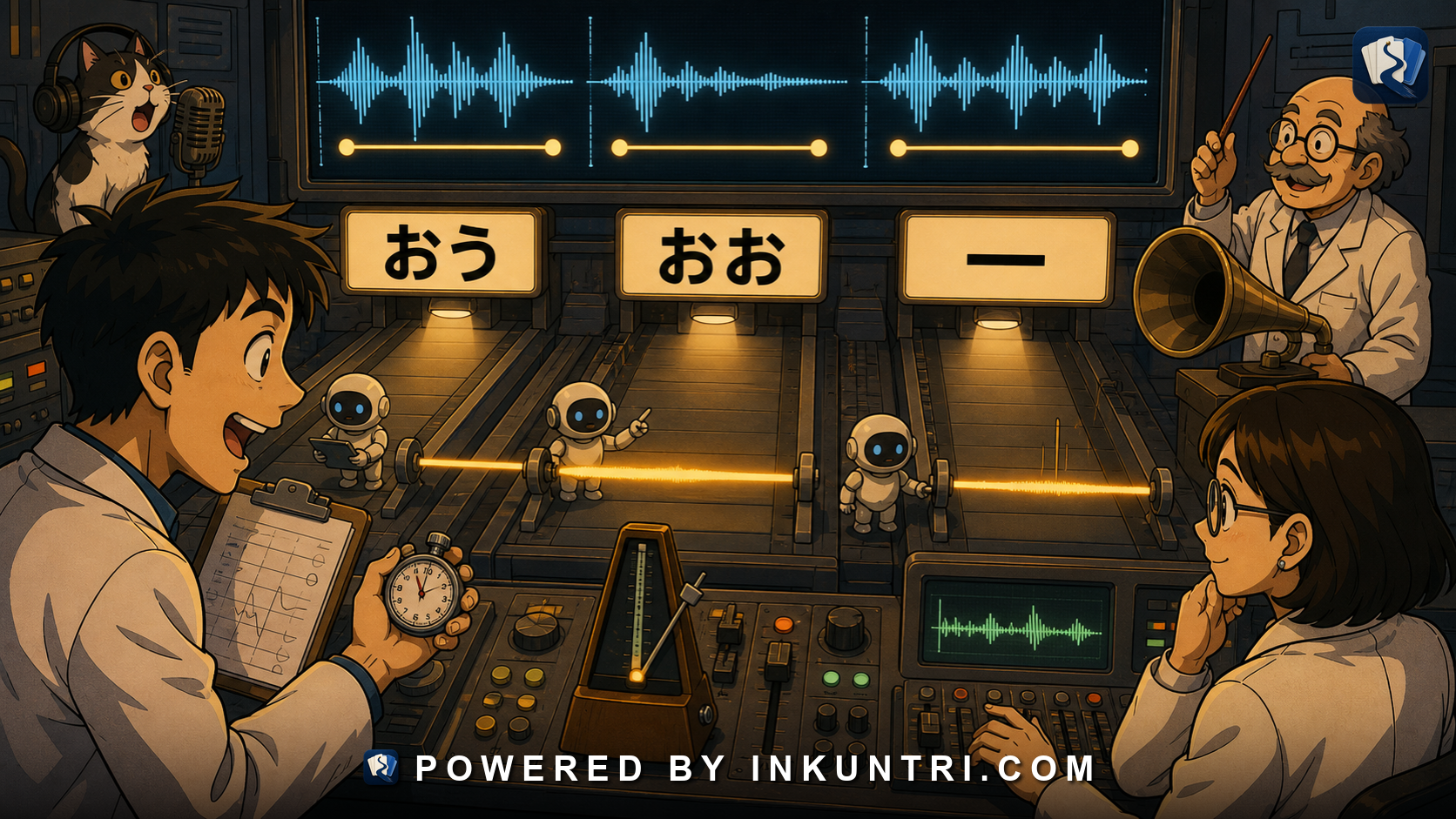
Core examples: おばさん/おばあさん, おじさん/おじいさん, こうこう, おおきい, とおい, コーヒー, スーパー.
The vowel that looks small but changes the word
Japanese learners often hear that Japanese pronunciation is “simple” because the vowels are stable and kana spelling is regular. That is true compared with English spelling, but it can hide a serious problem: vowel length.
A short vowel and a long vowel can make different words.
おばさん aunt; middle-aged woman
おばあさん grandmother; elderly woman
The difference is not decoration. It is timing. おばさん and おばあさん are not merely two spellings of the same sound. They are different words with different mora counts.
The same pattern appears in:
おじさん uncle; middle-aged man
おじいさん grandfather; elderly man
A learner who clips long vowels will be understood sometimes, but the speech will sound foreign and may create real misunderstandings. A learner who cannot hear long vowels will also struggle with dictation, names, place names, loanwords, and pitch accent practice.
The key principle is:
In Japanese, vowel length is part of the word’s shape.
You do not pronounce long vowels because the spelling looks fancy. You pronounce them because Japanese timing requires them.
Mora timing: why length matters
Japanese rhythm is built around morae. A mora is a timing unit. It is not exactly the same as an English syllable.
For example:
おばさん お・ば・さ・ん four morae
おばあさん お・ば・あ・さ・ん five morae
That extra あ is not swallowed. It occupies time.
Similarly:
ビル bi-ru building two morae: ビ・ル
ビール beer three morae: ビ・ー・ル
The long mark ー in ビール takes a timing slot. It lengthens the vowel of ビ.
A learner should not think of long vowels as “hold it a little if you feel like it.” They are structural.
The main long-vowel spellings in hiragana
Long vowels in hiragana are not written in one uniform way. They depend on vowel and word history.
Common patterns:
- あ-row long vowel: add あ おばあさん, おかあさん
- い-row long vowel: add い おじいさん, いい
- う-row long vowel: add う くうき, すうがく
- え-row long vowel: often add い, sometimes え せんせい, えいが, おねえさん
- お-row long vowel: often add う, sometimes お こうこう, とうきょう, おおきい, とおい
This is where learners get into trouble. おう and おお may both represent long o in many words, but the spelling matters.
Compare:
こうこう high school / filial piety / etc., depending on kanji
おおきい big
とおい far
The spelling is part of the word. You cannot freely choose おう or おお.
おう versus おお: spelling history, not pronunciation freedom
Many Japanese long o sounds are written おう:
こうこう とうきょう きょう もう そう
Some are written おお:
おおきい おおい とおい こおり おおさか
The spoken vowel may be long o in standard pronunciation, but the spelling must be learned with the word.
Learner trap:
“If both sound like long o, I can spell them however I want.”
No. Japanese spelling is more regular than English, but it is still lexical. The spelling of とおい is not とうい. The spelling of こうこう is not こおこお.
For reading, recognize both as long-vowel patterns. For writing, learn the actual spelling.
Katakana length mark: ー
Katakana uses the long sound mark ー very frequently, especially in loanwords.
Examples:
コーヒー coffee
スーパー supermarket
タクシー taxi
パーティー party
コンピューター computer
The mark ー lengthens the preceding vowel. It is not a dash. It is not decoration. It occupies a mora.
コーヒー is:
コ・ー・ヒ・ー
Four morae.
スーパー is:
ス・ー・パ・ー
Four morae.
Learners often pronounce katakana loanwords too much like English. That is a mistake. The Japanese word has Japanese timing.
Romanization causes trouble
Romanization systems try to represent Japanese sounds using Latin letters. This is useful for beginners, passports, signage, maps, and typing. But romanization can obscure long vowels.
Tokyo may be written:
Tokyo Tōkyō Toukyou Tookyoo
These are not equally useful for learners. Tokyo without macrons hides the long vowels. Tōkyō marks them. Toukyou reflects kana spelling more mechanically. Tookyoo approximates sound for English readers but is not a standard academic romanization.
The Japanese is:
とうきょう 東京
Mora timing:
と・う・きょ・う
A learner who sees “Tokyo” may say it with two English syllables and no Japanese length. That is common, but not Japanese pronunciation.
Romanization is a tool. Kana is the real spelling system.
Names and place names: do not trust English spellings
Long vowels in names are often flattened in English writing.
Examples:
- Tokyo for Tōkyō
- Osaka for Ōsaka
- Kyoto for Kyōto
- Taro for Tarō
- Saito for Saitō
- Yoko for Yōko or Yoko depending on the actual name
This matters because different Japanese names may collapse into the same unmarked romanization. A passport, map, English article, or travel website may omit macrons. Learners should not assume the English spelling gives full pronunciation.
When possible, check the kana:
- 東京 — とうきょう
- 大阪 — おおさか
- 京都 — きょうと
- 太郎 — たろう
- 斎藤 — さいとう
Kana tells you timing more reliably than unmarked romanization.
Listening: why long vowels disappear to English ears
English has vowel length, but it does not use it the same way Japanese does. English speakers tend to hear vowel quality, stress, and syllable shape more than mora timing. As a result, Japanese long vowels may sound like slightly drawn-out versions rather than separate timing units.
The learner’s job is to retrain the ear.
Do not ask only, “Is the vowel sound different?” Ask:
How many timing slots does this word occupy?
Practice with pairs:
おばさん / おばあさん おじさん / おじいさん ビル / ビール ここ / こうこう とり / とおり ゆき / ゆうき
The long vowel may not feel dramatic. It still matters.
Long vowels and pitch accent
Long vowels also affect pitch-accent learning because pitch patterns attach to morae. If you miscount morae, you cannot reliably track downstep or word rhythm.
For example, a word with a long vowel has an extra timing unit where pitch may continue or change according to the accent pattern. A learner who compresses the long vowel will distort the whole prosodic shape.
This is why pronunciation study should connect:
- kana spelling,
- mora count,
- vowel length,
- pitch accent,
- listening practice.
Studying pitch accent without long-vowel discipline is like trying to read music while ignoring note duration.
Example bank walkthrough
おばさん / おばあさん
The extra あ changes both timing and meaning. This is one of the classic minimal pairs for vowel length.
Learner action: tap the morae: お・ば・さ・ん versus お・ば・あ・さ・ん.
おじさん / おじいさん
The extra い changes the word. Do not reduce おじいさん to おじさん.
Learner action: practice with family terms because mistakes are socially obvious.
こうこう
Written with おう sequences. Depending on kanji and context, it may mean high school, public, filial piety, and more. The sound includes long o timing.
Learner action: learn spelling with the word, not from sound alone.
おおきい
Written おお, not おう. It means big.
Learner action: treat おお words as lexical spellings to memorize.
とおい
Written とおい, not とうい. It means far.
Learner action: notice common おお/お spellings that break the beginner’s overgeneralization.
コーヒー
Katakana loanword with long marks. Pronounce it with Japanese mora timing, not English stress.
Learner action: count コ・ー・ヒ・ー.
スーパー
Another katakana long-vowel example. It is not pronounced like English “super.”
Learner action: count ス・ー・パ・ー.
A long-vowel routine
When you learn a new Japanese word, record:
- Kana spelling: Is the long vowel written あ, い, う, え, お, or ー?
- Mora count: How many timing units?
- Romanization warning: Does English spelling hide the length?
- Audio check: Listen to native pronunciation.
- Minimal pair: Is there a similar short-vowel word?
- Production: Tap or clap the rhythm before saying it.
- Sentence practice: Use the word inside a phrase, not only in isolation.
A strong visual tool for this article would show long vowels as timing blocks.
Suggested functions:
- Kana input: User enters おばあさん, コーヒー, とうきょう.
- Mora blocks: Display each mora as a separate box.
- Audio playback: Slow and natural speed.
- Romanization comparison: Tokyo vs Tōkyō vs とうきょう.
- Minimal-pair quiz: おばさん/おばあさん, ビル/ビール.
- Spelling warning: おう vs おお forms.
- Pitch overlay: Show where pitch continues across long vowels.
Final rule
Long vowels in Japanese are not optional polish. They are part of the word.
Kana spelling tells you where the timing lives. Katakana ー marks length. Romanization often hides the truth. English intuition will not protect you.
Count morae, learn spelling, listen carefully, and pronounce the full timing. Japanese becomes clearer when length stops being invisible.
Related reading
Japanese Wedding Language: ご祝儀, 披露宴, 招待状, 内祝い
The reader can understand Japanese wedding language around gift money, receptions, invitations, return gifts, speeches, and formal register.
Kanji Component Analysis Without Fake Etymology
The reader can use kanji components for memory and lookup while avoiding made-up etymologies that teach false history.
How to Build a Kanji Component Notebook That Respects Japanese Readings
The reader can build a kanji component notebook that uses radicals and components without pretending they determine Japanese meanings or readings mechanically.
Tracking Japanese Listening Progress With Real Audio
The reader can track Japanese listening progress using real audio, transcripts, comprehension targets, error categories, and repeated measurement.
Chinese Classics in Japanese Education and Quotation
The reader can recognize Chinese-classics quotations and allusions in Japanese education, journalism, speeches, and public writing.
Japanese Bureaucratic Vocabulary: 実施, 対応, 検討, 周知, 徹底
The reader can unpack high-frequency bureaucratic Japanese and understand the institutional actions hidden behind neutral-sounding vocabulary.