
Katakana Beyond Loanwords: Emphasis, Species Names, Sound Effects, and Branding
The reader can interpret katakana as a marker of loanwords, emphasis, taxonomy, sound, technology, branding, and persona.
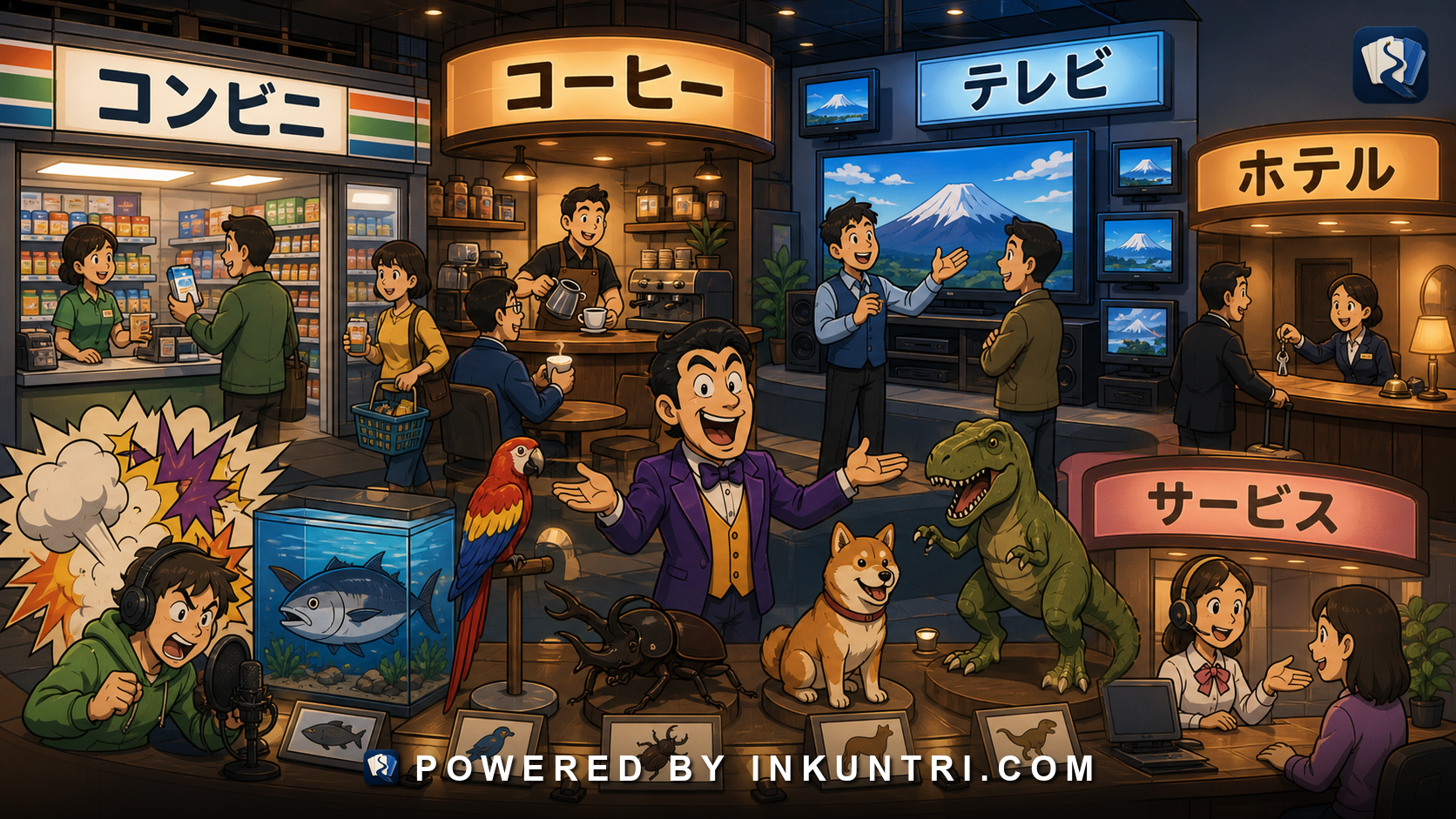
Core examples: ゴミ, ドキドキ, イヌ, バラ, キラキラ, ココ, メール, サービス, カワイイ.
The half-truth every learner hears
Most Japanese learners are taught a simple division of labor:
- Hiragana is for native Japanese grammar and words.
- Katakana is for foreign loanwords.
- Kanji is for meaning-heavy vocabulary.
That explanation is useful at the beginning. It helps learners understand why コンビニ, コーヒー, テレビ, ホテル, and サービス are written in katakana. It explains why foreign names such as ジョン, メアリー, ロンドン, and ニューヨーク use katakana.
But if you keep reading real Japanese, the rule starts to crack.
You see ゴミ, even though “trash” is not a foreign loanword. You see イヌ and ネコ in scientific or species contexts, even though 犬 and 猫 exist. You see ドキドキ and キラキラ as sound-symbolic words. You see カワイイ for emphasis or branding, even though かわいい and 可愛い are available. You see ココ on signs and packages. You see katakana in manga to make a robot sound mechanical, a monster sound strange, a foreigner’s speech feel marked, or a word pop visually on the page.
So the better rule is:
Katakana marks a word as visually special: foreign, technical, emphatic, sound-symbolic, taxonomic, branded, artificial, stylized, or voice-marked.
Loanwords are only one major use.
Katakana as marked writing
Katakana is a marked script. That means it often tells the reader, “Do not process this as ordinary neutral Japanese.” The marking can point in different directions depending on context.
Katakana can signal:
- foreign origin,
- foreign names,
- loanwords,
- technical vocabulary,
- species names,
- sound effects,
- onomatopoeia and mimetic words,
- emphasis,
- visual contrast,
- brand identity,
- slang or youth style,
- mechanical or alien voice,
- roughness or bluntness,
- nonstandard pronunciation,
- transcription of sounds.
A learner should not ask only, “What English word did this come from?” That question is sometimes useful. It is not enough.
The better question is:
Why did the writer choose katakana here?
Loanwords: the obvious but still tricky category
Katakana is indeed the normal script for many loanwords, especially modern borrowings.
Examples:
- コーヒー — coffee
- テレビ — television
- ホテル — hotel
- メール — mail/email
- サービス — service
- コンビニ — convenience store
- パソコン — personal computer
- インターネット — internet
But even loanwords are not simply English words in Japanese clothing. They become Japanese words with Japanese pronunciation, Japanese pitch behavior, Japanese meanings, and sometimes meanings that differ from the source language.
サービス is a good warning. It can mean service, but it can also mean something offered free, discounted, extra, or customer-oriented depending on context. メール usually refers to email or message, not physical mail in the full English sense. コンセント means electrical outlet, not “consent.”
Katakana tells you the word is likely borrowed or foreign-associated. It does not guarantee that English will decode it correctly.
Wasei-eigo: English-looking Japanese
Some katakana words are 和製英語, Japanese-made English-style expressions. They use English-derived parts but do not necessarily exist with the same meaning in English.
Examples include:
- サラリーマン — salaried office worker
- オーダーメイド — custom-made
- スキンシップ — physical affection/contact, often in family or intimacy contexts
- マイペース — doing things at one’s own pace
- ガソリンスタンド — gas station
These are Japanese words. English knowledge may help you guess, but it may also mislead you.
A learner should treat katakana words as vocabulary, not as automatic English recovery exercises.
Emphasis: katakana as visual boldface
Katakana can emphasize a word that would otherwise be written in hiragana or kanji.
Compare:
- かわいい
- 可愛い
- カワイイ
The basic meaning is similar: cute. But the visual feel changes. かわいい may feel soft, ordinary, or casual. 可愛い may feel more standard or written. カワイイ may feel pop, emphatic, branded, ironic, trendy, or visually punchy depending on context.
Katakana emphasis is common in advertising, packaging, manga, social media, and signage. It can make a word stand out the way italics, caps, bold type, or scare quotes might in English—but it is not exactly the same as any one of those.
Examples:
- ココがポイント — This is the key point.
- 今だけオトク — A good deal for now only.
- カンタン操作 — easy operation
- ナゾの人物 — mysterious person
- ヤバい — intense, risky, amazing, depending on context
The word may not be foreign at all. The script choice is doing attention work.
Species names: イヌ, ネコ, バラ
Katakana is often used for biological species names, especially in scientific or semi-technical contexts.
Examples:
- イヌ — dog
- ネコ — cat
- サクラ — cherry tree/blossom
- バラ — rose
- カラス — crow
- サケ — salmon
This does not mean the ordinary kanji or hiragana forms are wrong. 犬, いぬ, イヌ can all exist, but they do different things in different contexts.
In a pet story, 犬 or いぬ may be natural. In a biology label, museum display, plant guide, field guide, or zoo sign, katakana may signal taxonomic treatment.
For learners, this is a major correction: katakana is not only foreignness. It can mark scientific categorization.
Onomatopoeia and mimetic words: ドキドキ, キラキラ, しーん
Japanese uses a rich system of sound-symbolic words. Some represent actual sounds. Others represent states, textures, feelings, motion, atmosphere, or bodily sensations.
Katakana often appears in this world, especially in manga, advertising, captions, and expressive writing.
Examples:
- ドキドキ — heartbeat, nervous excitement
- キラキラ — sparkling
- ゴロゴロ — rumbling, rolling, lazing around depending on context
- ワクワク — excited anticipation
- ザーザー — heavy rain sound
- ガタガタ — rattling, shaking
- シーン — silence, stillness
Some mimetic words are commonly seen in hiragana too: どきどき, きらきら, しーん. The script choice changes the visual feel. Katakana may make it sharper, louder, more graphic, more manga-like, or more emphatic.
In manga especially, katakana can become part of the artwork. The word is not merely read; it is seen as sound, motion, and atmosphere.
Branding: katakana as product voice
Katakana is everywhere in branding because it has visual energy. It can feel modern, foreign, technical, cute, sleek, playful, or commercial.
A product may choose katakana not because the word is foreign but because the script creates a brand effect.
Examples:
- カワイイ cosmetics branding
- おトク retail signage with mixed script
- ココ as a location cue or brand element
- サクサク to advertise crisp texture or quick performance
- スッキリ for clean, refreshed feeling
- モチモチ for chewy texture
Food packaging, cosmetics, convenience-store labels, phone apps, games, and tourism materials often use katakana as part of the design system.
The learner should read the word and the typography together. Katakana can be selling you a feeling.
Voice marking: robots, foreigners, monsters, and awkwardness
Katakana can mark voice in fiction and media.
A robot might speak in katakana to sound mechanical. A monster might speak in katakana to sound nonhuman. A foreigner’s Japanese may be written in katakana to mark accent or otherness. A character’s internal voice may use katakana to sound cold, artificial, childish, or strange.
This can be powerful. It can also be stereotyped or uncomfortable depending on the work.
Examples of script-shift effects:
- わたし vs ワタシ
- ぼく vs ボク
- 俺 vs オレ
- かわいい vs カワイイ
- すごい vs スゴイ
The lexical meaning may barely change. The persona changes.
A serious reader of manga, games, light novels, and subtitles must learn to separate word meaning from script voice.
Katakana and roughness
Katakana can sometimes make ordinary Japanese feel rougher, harder, or more blunt.
For example:
- バカ instead of ばか or 馬鹿
- ムカつく instead of むかつく
- ウザい instead of うざい
- キモい instead of きもい
This is not a universal rule. Context matters. But katakana can add edge, punch, or emotional sharpness. It can make a word feel shouted, clipped, graphic, or stylized.
In online writing and manga, script choice is often part of attitude.
Katakana, technology, and modernity
Tech vocabulary often uses katakana because so much of the vocabulary is borrowed, abbreviated, branded, or globally circulated.
Examples:
- アプリ — app
- サーバー — server
- クラウド — cloud
- データ — data
- ログイン — login
- アカウント — account
- パスワード — password
- チャット — chat
But the effect is not only lexical. A katakana-heavy passage can feel technical, corporate, software-like, or globally modern. Japanese UI text often mixes kanji for core institutional concepts, hiragana for grammar, and katakana for product/tech terms.
For learners building apps, reading interfaces, or studying digital Japanese, katakana literacy is not optional.
The danger of English back-translation
English-speaking learners often try to decode katakana by reversing it into English. Sometimes this works:
- コーヒー → coffee
- ホテル → hotel
- ラジオ → radio
Sometimes it half-works:
- メール → email/message, not all mail
- サービス → service/free extra/customer treatment, context-dependent
- テンション → mood/energy/excitement, not exactly English “tension”
Sometimes it fails badly:
- コンセント → electrical outlet
- マンション → apartment/condominium building, not mansion
- クレーム → complaint, not claim in the ordinary English sense
The correct habit is:
Let English suggest a possibility, then verify the Japanese word.
A katakana word is not less Japanese because it came from somewhere else.
A katakana annotation routine
When you meet katakana, ask these questions.
1. Is it a loanword or foreign name?
If yes, identify the Japanese meaning, not just the source word.
2. Is it sound-symbolic?
Words like ドキドキ, キラキラ, ザーザー, ゴロゴロ may describe sound, motion, state, emotion, or texture.
3. Is it biological or taxonomic?
イヌ, ネコ, バラ, サクラ may appear in species contexts.
4. Is it emphasis?
Would the word normally be written in hiragana or kanji? If so, katakana may be adding punch or visual contrast.
5. Is it branding?
Packaging, ads, shop signs, and apps often use katakana for tone.
6. Is it voice?
In dialogue, katakana may mark a character’s personality, accent, artificiality, or emotional state.
7. Is English misleading you?
Check for wasei-eigo, semantic drift, and Japanese-specific usage.
Example bank walkthrough
ゴミ
ゴミ means trash/garbage. It is not a foreign loanword in ordinary use, but katakana can make the word more visually blunt or sign-like.
Learner action: do not assume katakana equals English-derived vocabulary.
ドキドキ
ドキドキ represents heartbeat, nervousness, excitement, or anticipation. It is sound-symbolic and often expressive.
Learner action: translate the function, not only the sound.
イヌ
イヌ can appear in species or taxonomic contexts. 犬 and いぬ are also possible in other contexts.
Learner action: notice genre before deciding what the script means.
バラ
バラ may mean rose and is common in plant/species contexts. It can also appear in other words and expressions, so context matters.
Learner action: read katakana species names as a scientific/register cue.
キラキラ
キラキラ means sparkling or glittering. Katakana can make the sparkle more visual, energetic, or graphic.
Learner action: connect mimetic words to sensory scenes.
ココ
ココ may be an emphatic or branded form of ここ, “here.” It often appears in signs, ads, and design-heavy text.
Learner action: ask why the writer wanted “here” to pop visually.
メール
メール usually means email or message in modern Japanese, though context matters.
Learner action: do not translate mechanically as “mail” in every English sense.
サービス
サービス can refer to service, customer care, an extra/freebie, or discounted offering.
Learner action: learn common Japanese collocations rather than relying on English.
カワイイ
カワイイ is a katakana spelling of kawaii/cute that can feel pop, branded, emphatic, ironic, or stylized.
Learner action: compare かわいい, 可愛い, and カワイイ as tone choices.
A strong tool for this article would present katakana examples and ask users to classify why katakana is being used.
Suggested categories:
- Loanword: メール, ホテル, コーヒー.
- Wasei-eigo: サラリーマン, マイペース, コンセント.
- Foreign name: ジョン, ロンドン, ニューヨーク.
- Sound-symbolic: ドキドキ, キラキラ, ザーザー.
- Species/taxonomy: イヌ, ネコ, バラ.
- Emphasis: ココ, スゴイ, カワイイ.
- Branding: product/package examples.
- Voice/persona: ワタシ, ボク, オレ in dialogue.
- Technical/UI: アプリ, ログイン, データ.
Useful features:
- Show the same word in hiragana, kanji, and katakana where possible.
- Explain the tone shift.
- Provide genre labels: manga, ad, biology, tech, signage, conversation.
- Warn when English back-translation is unreliable.
Final rule
Katakana does not mean “English.” It means “marked.”
Sometimes the mark is foreign origin. Sometimes it is sound. Sometimes science. Sometimes emphasis. Sometimes branding. Sometimes character voice. Sometimes roughness. Sometimes technology.
When you meet katakana, do not stop at “loanword.” Ask what the script choice is doing.
That question turns katakana from a beginner alphabet into a serious reading tool.
Related reading
Tracking Japanese Listening Progress With Real Audio
The reader can track Japanese listening progress using real audio, transcripts, comprehension targets, error categories, and repeated measurement.
Katakana Loans vs Chinese Transliterations of the Same Global Terms
The reader can compare how Japanese katakana loans and Chinese transliterations or semantic translations handle the same global terms.
The Sound of Japanese Newsreading vs Conversation
The reader can compare Japanese newsreading and conversation as different speech styles with different pacing, pronunciation, and information structure.
Polite Speech Prosody: Why 丁寧語 Has a Sound
The reader can notice that polite Japanese has prosodic conventions in addition to polite vocabulary and grammar.
When CJK Comparison Helps Learners and When It Becomes Noise
The reader can decide when CJK comparison accelerates Japanese learning and when it creates noise, overconfidence, or bad habits.
The Social Life of Katakana in Modern Japan
The reader can analyze katakana as a social script that marks foreignness, emphasis, technicality, branding, species names, and voice.