
Jinmeiyō Kanji and the Special Problem of Japanese Names
The reader can explain why Japanese personal names require a separate literacy strategy from ordinary vocabulary and school kanji.
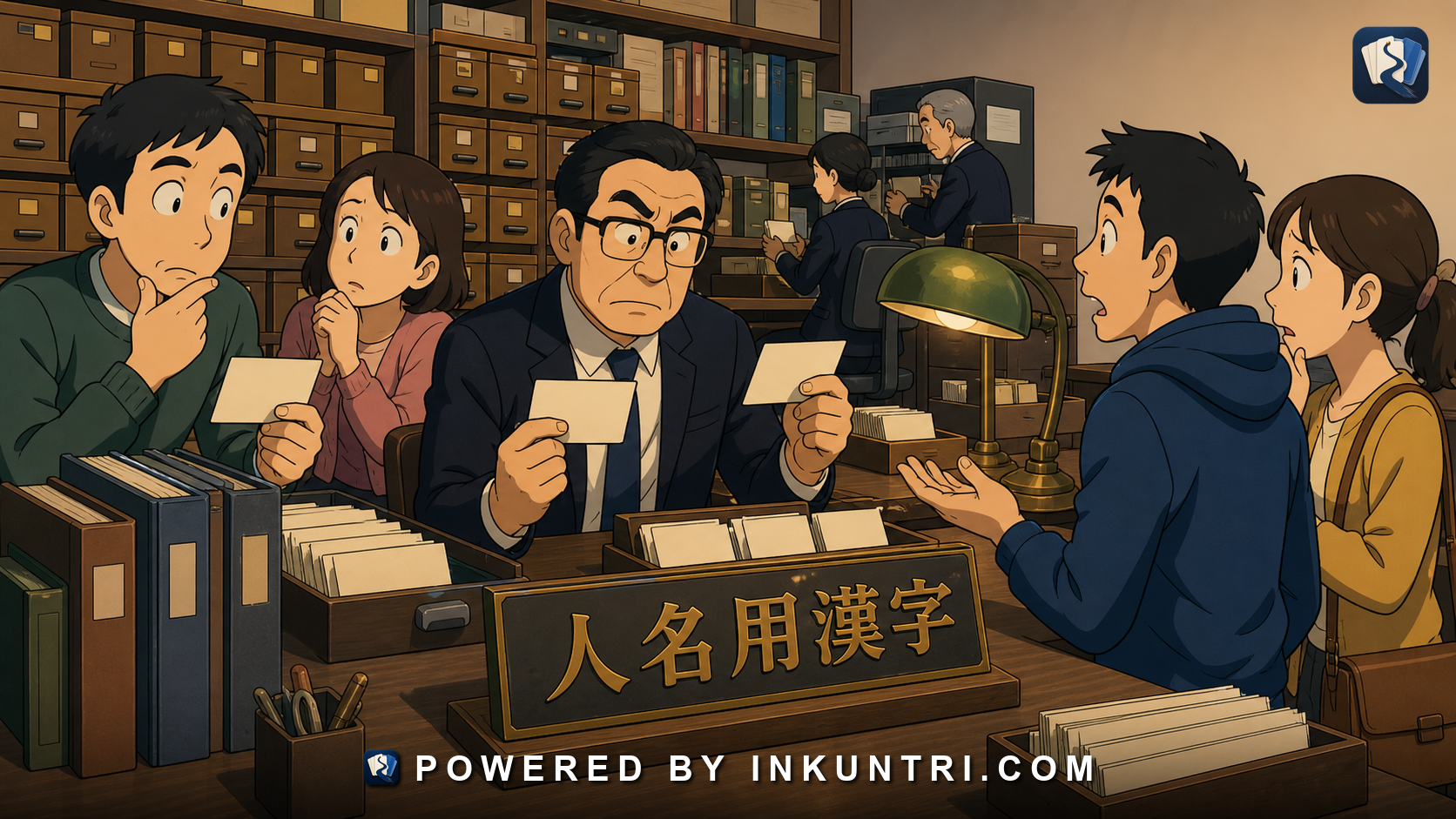
Core examples: 翔, 凛, 愛, 陽菜, 大翔, 太郎, 髙/高, 﨑/崎, 齋藤/斎藤.
The moment ordinary kanji knowledge stops working
A learner can know Japanese vocabulary well and still freeze in front of a name.
The kanji looks familiar. The individual character meanings are not mysterious. The learner may know several on-readings and kun-readings. Then the name appears on a business card, school roster, news article, wedding invitation, name plate, election poster, or email signature—and the reading is not obvious.
This is not because the learner is bad at kanji. It is because Japanese names are not ordinary vocabulary.
Names have their own system. They use ordinary kanji, name-specific kanji, variant forms, family traditions, historical readings, regional patterns, legal constraints, fashion cycles, and personal preference. They also use readings that are not always predictable from standard vocabulary study.
The beginner’s mistake is to think, “If I learn all the normal readings, I should be able to read names.”
A better rule is:
Japanese name reading is a separate literacy skill. Kanji knowledge helps, but it does not solve the problem by itself.
That is why forms ask for ふりがな. That is why business cards often include romanization or furigana. That is why native speakers can hesitate over unfamiliar names. That is why news captions often supply readings. That is why guessing someone’s name aloud can be embarrassing.
Name literacy is not just linguistic. It is social.
What Jinmeiyō Kanji are
人名用漢字 means “kanji for use in personal names.” These are characters approved for use in names in addition to the regular-use Jōyō Kanji. The existence of the list tells you something important: ordinary public-use kanji policy is not enough for naming.
Japanese personal names need a broader controlled space. Parents cannot use absolutely any character they want in a legal given name, but the allowed set extends beyond ordinary school-literacy expectations. Over time, the list has changed as naming practices, legal disputes, social preferences, and administrative needs have evolved.
For learners, the precise legal history is less important than the practical result:
- Some characters are familiar from ordinary vocabulary.
- Some are especially common in names.
- Some are allowed primarily because names preserve or prefer them.
- Some variant forms appear in family names.
- Some readings are name-specific.
- Some spellings are identity-sensitive.
A name is not just a word. It is a person’s official and social identity.
Kanji in names do several jobs at once
In ordinary vocabulary, a kanji usually helps represent a morpheme: a meaning-bearing unit attached to a word. In names, kanji may do more varied work.
A name kanji can signal meaning, sound, family tradition, gendered expectation, generation, aspiration, regional history, aesthetic preference, religious or literary association, fashionable naming style, continuity with ancestors, or distinction from other people with the same spoken name.
For example, 愛 is associated with love and is common in names. 翔 suggests flying or soaring and has been popular in given names. 太郎 is a traditional male name pattern. 陽 can suggest sun, brightness, or warmth. 菜 appears in many feminine given names and has associations with greens/vegetables but functions largely as a naming element in modern names.
If you try to translate names character by character, you will often sound silly. A name is not a miniature poem to be translated literally every time. But the characters are not meaningless either. They carry associations that matter to families and readers.
The correct stance is balanced: notice the associations, but treat the name as a name.
Nanori: the readings learners are not prepared for
名乗り readings, often called nanori, are name readings associated with kanji in personal names. They are a major reason name reading cannot be reduced to ordinary on/kun reading charts.
A character may have common vocabulary readings and additional name readings. Some name readings are historically grounded. Some are conventional. Some are rare. Some are productive in modern names. Some are tied to particular families or individuals.
This is why a familiar character can surprise you.
A learner may know 大 as だい, たい, おお, or おおきい-related forms, but in names it can participate in readings that do not feel mechanically obvious. A learner may know 愛 as あい, but names using 愛 may have readings that require name-specific knowledge. A learner may know 翔 as しょう or とぶ-related meaning, but a given name containing 翔 may be read in several ways.
The safest rule:
For names, readings are confirmed, not derived.
That does not mean you cannot make educated guesses. Native speakers do it. Dictionaries do it. Name databases do it. But a guess is still a guess until confirmed by furigana, romanization, an official source, or the person.
Family names and given names behave differently
Japanese family names and given names present different problems.
Family names often preserve older place-based, regional, occupational, or historical patterns. They may contain common characters with uncommon readings, rare characters, or variant forms. Some family names are frequent and predictable: 佐藤, 鈴木, 高橋, 田中, 伊藤, 渡辺. Others are less common and can be difficult even for native readers.
Given names are more open to fashion and creativity. Parents choose characters for meaning, sound, beauty, family preference, or distinctiveness. Some names are traditional and highly predictable, like 太郎 or 花子 in textbook-style examples. Others are modern, fashionable, or deliberately distinctive. Some use readings that are legal but difficult to infer.
A learner should not treat all names as one category. A family name may be hard because of historical convention. A given name may be hard because of creative reading.
Variant characters: identity lives in the shape
Names also preserve variant forms. This is where typography becomes personal.
Examples include:
- 高 / 髙
- 崎 / 﨑
- 斎 / 齋 / 齊 / 斉
- 渡辺 / 渡邊 / 渡邉
- 島 / 嶋
- 沢 / 澤
In ordinary text, a simplified or standardized form may be acceptable. In a person’s legal name, the exact character can matter. A database, passport, residence card, diploma, certificate, family registry, business card, or official document may require the precise form.
This is not pedantry. A person’s name is identity data.
For language learners and tool builders, variant characters create practical problems:
- Some fonts do not display variants clearly.
- Some systems normalize forms.
- Some keyboards make variants hard to enter.
- Search may fail if you use the wrong form.
- OCR may confuse forms.
- Romanization may hide the character distinction.
- Official documents may require exact matching.
The humane rule is simple: preserve the form the person uses.
Why forms ask for ふりがな
Japanese forms often include a field for ふりがな or フリガナ above or beside the name field. This is not a beginner crutch. It is an administrative necessity.
A name written in kanji may have multiple possible readings. The form needs to know how to pronounce, sort, index, or contact the person. Furigana supplies the reading.
You may see:
- 氏名
- ふりがな
- フリガナ
- 姓
- 名
- お名前
- ふりがなをご記入ください
Sometimes the furigana field expects hiragana. Sometimes it expects katakana, especially in formal, banking, or administrative contexts. A learner who fills a form must notice which script is requested.
Name fields are not only about language. They are about matching identity across systems.
The social risk of guessing names
Misreading a name is not always a disaster. People understand that Japanese names can be hard. But guessing carelessly can still feel rude, especially in professional or formal contexts.
A good learner develops polite repair phrases and confirmation habits.
Useful strategies:
- Look for furigana before asking.
- Check email signatures, business cards, profile pages, and official bios.
- If you must ask, ask directly and respectfully.
- Avoid making a joke out of the difficulty.
- Do not overgeneralize from one person’s reading to another name with the same character.
- Record the reading once confirmed.
Polite confirmation phrases include:
- お名前の読み方を教えていただけますか。
- こちらのお名前は、何とお読みすればよろしいでしょうか。
- 失礼ですが、お名前の読み方を確認させてください。
- ふりがなをお願いできますでしょうか。
The point is not to perform humility theatrically. The point is to respect identity.
News, sports, and public figures
News articles often provide readings for names that may be unfamiliar. Broadcast captions, election coverage, sports rosters, and official announcements must handle name pronunciation carefully.
A learner reading news should pay attention to how names are introduced. A first mention may include furigana or explanatory context; later mentions may not. A television caption may show kanji while the announcer provides the reading. Online articles may include kana in parentheses.
Names in news also reveal another issue: public figures may have established readings that become known through repetition. A learner may think the reading is obvious when it is actually memorized through exposure.
Treat names as entries in your vocabulary system, but keep them separate from ordinary words.
Cross-CJK confusion: familiar characters, wrong assumptions
Learners who know Chinese characters or Korean hanja may recognize many Japanese name characters. That helps with visual recognition, but it can create false confidence.
A Chinese-literate learner may recognize 高, 山, 田, 中, 林, 藤, 大, 小, and many other characters. But Japanese family-name readings—Takahashi, Yamada, Tanaka, Hayashi, Satō, Itō, Ōno, Kobayashi—are not Chinese readings. The characters are familiar; the name system is different.
Similarly, Japanese name variants may resemble traditional Chinese forms, simplified forms, or older forms, but their function in Japanese identity is separate.
The rule for cross-CJK learners:
Transfer character recognition, not name pronunciation.
Example bank walkthrough
翔
翔 suggests flying or soaring and appears in modern given names. It may be associated with readings such as しょう and other name readings depending on the name. It is a good example of a character whose meaning feels attractive for naming.
Learner action: learn it as a name-frequent character, but confirm actual readings.
凛
凛 suggests dignity, coldness, or crispness and appears in names. It can feel visually elegant and modern. It is also a good reminder that name popularity can elevate characters beyond what a learner might meet first in ordinary prose.
Learner action: treat name frequency and general vocabulary frequency separately.
愛
愛 is familiar as love and common in names. But names containing 愛 are not always read simply as あい. The character may participate in longer names and name-specific readings.
Learner action: do not assume the vocabulary reading solves every name.
陽菜
陽菜 is a modern name-type example with attractive associations: sun/brightness and greens/vegetation/name element. It may be read in expected modern ways, but the exact reading still belongs to the person.
Learner action: learn fashionable name patterns, but confirm.
大翔
大翔 combines big/great with flying/soaring associations. It has been seen in modern male given-name patterns and can have multiple possible readings.
Learner action: do not derive a single reading from meanings.
太郎
太郎 is a traditional male given-name pattern and appears in examples, placeholders, and actual names. It is more predictable than many modern creative names.
Learner action: use predictable names for practice, but do not let them define the whole name system.
髙 / 高
髙 is a variant of 高 seen in names. In casual text, people may substitute 高, but official identity contexts may preserve 髙.
Learner action: respect the variant when exact identity matters.
﨑 / 崎
﨑 is a variant seen in names, often alongside 崎. Search systems may treat them differently.
Learner action: search both forms when necessary and preserve official spelling.
齋藤 / 斎藤 / 斉藤
Saitō-family names can appear with several character variants. The pronunciation may be the same or similar, but the written identity differs.
Learner action: do not “clean up” a person’s name unless a specific system requires standardization and the person accepts it.
A learner workflow for names
Use this routine whenever you meet an unfamiliar Japanese name.
Step 1: Identify whether it is a name
Look for context: honorifics, business cards, rosters, bylines, email signatures, forms, introductions, certificates, or news articles.
Step 2: Do not force vocabulary readings
Use known readings as clues, not as final answers.
Step 3: Search for furigana or romanization
Check the surrounding text. Japanese materials often supply readings when they matter.
Step 4: Check reliable name sources
Use a name dictionary, official website, profile page, school/company page, or public record when appropriate.
Step 5: Confirm politely if interacting with the person
Especially in professional contexts, asking is better than guessing.
Step 6: Preserve the exact written form
Do not casually replace variants in official or respectful contexts.
Step 7: Record name and reading together
Your note should include kanji, kana reading, romanization if needed, context, and source.
For Inkuntri-style tools, Japanese names deserve special treatment.
A normal vocabulary card is not enough. A name card should include:
- written form,
- furigana,
- romanization,
- type: family name, given name, place name, company name,
- variant forms,
- commonness,
- possible readings,
- confirmed reading,
- source of confirmation,
- caution label if reading is uncertain.
A Japanese reading app should not silently “guess” names as if they were ordinary vocabulary. It should mark uncertainty.
A form-filling assistant should distinguish 氏名 from ふりがな and preserve script requirements.
A dictionary should show when a reading is a name reading, not ordinary vocabulary pronunciation.
A strong visual tool for this article would let users explore why names are hard without reducing the problem to trivia.
Suggested functions:
- Kanji card: Show a character such as 翔, 愛, 陽, 凛, 大, 菜.
- Vocabulary readings: Show common on/kun readings.
- Name readings: Show possible nanori/name readings, clearly marked as possibilities.
- Name examples: Display family names and given names separately.
- Variant warning: Show 高/髙, 崎/﨑, 斎/齋/齊/斉.
- Confirmation phrases: Provide polite phrases for asking readings.
- Confidence labels: Mark “common,” “possible,” “rare,” “requires confirmation.”
- Form mode: Simulate 氏名 and ふりがな fields with script expectations.
Final rule
Do not treat Japanese names as vocabulary with decorative kanji.
Names are identity-bearing forms with their own readings, variants, conventions, and social stakes. Kanji knowledge helps you approach them intelligently, but it does not give you permission to guess confidently.
For ordinary words, learn characters and compounds. For names, confirm the reading, preserve the spelling, and respect the person.
That habit is not only better Japanese. It is better manners.
Related reading
National Language Policy and the Idea of Kokugo
The reader can understand kokugo as a national-language idea with educational, political, and cultural consequences.
Religious and Shrine Japanese for Visitors and Researchers
The reader can read religious and shrine Japanese respectfully by understanding visitor signs, ritual terms, offerings, festivals, and institutional labels.
Language Contact in Japan: Chinese, Korean, English, Portuguese, Dutch
The reader can trace language contact in Japan through words from Chinese, Korean, English, Portuguese, Dutch, and other sources.
Kango in Japanese and Sino-Korean Vocabulary Compared
The reader can compare Japanese kango and Sino-Korean vocabulary as parallel systems built from Chinese-character roots but shaped by different languages.
The Meiji Translation Boom and the Making of Modern Japanese Vocabulary
The reader can see how Meiji-era translation created much of the modern vocabulary for politics, science, society, and philosophy.
False Friends Between Japanese and Mandarin in Everyday Kanji Words
The reader can recognize false friends between Japanese and Mandarin in everyday character words before they cause practical misunderstandings.