
Email Japanese: Formatting, Openings, Closings, and Line Breaks
The reader can write and read Japanese email by understanding formulaic openings, closings, line breaks, signatures, and politeness expectations.
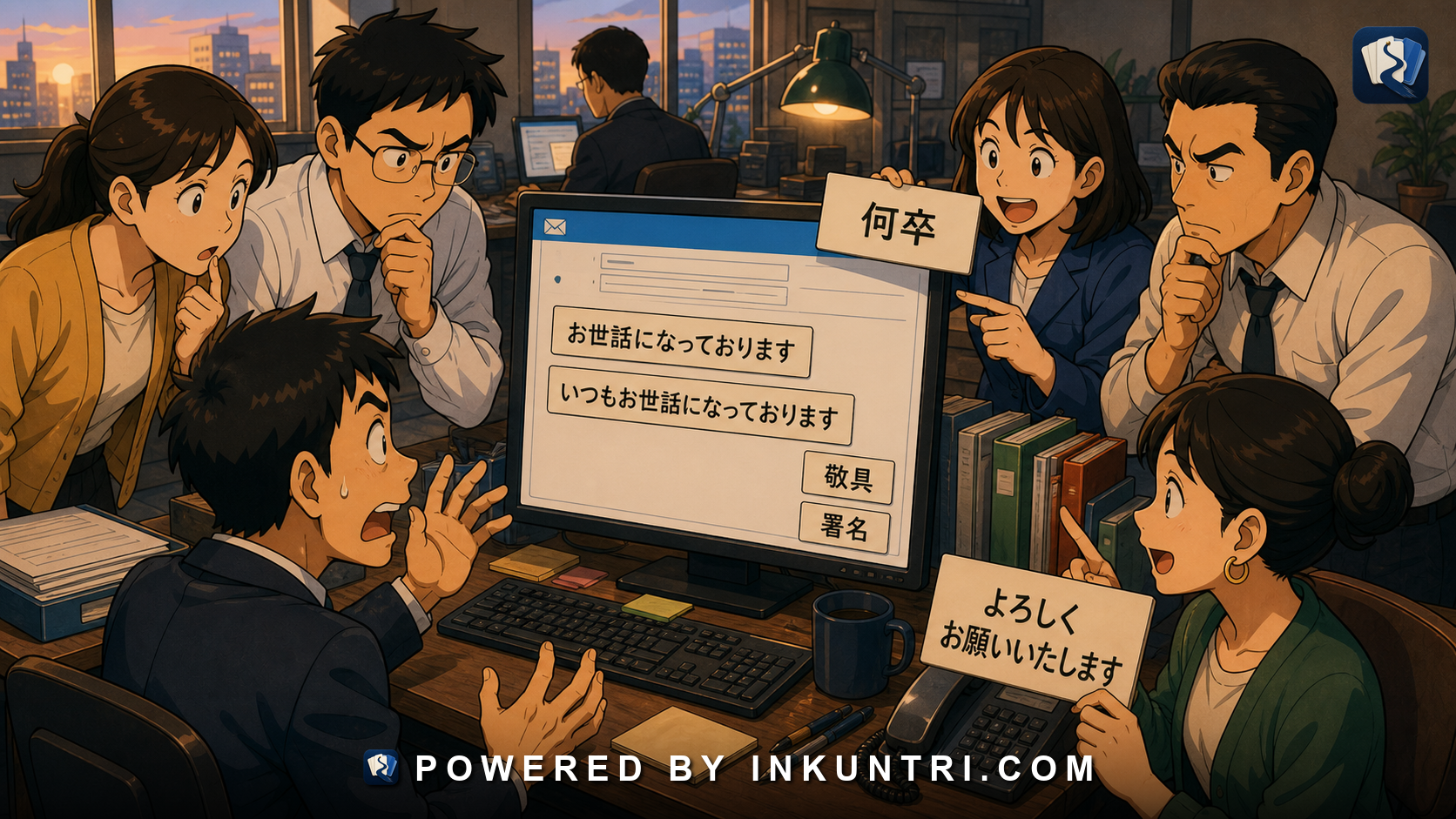
Core examples: お世話になっております, いつもお世話になっております, 何卒, よろしくお願いいたします, 敬具, 署名.
Correct grammar is not enough
A learner writes a Japanese email. The grammar is correct. The vocabulary is correct. The request is understandable. Yet the message feels abrupt, foreign, or socially off.
Why?
Because Japanese email is not only sentences. It is a format.
Business and formal Japanese email often follows expected blocks: addressee, greeting, identification, context, purpose, request, apology or thanks, closing formula, and signature. The language is formulaic not because Japanese people cannot write freely, but because email is a social and professional ritual. The structure reduces friction and clarifies relationships.
The key principle:
Japanese email is built from blocks. If the blocks are missing, the message may sound abrupt even when every sentence is grammatical.
Learners should study email as a genre, not as ordinary conversation typed into a screen.
The basic architecture of a formal email
A standard business-style email often includes:
- Addressee
- Opening greeting
- Self-identification
- Purpose/context
- Main message
- Request or action
- Closing thanks/apology
- Signature
A simplified structure:
株式会社〇〇 田中様 いつもお世話になっております。 株式会社△△の山田です。 〇〇の件についてご連絡いたします。 ...main body... お忙しいところ恐縮ですが、ご確認のほどよろしくお願いいたします。 署名
This may feel overly formulaic in English. In Japanese business contexts, the formula is often the point. It frames the message politely and efficiently.
Addressee: 宛名 matters
The addressee comes first.
Common forms:
田中様 Mr./Ms. Tanaka
株式会社〇〇 営業部 田中様
関係者各位 To all concerned parties
〇〇先生 Professor/Teacher/Dr. X
〇〇株式会社 御中 To Company X
Use 様 for individuals in formal email. Use 御中 for organizations or departments when not naming a specific person. Avoid combining 御中 and 様 incorrectly for the same target.
Wrong-style example:
株式会社〇〇御中 田中様
If you are addressing Tanaka at the company, use the company/department line plus 田中様, not 御中.
Opening formulas: お世話になっております
The classic business opening:
お世話になっております。
This does not translate cleanly. It roughly acknowledges the relationship and ongoing support. It is a professional greeting, not a literal statement that the person is taking care of you at that moment.
A stronger ongoing version:
いつもお世話になっております。
“Thank you as always for your continued support/assistance” is a functional translation.
Learners often find this phrase strange because English email may begin directly with “I hope you’re well” or the purpose. In Japanese, お世話になっております is a conventional relationship opener.
Use it in business or formal correspondence where appropriate. Do not force it into every casual email.
Self-identification
Japanese business email often identifies the sender early, even if the email address shows the name.
Example:
株式会社△△の山田です。
or more politely:
株式会社△△の山田と申します。
If it is a first contact, と申します is common. If the relationship is established, です may be natural.
This identification helps the reader locate the relationship quickly.
Stating the purpose
Japanese email often uses formulas to introduce the purpose:
〇〇の件でご連絡いたしました。 I am contacting you about X.
〇〇についてご相談がございます。 I would like to consult with you about X.
〇〇の資料をお送りいたします。 I am sending the materials for X.
先日の打ち合わせについて、確認させていただきたい点がございます。 Regarding the recent meeting, there are points I would like to confirm.
Good email does not hide the purpose. The formula gives social framing, then the message moves to business.
Line breaks and readability
Japanese email often uses short paragraphs and frequent line breaks. Dense paragraphs are hard to read, especially on phones.
A good pattern:
- one idea per paragraph,
- blank lines between blocks,
- bullet points for multiple items,
- clear dates and deadlines,
- key request near the end,
- closing formula separated from body.
Example:
以下の3点についてご確認をお願いいたします。 1. 日程 2. 参加人数 3. 必要な資料
Line breaks are not just visual. They show respect for the reader’s time.
Requests: soften burden
Requests are central to email, and Japanese request language often marks burden.
Common phrases:
ご確認ください。 Please confirm.
ご確認いただけますでしょうか。 Could you please confirm?
ご確認のほど、よろしくお願いいたします。 Thank you in advance for your confirmation / Please kindly confirm.
お忙しいところ恐縮ですが、 I apologize for troubling you while you are busy, but...
恐れ入りますが、 I am sorry to trouble you, but...
The more burden, distance, or formality, the more softening is expected.
But do not overdo it. Excessive keigo can become stiff, evasive, or confusing. Good email is polite and clear.
何卒 and formal closing weight
何卒よろしくお願いいたします。
何卒 adds formality and weight. It is common in formal requests, apologies, and business messages. It can sound too heavy for routine casual communication.
Compare:
よろしくお願いします。 casual/polite
よろしくお願いいたします。 standard business polite
何卒よろしくお願い申し上げます。 very formal/heavy
Learner action: match closing weight to situation. Do not use the heaviest form for every message.
敬具 and letter-style closings
敬具 appears in formal letters and some very formal email contexts, often paired with 拝啓. But everyday business email usually closes with よろしくお願いいたします or similar formulas rather than full letter style.
Examples:
拝啓 ... 敬具
This is letter format, not the default for ordinary email.
Learners should recognize 敬具 but not assume it belongs in every email.
Signature: 署名
A Japanese email signature often includes:
- name,
- company,
- department/title,
- phone number,
- email,
- website,
- address,
- divider lines.
Example:
山田 太郎 株式会社〇〇 営業部 TEL: 03-1234-5678 Email: yamada@example.co.jp
The signature helps the recipient respond and confirms institutional identity.
Common mistakes by learners
Mistake 1: Starting too directly
資料を送ってください。
This may be grammatical but abrupt in a formal email.
Better:
お忙しいところ恐れ入りますが、資料をお送りいただけますでしょうか。
Mistake 2: Overusing keigo without clarity
Too much elaborate language can bury the request. Politeness should not hide action.
Mistake 3: Missing the addressee
A business email without 田中様 or appropriate address can feel sloppy.
Mistake 4: Forgetting self-introduction
Especially in first contact, identify yourself early.
Mistake 5: No line breaks
A wall of Japanese text is hard to read.
Example bank walkthrough
お世話になっております
Standard professional relationship greeting.
Learner action: use in business/formal contexts, not as literal English.
いつもお世話になっております
Stronger ongoing relationship acknowledgment.
Learner action: appropriate when there is established contact.
何卒
Formal intensifier for requests/apologies.
Learner action: use when the situation deserves weight.
よろしくお願いいたします
Standard polite closing/request formula.
Learner action: learn several levels of formality.
敬具
Formal letter closing.
Learner action: recognize it; do not overuse in ordinary email.
署名
Signature block.
Learner action: include contact details in professional messages.
Email-building workflow
When writing a Japanese email:
- Relationship: friend, teacher, customer, company, superior, unknown person?
- Addressee: 様, 先生, 御中, 各位?
- Opening: お世話になっております or other greeting?
- Self-ID: Who are you?
- Purpose: Why are you writing?
- Body: What information or context is needed?
- Request: What should the recipient do?
- Deadline: Is timing clear?
- Softener: Is the burden acknowledged?
- Closing: Appropriate よろしく formula?
- Signature: Complete and professional?
A strong tool for this article would let users assemble a Japanese email by formality level.
Suggested functions:
- Relationship selector: customer, professor, coworker, friend, unknown company.
- Addressee builder: 様, 御中, 各位, 先生.
- Opening phrase menu: お世話になっております, 初めてご連絡いたします, etc.
- Request strength slider: direct to very formal.
- Line-break preview: mobile-friendly formatting.
- Closing formula selector: よろしくお願いします to 何卒よろしくお願い申し上げます.
- Signature generator: Japanese business signature format.
- Error warnings: double honorifics, over-heavy keigo, missing purpose.
Final rule
Japanese email is a format before it is a free-form message.
Write in blocks. Name the recipient. Establish the relationship. Identify yourself. State the purpose. Make the request clearly. Close at the right formality level. Use line breaks.
Correct sentences matter. Correct email shape matters just as much.
Related reading
Idioms From Classical Chinese in Modern Japanese
The reader can identify idioms inherited from Classical Chinese and understand why they still shape formal and literary Japanese.
How to Compare Tokyo, Kansai, and Regional Usage Responsibly
The reader can compare Tokyo, Kansai, and regional Japanese usage without overgeneralizing from stereotypes, jokes, or one speaker’s habits.
False Friends Between Japanese and Korean Sino-Xenic Words
The reader can spot false friends between Japanese kango and Korean Sino-Xenic words by checking meaning, usage, and register rather than characters alone.
Tracking Japanese Listening Progress With Real Audio
The reader can track Japanese listening progress using real audio, transcripts, comprehension targets, error categories, and repeated measurement.
A Research Stack for Japanese Learners: Corpora, Dictionaries, White Papers, Archives
The reader can assemble a Japanese research stack using corpora, dictionaries, official white papers, archives, news databases, and domain sources.
When CJK Comparison Helps Learners and When It Becomes Noise
The reader can decide when CJK comparison accelerates Japanese learning and when it creates noise, overconfidence, or bad habits.