
Why Simplified Chinese Is Not Just “Fewer Strokes”
The reader understands simplification as a system of graphic, phonetic, historical, and administrative choices rather than a simple stroke-count reduction.
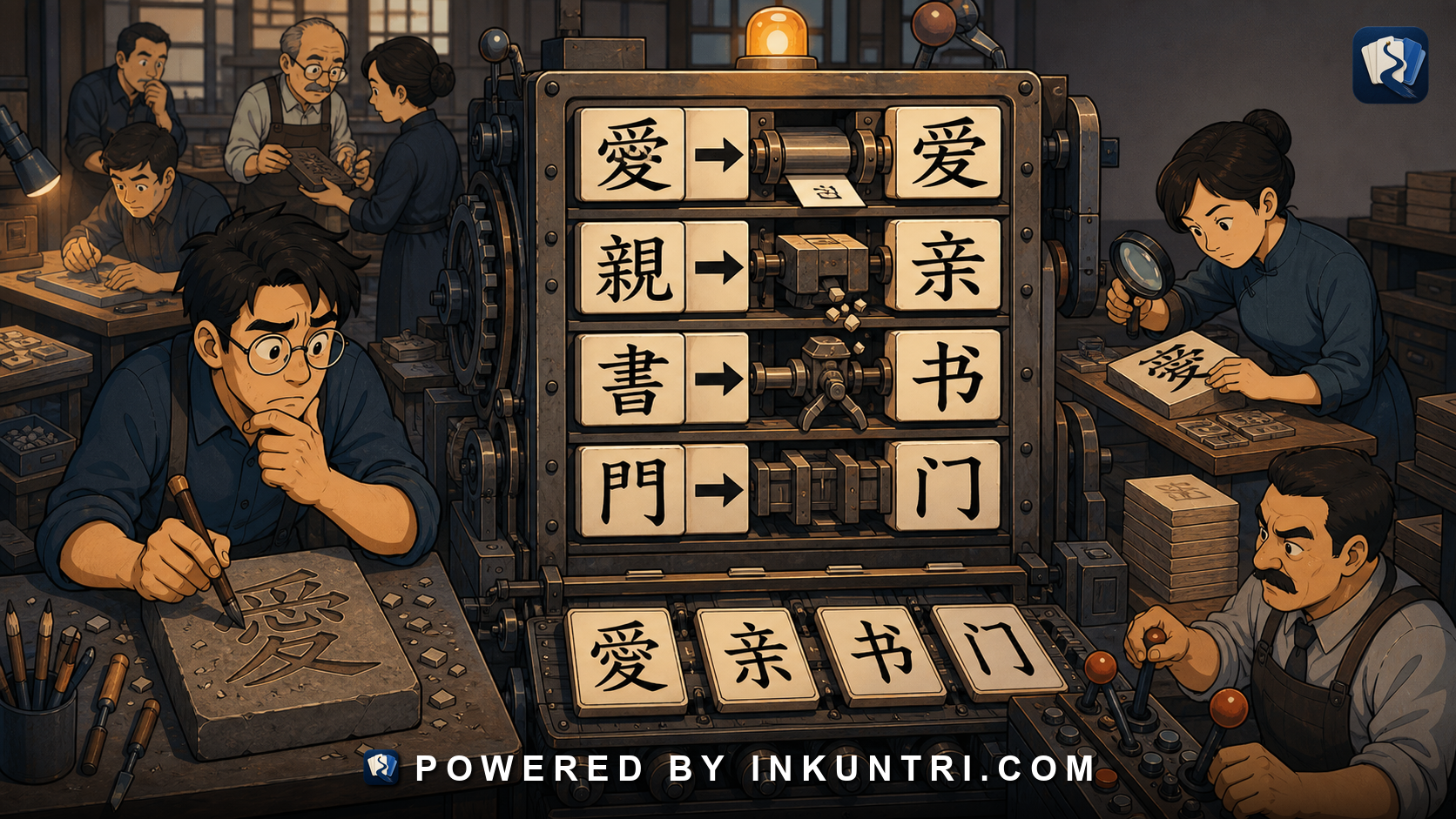
Core examples: 愛/爱, 親/亲, 漢/汉, 書/书, 門/门, 發/髮/发, 後/后, 乾/幹/干.
The useful half-truth
The fastest explanation of simplified Chinese is also the explanation that causes the most confusion: “Simplified characters are traditional characters with fewer strokes.”
That is often true at the surface level. 愛 became 爱. 親 became 亲. 書 became 书. 門 became 门. In each pair, the simplified form is quicker to write by hand and usually visually lighter on the page.
But “fewer strokes” is only the visible result. It is not the whole process. Character simplification involved several different kinds of decisions: some graphic, some historical, some phonetic, some based on existing handwritten forms, and some based on administrative standardization. A learner who thinks of simplification only as subtraction will miss the patterns that make many simplified characters predictable. Worse, that learner will be surprised by cases where simplification does not simply “remove strokes” but replaces a component, regularizes a whole family, or merges several historically different characters into one modern form.
A better way to think about simplified Chinese is this:
Simplification is not one operation. It is a bundle of operations applied unevenly across the writing system.
That unevenness matters. It affects how you memorize characters, how you look them up, how you convert text between simplified and traditional forms, and how you read material from Mainland China, Taiwan, Hong Kong, Japan, Singapore, old books, menus, subtitles, signs, and family records.
This article is not a defense of simplified characters or an attack on traditional characters. Those debates quickly become aesthetic, political, and personal. The practical question for serious learners is more useful: What actually changed, and what should I notice?
Simplification did not redraw the whole writing system
The first thing to notice is that many characters did not change at all.
人, 口, 山, 水, 火, 大, 小, 中, 上, 下, 天, 心, 手, 日, 月, 年, 我, 你, 他, 是, 不, 在, 有, and many other high-frequency characters are the same in simplified and traditional writing. A page of simplified Chinese is not a page where every character has been redesigned. It is a page where some characters use simplified forms, some use forms that were already shared, and some preserve older distinctions.
Even when a character did change, the change may not be unique to the twentieth century. Some simplified forms have roots in older handwritten variants, popular forms, or cursive writing. Others were standardized through component rules: once a component was simplified, many characters containing that component were simplified in parallel.
This is why simplified Chinese can feel both systematic and irregular. It is systematic when a component transformation repeats across dozens or hundreds of characters. It is irregular when a particular character reflects an older variant, a handwritten shortcut, a phonetic replacement, or a merger that only makes sense historically.
The learner’s job is not to reconstruct every historical decision. The learner’s job is to recognize the major patterns.
Mechanism 1: Systematic component replacement
Some simplifications are easiest to understand as component-level changes. A recurring piece of a character is replaced by a simpler form, and that replacement appears across a family of characters.
The traditional speech component 訁 becomes 讠 when it appears on the left side of simplified characters:
| Traditional | Simplified | Pinyin | Basic meaning |
|---|---|---|---|
| 語 | 语 | yǔ | language; speech |
| 說 | 说 | shuō | to speak; to say |
| 話 | 话 | huà | speech; words |
| 認 | 认 | rèn | to recognize; to admit |
| 請 | 请 | qǐng | to request; please |
Once you learn 訁 → 讠, you do not need to treat every pair as a completely separate fact. You still have to learn the words, pronunciations, and meanings, but the graphic change is reusable knowledge.
The same pattern appears with other components:
| Traditional component | Simplified component | Example pair |
|---|---|---|
| 門 | 门 | 間/间, 問/问, 開/开 in a different whole-character simplification pattern |
| 飠 | 饣 | 飯/饭, 飲/饮, 餓/饿 |
| 糹 | 纟 | 紅/红, 紙/纸, 給/给 |
| 貝 | 贝 | 買/买, 貴/贵, 貨/货 |
| 車 | 车 | 軍/军, 輕/轻, 輸/输 |
| 釒 | 钅 | 銀/银, 鐵/铁, 錢/钱 |
These are among the most learner-friendly simplifications because they reduce the burden of memorization. If you know that 門 often becomes 门, then 間 → 间 and 問 → 问 are no longer random. If you know 貝 often becomes 贝, then 貴 → 贵 and 貨 → 货 feel related.
But there is a warning: component replacement is not the same thing as automatic conversion. Not every visible resemblance guarantees a valid transformation, and not every character with a traditional-looking component behaves in the way a beginner expects. Treat component patterns as strong clues, not as a license to invent forms.
Mechanism 2: Whole-character simplification
Other simplifications affect the whole character rather than one obvious reusable component.
書 → 书 is a good example. The simplified form is not merely the traditional form with a few strokes erased. It reflects a standardized simpler shape, related to handwritten abbreviation. The same is true of many forms that feel “compressed” rather than mechanically reduced.
Consider:
| Traditional | Simplified | Pinyin | Basic meaning |
|---|---|---|---|
| 書 | 书 | shū | book; to write |
| 長 | 长 | cháng / zhǎng | long; to grow; elder |
| 馬 | 马 | mǎ | horse |
| 鳥 | 鸟 | niǎo | bird |
| 樂 | 乐 | lè / yuè | happy; music |
These forms have to be learned directly. You may notice historical or handwritten logic behind them, but the modern learner still needs to recognize the simplified shape as its own standard character.
This is where “fewer strokes” is most tempting as an explanation. 马 is obviously simpler than 馬. 书 is obviously simpler than 書. But if you stop there, you miss the point: simplified characters are not a series of private handwriting hacks. They are standardized forms. In formal writing, 马 is not an informal sketch of 馬; it is the standard simplified character.
That distinction matters when reading. A simplified form is not a damaged traditional form. It is a legitimate form within a particular writing standard.
Mechanism 3: Cursive-derived and handwritten forms
A number of simplified characters make more sense if you remember that writing systems are shaped by hands, not just by printed fonts. For centuries, people wrote characters quickly in notes, drafts, accounting records, letters, and cursive styles. Some simplified forms draw on those established handwritten shortcuts.
This is one reason the simplified/traditional split is not simply “new versus old.” Some simplified-looking shapes are older than modern language policy. Some traditional-looking printed forms were never the only way people actually wrote.
For learners, this historical fact has a practical consequence: simplified characters often look strange if you compare only regular-script printed forms, but they may look less strange if you imagine a handwritten or cursive pathway. 書 → 书, for example, is easier to understand as standardization of a quick written form than as an abstract decision to delete random strokes.
This does not mean learners need to master cursive script before learning simplified characters. It only means that “why does this form look like that?” often has a handwriting answer, not just a stroke-count answer.
Mechanism 4: Adoption of existing variants
Some simplified forms were not invented from scratch. They came from existing variants, popular forms, or alternate ways of writing the same character.
A useful example is 體 → 体. The simplified form 体 is not simply a careless reduction of 體. It existed as a variant form and was later standardized in simplified writing. The same broad pattern applies to a number of characters where the simplified form feels surprisingly compact because it is not trying to preserve every component of the traditional form.
For learners, variants explain why some simplified forms seem to “skip” the obvious component-by-component route. If you expect every simplified character to be produced by a transparent modern formula, you will be frustrated. Standardization often chooses among available forms rather than generating a new form from scratch.
This also explains why Chinese literacy across regions is not a clean two-column chart. There are traditional forms, simplified forms, historical variants, Japanese forms, handwriting forms, calligraphic forms, name variants, and font variants. The simplified/traditional distinction is important, but it is not the only axis of variation.
Mechanism 5: Many-to-one mergers
The most important complication for serious learners is semantic merger: several traditional characters can collapse into one simplified character.
This is where “fewer strokes” becomes actively misleading. A merger is not just a shorter shape. It is a loss of graphic distinction.
The classic example is:
| Traditional | Simplified | Meaning area |
|---|---|---|
| 發 | 发 | to emit; to send out; to develop; to issue |
| 髮 | 发 | hair |
In simplified writing, both 發 and 髮 are written 发. So 發展 becomes 发展, and 頭髮 becomes 头发. The simplified character 发 carries both jobs, and the word tells you which meaning is intended.
Another important pair:
| Traditional | Simplified | Meaning area |
|---|---|---|
| 後 | 后 | after; behind; later |
| 后 | 后 | queen; empress; a surname in some contexts |
In simplified writing, 後天 is 后天 and 皇后 remains 皇后. The character 后 does more work than either traditional form did by itself.
And another family:
| Traditional | Simplified | Meaning area |
|---|---|---|
| 乾 | 干 | dry, in many modern words such as 干净 / 乾淨 |
| 幹 | 干 | trunk; main part; to do; cadre-related uses such as 干部 / 幹部 |
| 干 | 干 | to interfere; shield; existing character retained |
This family is especially tricky because 乾 is still retained in some standard simplified contexts, especially in proper names and certain classical or specialized uses such as 乾隆 or 乾坤. The point is not “乾 always becomes 干.” The point is that simplified writing often makes 干 carry distinctions that traditional writing keeps separate.
Mergers are efficient for handwriting and standardization, but they create a one-way problem: traditional → simplified is often easier than simplified → traditional. If you convert 發 and 髮 into simplified, both become 发. If all you have is 发, you need context to decide whether to restore 發 or 髮.
This is why automated conversion sometimes makes mistakes. The machine must not only map characters; it must understand words.
What simplification made easier
It is easy to be cynical about character simplification, especially if you love traditional forms. But simplification did solve real practical problems.
First, many characters became faster to write. A learner may not handwrite thousands of characters every day, but mass education in the twentieth century depended heavily on handwriting. Reducing the stroke burden of frequent characters mattered.
Second, component simplification created regular patterns. Once 訁 becomes 讠, a learner can recognize the simplified speech component across many characters. Once 門 becomes 门, a large set of characters becomes graphically lighter.
Third, simplification helped standardize forms in Mainland China. Standardization is not only about beauty or etymology. It is about textbooks, exams, printing, signage, typewriters, fonts, dictionaries, literacy campaigns, and later digital input.
Fourth, simplified forms often reduce visual density on the page. A page of simplified Chinese can look less packed to a beginner than the same content in traditional characters. That does not automatically make it easier to understand, but it can reduce the immediate visual burden.
What simplification made harder
The tradeoffs are just as real.
Some simplified characters weaken semantic transparency. 愛 contains 心, the heart component, in its traditional form. The simplified 爱 no longer contains 心. A learner should not over-romanticize etymology, but the missing component is still a visible loss for people comparing the two forms.
Some simplified characters obscure historical relationships. 親 contains 見 in traditional form; the simplified 亲 removes that visual relationship. Again, this does not prevent modern readers from understanding 亲. Native readers do not need an etymology lesson to read a common word. But for learners, teachers, and historically minded readers, the traditional form sometimes preserves clues that the simplified form does not.
Some simplifications reduce distinctiveness. When several traditional characters merge into one simplified character, the simplified form carries more contextual burden. 发, 后, 干, 里, 面, 台, and similar characters require word-level interpretation. This is normal for fluent readers, but it complicates conversion and beginner lookup.
Finally, simplified-only literacy can make traditional materials feel further away. A learner who knows only simplified characters may struggle with Taiwan publications, Hong Kong signs, older books, historical documents, Japanese kanji in some contexts, calligraphy, family records, religious texts, and restaurant names that prefer traditional forms for aesthetic reasons.
None of this means every learner must master both systems immediately. It means learners should understand the shape of the problem.
How simplification affects dictionary lookup
In alphabetic writing, spelling gives you a direct path to lookup. Chinese lookup has always required more strategies: pronunciation, radical, component, handwriting recognition, OCR, and digital search. Simplification changes some of those routes.
If you look up 语, you need to know that its left component 讠 corresponds to 訁 in traditional writing. If you look up 问, you need to recognize 门 as the simplified form of 門. If you see 飯 on a sign, knowing 饭 alone is not enough unless you recognize the food component relationship 飠/饣.
Digital tools reduce the pain, but they do not eliminate the skill. OCR may fail on stylized fonts. Handwriting input may misread your stroke order. A dictionary may list a simplified form as the headword and place the traditional form in a variant field. A traditional dictionary may do the reverse. Names and rare variants may not appear where you expect them.
A practical learner should build a small internal map of high-frequency component correspondences. You do not need to memorize every traditional character at the beginning, but you should learn to recognize that 讠, 门, 饣, 贝, 纟, 车, and 钅 are not arbitrary simplified shapes. They are doors into larger families.
How simplification affects reading across regions
Simplified characters are standard in Mainland China and Singapore. Traditional characters are standard in Taiwan, Hong Kong, and Macau, though actual usage in each place has its own vocabulary, typography, and local conventions. Japanese uses kanji, including many forms that overlap with traditional or simplified Chinese but do not match either system perfectly.
This is why “I know simplified Chinese” and “I can read Chinese everywhere” are not the same claim. A Mainland news article, a Taiwan blog post, a Hong Kong restaurant sign, a Japanese train notice, and a Qing dynasty text may all use Chinese characters, but they do not present the same reading problem.
For learners, the smartest path depends on goals:
- If you mainly need Mainland textbooks, apps, exams, and news, simplified should be your base.
- If you mainly need Taiwan materials, classical quotations in traditional form, Hong Kong media, or family-history documents, traditional recognition matters earlier.
- If you want broad character literacy, you eventually need high-frequency cross-system recognition even if you write only one system.
Notice the word recognition. Many learners do not need to handwrite both forms of every character. But being able to recognize 愛 as 爱, 門 as 门, and 發/髮 as 发 pays off quickly.
A learner framework: memorize, notice, and ignore for now
The worst way to study simplified and traditional forms is to treat every pair as equally urgent. They are not equally urgent.
Use three categories.
1. Memorize high-frequency forms you actually read and write
If you read simplified Chinese daily, memorize simplified forms as your active writing forms: 说, 语, 问, 门, 饭, 书, 马, 爱, 亲, 汉.
If you read traditional Chinese daily, memorize traditional forms as your active writing forms: 說, 語, 問, 門, 飯, 書, 馬, 愛, 親, 漢.
Do not let script comparison replace vocabulary learning. 说话 and 說話 are not just character pairs; they are the same word in two writing standards. Learn the word.
2. Notice systematic component families
Build recognition for reusable transformations:
- 訁 → 讠
- 門 → 门
- 飠 → 饣
- 糹 → 纟
- 貝 → 贝
- 車 → 车
- 釒 → 钅
This kind of noticing gives you leverage. It helps you read unfamiliar characters, understand dictionary entries, and decode cross-script text.
3. Flag semantic mergers as special
Some characters deserve a warning label because simplified form alone is not enough to recover traditional form:
- 发 may be 發 or 髮.
- 后 may be 後 or 后.
- 干 may correspond to 乾, 幹, or 干 depending on the word.
- 里 may be 裡/裏 or 里.
- 面 may be 麵 or 面.
- 台 may be 臺, 檯, 颱, or 台 depending on usage and regional preference.
Do not try to solve these with character-by-character rules. Learn them through words: 发展, 头发, 后天, 皇后, 干净, 干部, 里面, 面条, 台风.
4. Ignore rare forms until you need them
A broad character education can last a lifetime. You do not need every variant on day one. If a character is rare, domain-specific, or mainly relevant to names and archives, leave it in a lookup workflow rather than forcing it into beginner memory.
Good literacy is not memorizing everything. Good literacy is knowing what kind of problem you are looking at.
Example walkthroughs
愛 → 爱
Traditional 愛 contains 心, “heart,” inside the character. Simplified 爱 removes that component. The modern word 爱 still means love, and readers do not need 心 to understand it. But the traditional form preserves a visible semantic association that the simplified form no longer displays.
Learner lesson: simplified forms can be easier to write while less transparent historically.
親 → 亲
Traditional 親 contains 見, “to see,” as part of the full form. Simplified 亲 is much lighter. The simplified form is efficient, but the internal structure is less informative to someone studying historical components.
Learner lesson: do not assume every simplified character preserves the same component logic.
漢 → 汉
漢 becomes 汉. The water component 氵 remains, but the complex right side is replaced by 又. The result is much simpler, but the original internal structure is compressed.
Learner lesson: some simplifications preserve one component while replacing another heavily.
書 → 书
書 becomes 书. This is a whole-character simplification tied to handwritten simplification rather than a neat component-by-component substitution.
Learner lesson: some forms must be learned as standardized shapes.
門 → 门
門 becomes 门, and the component appears across a family: 問/问, 間/间, 聞/闻.
Learner lesson: component patterns give high return on attention.
發 / 髮 → 发
發 and 髮 merge as 发. 发展 and 头发 use the same simplified character but different traditional characters.
Learner lesson: some simplified characters require word-level interpretation.
後 / 后 → 后
後 “after/behind” and 后 “queen/empress” merge in simplified writing. 后天 and 皇后 are not the same kind of 后 historically.
Learner lesson: context disambiguates what simplified writing no longer distinguishes graphically.
乾 / 幹 / 干 → 干, with important exceptions
Several traditional distinctions collapse into 干 in many modern simplified words: 干净, 干部, 干涉. But 乾 remains in certain readings and proper-name/classical contexts such as 乾隆 and 乾坤.
Learner lesson: mergers can have exceptions. Learn words, not just arrows.
A strong visual tool for this article would let readers compare character pairs through layers rather than through a flat table.
Suggested functions:
- Pair view: 愛→爱, 親→亲, 漢→汉, 書→书, 門→门, 訁→讠, 食/飠→饣, 發/髮→发.
- Component highlight: Show which component stayed, changed, disappeared, or merged.
- Mechanism toggle: Label the simplification as component simplification, whole-character simplification, cursive/handwritten-derived form, variant adoption, or semantic merger.
- Stroke-order replay: Animate both forms to show why a form may be faster to write.
- Context mode: For merged forms, show words such as 发展/發展 and 头发/頭髮 so the reader sees why character-level conversion is not enough.
Final rule
Do not ask whether simplified characters are “just easier.” Ask which kind of simplification you are looking at.
If it is a component simplification, learn the family. If it is a whole-character simplification, learn the standard shape. If it is a merger, learn the word context. If it is a variant, expect historical and regional complications.
Simplified Chinese is not traditional Chinese with pieces randomly erased. It is a standardized writing system shaped by handwriting, component regularization, variant selection, merger, and policy. Once you see those layers, the writing system becomes less mysterious and much easier to study intelligently.
Related reading
Influencer Commerce Vocabulary in Mandarin
The reader can understand Chinese influencer-commerce language across live streams, product promotion, affiliate links, commissions, and buyer claims.
Memes, Homophones, and Political Caution in Chinese Online Culture
The reader can understand how Chinese online users use homophones, euphemisms, abbreviations, and layered jokes to manage sensitivity, moderation, and community recognition.
Reduplication in Mandarin: Verbs, Adjectives, Nouns, and Tone
The reader learns how reduplication changes meaning, tone, duration, softness, and register.
Chinese Characters Abroad: Hanzi, Kanji, Hanja, and the Shared Scriptworld
The reader understands the shared character tradition across China, Japan, and Korea while respecting each language’s independent grammar, pronunciation, and history.
How to Build a Personal Mandarin Shadowing Corpus
The reader can build a focused, repeatable set of audio materials for pronunciation, rhythm, vocabulary, and register practice.
Initials That Sound Similar to English but Are Not: b/p, d/t, g/k
The reader learns Mandarin stop contrasts as aspiration contrasts rather than English-style voiced/voiceless contrasts.