
Why Chinese Search Engines Care About Segmentation
The reader learns why Chinese text search requires word segmentation and how segmentation errors affect search, NLP, and reading tools.
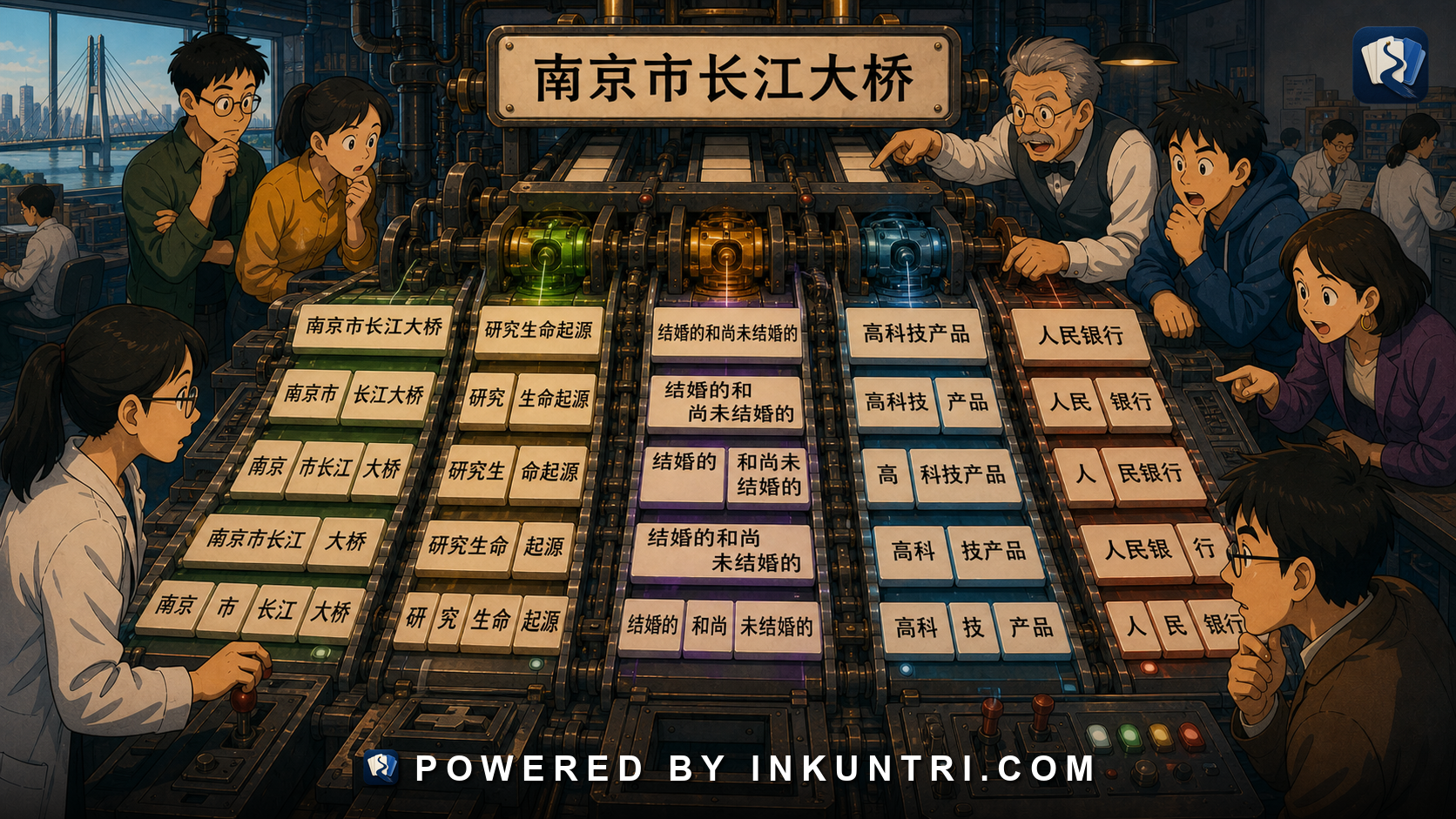
Core examples: 南京市长江大桥, 研究生命起源, 结婚的和尚未结婚的, 高科技产品, 人民银行. Recommended feature module: Segmentation explorer: users drag word boundaries between characters and see how meanings and search tokens change. Related internal articles: 003, 010, 024, 029, 047, 066, 076, 090.
Chinese has words. It just usually does not mark them with spaces.
A Chinese sentence may look like an unbroken string of characters:
我今天下午去人民银行办事。A learner sees characters. A reader understands words:
我 / 今天下午 / 去 / 人民银行 / 办事A search engine has to make a similar decision. It cannot simply assume that every character is a word. It also cannot assume that every two-character chunk is a word. It has to decide which character sequences should be treated as searchable units.
This process is called segmentation. In Chinese, segmentation means deciding where word-like boundaries fall in text that normally lacks spaces.
Segmentation matters for:
- search engines
- dictionary popups
- machine translation
- subtitles
- OCR cleanup
- text-to-speech
- speech recognition
- language-learning readers
- corpus analysis
- SEO
- autocomplete
- spell correction
For learners, segmentation is not just a technical topic. It is one of the main reasons Chinese reading feels difficult at the intermediate stage. You may know every character in a sentence and still fail to see the words.
1. The character is visible; the word must be inferred
English marks word boundaries with spaces:
I went to the bank today.Chinese usually does not:
我今天去了银行。The written units are characters:
我 今 天 去 了 银 行But the lexical units are closer to:
我 / 今天 / 去了 / 银行That difference matters because characters and words do not always align.
| Character string | Bad character-by-character reading | Better word-level reading |
|---|---|---|
| 今天 | now + day | today |
| 银行 | silver + walk/line | bank |
| 东西 | east + west | thing; stuff |
| 研究 | grind? + study? | research; study |
| 生命 | life + fate/order | life |
| 产品 | produce + item | product |
A search engine that indexes only individual characters may retrieve too much irrelevant material. A search engine that indexes only fixed dictionary words may miss new names, slang, technical terms, or unusual compounds. A good search system uses multiple strategies.
2. Why segmentation changes meaning
Some Chinese strings can be segmented in more than one plausible way. Sometimes the alternatives are funny; sometimes they matter.
A classic example:
南京市长江大桥Possible segmentation:
南京市 / 长江大桥
Nanjing City / Yangtze River Bridge
A learner might accidentally see:
南京 / 市长 / 江大桥
Nanjing / mayor / Jiang Daqiao
The second reading is absurd in normal context, but the characters allow the ambiguity if you do not know the place name 南京市 and the bridge name 长江大桥.
Another example:
研究生命起源Likely segmentation:
研究 / 生命 / 起源
study / life / origin
But in a broader sentence, 研究生 could mean “graduate student”:
研究生 / 命 / 起源
graduate student / life? / origin?
That second segmentation is not the intended reading, but the overlap shows why segmentation algorithms cannot rely only on fixed character counts.
A famous ambiguity type uses 和:
结婚的和尚未结婚的Two readings are possible depending on boundaries:
结婚的 / 和 / 尚未结婚的
married people / and / not-yet-married people
or, jokingly:
结婚的 / 和尚 / 未结婚的
married / monk / unmarried
Human readers use context, grammar, world knowledge, and probability. Machines must approximate that.
3. Search engines need tokens
A search engine does not “understand” a page the way a human does. At some level, it has to create an index: a list of searchable units pointing to documents.
For English, a simplified index might split on spaces and punctuation:
Chinese search engines care about segmentation
→ Chinese / search / engines / care / about / segmentation
For Chinese, there are no spaces to split on:
中文搜索引擎需要分词Possible tokens might include:
中文 / 搜索 / 搜索引擎 / 引擎 / 需要 / 分词A search system has to decide what to index. Different systems may index:
- single characters
- words from a dictionary
- overlapping two-character or three-character n-grams
- names and entities
- user queries as typed
- variants and synonyms
- simplified/traditional mappings
- pinyin or spelling variants
- domain-specific terms
For the query:
人民银行Good tokenization should recognize 人民银行 as an institution name, not merely 人民 plus 银行. For the query:
高科技产品The system might index:
高科技 / 产品and perhaps also:
科技 / 高科技产品depending on the search design.
4. Why dictionary popup tools sometimes split badly
Learners often discover segmentation through popup dictionaries. You hover over a sentence, and the tool highlights what it thinks is a word.
This can be magical:
他在人民银行工作。
他 / 在 / 人民银行 / 工作
But it can also fail:
这里有很多高科技产品。
这里 / 有 / 很多 / 高科技 / 产品
A weak tool might split:
高 / 科技产品or:
高科 / 技 / 产品The tool may know common dictionary entries but miss named entities, new slang, abbreviations, product names, or domain-specific terms. It may also choose a segmentation that is valid in one context but wrong in another.
Learner warning:
Popup segmentation is a hypothesis, not a teacher.Use it, but do not outsource judgment completely.
5. How segmentation affects SEO and web writing
Chinese SEO is not simply “write keywords with no spaces.” Search engines handle Chinese, but segmentation still affects how text is indexed and matched.
Suppose a page is about:
儿童中文分级读物
Chinese graded readers for children
Useful terms include:
儿童 / 中文 / 分级读物
儿童中文 / 中文分级读物
分级 / 读物
A writer who understands segmentation will make sure key terms appear in natural forms, not only in overly clever compressed titles. If the title says:
儿童中文分级读物推荐the body should also include normal phrases such as:
适合儿童的中文分级读物
中文阅读分级
儿童汉字阅读
拼音辅助阅读
The goal is not keyword stuffing. The goal is giving both readers and search systems enough lexical evidence.
This matters for Inkuntri articles too. A title can be elegant, but the article body should include the ordinary terms learners and searchers use.
6. Names, institutions, and places are segmentation traps
Chinese proper nouns often look like ordinary word sequences.
| String | Better segmentation | Why it matters |
|---|---|---|
| 北京大学 | 北京大学 | Institution name, not just Beijing + university in every context. |
| 人民银行 | 人民银行 | Institution name; may refer to the central bank in formal contexts. |
| 中山路 | 中山路 | Road name, not just 中山 + road in a compositional sense. |
| 上海交通大学 | 上海交通大学 | University name; long entity. |
| 国家博物馆 | 国家博物馆 | Institution name. |
| 王小明 | 王 / 小明 | Personal name; surname plus given name. |
A search system must recognize entities. A learner must also learn to recognize them, because dictionaries may not help with every name.
Practical tip: when a string contains a place, institution, or person, ask:
Is this a fixed name?
Is the whole string the searchable unit?
Would splitting it destroy the reference?
For example, 中国人民银行 should usually be treated as a full institutional name. Splitting it into 中国 / 人民 / 银行 loses the institutional reference, though those components are still meaningful.
7. Segmentation and simplified/traditional conversion
Segmentation also matters for character conversion. Many simplified/traditional mappings require word context.
Example:
头发The simplified 发 may correspond to traditional 髮 when it means hair:
頭髮But in:
发展发 corresponds to 發:
發展A conversion tool that segments correctly has a better chance of selecting the right traditional form. A character-by-character converter may fail.
This is why article 002’s conversion logic and this article’s segmentation logic are connected. Chinese digital tools often need word-level interpretation even when the visible writing system is character-based.
8. A learner method for segmenting unfamiliar sentences
When reading Chinese, do not start by translating every character. Start by finding chunks.
Use this sequence:
- Mark punctuation.
- Identify obvious names, numbers, dates, and places.
- Circle high-frequency function words: 的, 了, 在, 是, 和, 对, 把, 被.
- Look for two-character words you know.
- Check whether longer chunks are fixed terms.
- Confirm with a dictionary only after making a hypothesis.
Example:
南京市长江大桥今天上午恢复通行。Step-by-step:
| Chunk | Role |
|---|---|
| 南京市 | place/admin unit |
| 长江大桥 | bridge name |
| 今天上午 | time expression |
| 恢复 | verb |
| 通行 | traffic/passability noun/verb |
Better segmentation:
南京市 / 长江大桥 / 今天上午 / 恢复 / 通行。Natural translation:
Nanjing’s Yangtze River Bridge reopened to traffic this morning.Do not translate 长 as “long” or 江 as “river” separately if 长江 is the Yangtze River. Segmentation saves you from false literalism.
9. Segmentation is not always one correct answer
Some segmentation decisions depend on purpose.
For language learning, you might segment more finely:
高科技 / 产品For search indexing, a system might also include:
高 / 科技 / 高科技产品 / 产品For machine translation, the best segmentation may depend on the model. For dictionary lookup, the best segmentation is the one that helps the learner identify usable lexical entries. For linguistic analysis, the criteria may be stricter and theory-dependent.
So avoid thinking:
There is always exactly one true segmentation.A better view:
Segmentation should serve the task: reading, search, translation, indexing, or teaching.This does not mean anything goes. Many segmentations are clearly wrong. But borderline cases exist, especially with compounds, names, technical terms, abbreviations, and new slang.
10. Tool concept: segmentation explorer
An Inkuntri module for this article should let users manipulate boundaries directly.
Example input:
研究生命起源The interface shows draggable boundary slots:
研 究 生 命 起 源User can test:
研究 / 生命 / 起源
研究生 / 命 / 起源
For each segmentation, the tool displays:
- likely meaning
- naturalness score
- dictionary entries
- search tokens
- warning if a chunk is unlikely
- examples from authentic sentences
Another input:
南京市长江大桥The tool should show why:
南京市 / 长江大桥is better than:
南京 / 市长 / 江大桥This would teach learners not just “the answer,” but the reasoning.
10. Edge cases that make segmentation hard
Segmentation is easy when every word is familiar:
我 / 今天 / 去 / 学校 / 上课It becomes difficult when several valid-looking word boundaries compete.
The famous examples are useful because they show different kinds of ambiguity:
| String | Segmentation A | Segmentation B | Why it matters |
|---|---|---|---|
| 南京市长江大桥 | 南京市 / 长江大桥 | 南京市长 / 江大桥 | Named entity recognition prevents absurd parsing. |
| 研究生命起源 | 研究 / 生命 / 起源 | 研究生 / 命 / 起源 | Word frequency alone can mislead. |
| 结婚的和尚未结婚的 | 结婚的 / 和 / 尚未结婚的 | 结婚的和尚 / 未结婚的 | 的, 和, 尚未 can flip the parse. |
| 高科技产品 | 高科技 / 产品 | 高 / 科技产品 | Compound status affects search matching. |
| 人民银行 | 人民 / 银行 | 人民银行 | Institution name is a named entity. |
The technical issue is not that Chinese “has no words.” The issue is that word boundaries are not visible in ordinary writing, and the category “word” itself can be fuzzy in compounds, names, abbreviations, and fixed phrases.
A learner should therefore treat segmentation as an evidence problem:
character meaning + known vocabulary + grammar + genre + world knowledgeNo single clue is enough.
11. What search engines do that learners also need to do
A search engine does not simply split Chinese text once and call it done. In practice, search systems may combine several layers:
| Layer | What it tries to identify | Learner equivalent |
|---|---|---|
| Dictionary words | common lexical items | known vocabulary |
| Named entities | people, places, institutions, products | “Is this a proper noun?” |
| Numbers and units | 2026年, 88元, 3公斤 | quantity parsing |
| Abbreviations | 北大, 高铁, 两会 | expansion knowledge |
| New words/slang | yyds, 绝绝子, 新质生产力 | recency and genre awareness |
| Query expansion | synonyms and related terms | trying related search terms |
| User intent | shopping, navigation, news, explanation | “What is this text trying to do?” |
The learner version of segmentation is not a computational algorithm. It is a reading habit. When you meet a dense line of characters, ask:
1. Are there proper nouns?
2. Are there common two-character words?
3. Are there grammar markers like 的, 了, 在, 把, 被?
4. Are there number + unit chunks?
5. Are there institutional phrases or abbreviations?
6. Does the genre predict the vocabulary?
For example:
多地发布高温橙色预警A learner might first see:
多 / 地 / 发布 / 高 / 温 / 橙 / 色 / 预 / 警But a better segmentation is:
多地 / 发布 / 高温 / 橙色预警Then the sentence means:
Many places issued orange high-temperature warnings.The key unit is 橙色预警, not just “orange color + early warning.” Public-alert language is a domain vocabulary.
12. Segmentation errors in learner tools
Popup dictionaries and reader apps are helpful, but they are not infallible. A bad segmentation can send the learner down the wrong path.
Example:
他研究生命起源。A tool might offer:
他 / 研究生 / 命 / 起源That is nonsense in this context. The correct reading is:
他 / 研究 / 生命起源。
He studies the origin of life.
Or consider:
这个项目已经进入试运行阶段。Useful segmentation:
这个 / 项目 / 已经 / 进入 / 试运行 / 阶段A weak tool may split 试运行 as 试 / 运行, which is not catastrophic but makes the reader miss the technical term “trial operation.”
A learner should build a habit of checking tool output against sentence logic:
| Tool says… | Ask yourself… |
|---|---|
| This is a word. | Does it fit the sentence meaning? |
| This is a character meaning. | Is it functioning alone or inside a compound? |
| This is a name. | Is there capitalization/position/context support? |
| This is an abbreviation. | Can I reconstruct the full form? |
| This is an unknown phrase. | Is it domain-specific vocabulary? |
Treat segmentation tools as assistants, not judges.
13. Query design: how segmentation changes search results
Search behavior also teaches segmentation. Suppose you want to learn about 人民银行.
Search A:
人民 银行This may retrieve pages containing the separate ideas “people” and “bank.” Search B:
人民银行This targets the institution name. Search C:
中国人民银行This targets the central bank’s full name.
The same applies to learning searches:
| Bad search | Better search | Why |
|---|---|---|
| 高 科技 产品 | 高科技产品 | compound topic |
| 南京 市长 江大桥 | 南京市长江大桥 | place-name phrase |
| 试 运行 阶段 | 试运行阶段 | technical term |
| 未 成年 人 | 未成年人 | legal/social category |
| 公共 服务 平台 | 公共服务平台 | institutional phrase |
For SEO and site architecture, this matters too. An article about Chinese segmentation should not only target “Chinese search engines.” It should naturally include terms like:
Chinese word segmentation
中文分词
word boundaries
search query matching
dictionary popup errors
Chinese NLP for learners
The content should model the exact problem it explains: words have to be discoverable.
14. Stronger tool spec: segmentation explorer with confidence
The segmentation explorer should let users drag boundaries, but it should also show confidence and evidence.
Example input:
南京市长江大桥很有名。Suggested interface:
| Candidate segmentation | Meaning preview | Confidence | Evidence |
|---|---|---|---|
| 南京市 / 长江大桥 / 很 / 有名 | Nanjing City / Yangtze River Bridge / is famous | high | known place + known bridge name |
| 南京 / 市长 / 江大桥 / 很 / 有名 | Nanjing / mayor / Jiang Daqiao / is famous | low | possible grammar, poor real-world fit |
The module should not just mark answers as right or wrong. It should teach why the better parse wins:
长江大桥 is a common bridge-name phrase.
南京市 is an administrative place name.
市长 is possible, but it would need a plausible following name or title structure.
This turns segmentation from a hidden algorithm into visible reading reasoning.
Final learner takeaway
Chinese text does not use spaces the way English does, but Chinese absolutely has words. Search engines, dictionaries, translation systems, subtitle tools, and learners all have to infer word boundaries.
When a Chinese sentence feels impossible, the problem is often not characters. It is segmentation.
Ask:
Where are the words?
Which characters belong together?
Is this a name, a compound, an abbreviation, or a phrase?
What would a search engine index here?
If you learn to see segmentation, Chinese reading becomes less like decoding a wall of characters and more like reading a language.
Related reading
Building a Mandarin Reader Workflow From News, Documents, and Literature
The reader can build a sustainable Mandarin reading workflow that combines current news, practical documents, essays, and literature without drowning in vocabulary.
Chinese Characters Abroad: Hanzi, Kanji, Hanja, and the Shared Scriptworld
The reader understands the shared character tradition across China, Japan, and Korea while respecting each language’s independent grammar, pronunciation, and history.
Comparing Word Order: Chinese SVO vs Japanese and Korean SOV
The reader sees why shared vocabulary does not make sentence structure shared, especially when comparing Mandarin with Japanese and Korean.
Political Slogans and Four-Character Style Across East Asia
The reader understands how four-character rhythm and classical-style compression shape political and public language across Chinese, Japanese, and Korean contexts.
From Flashcards to Literacy: When Chinese Study Must Leave the Card
The reader can recognize when flashcards are helping and when they are delaying real Chinese literacy, then shift toward connected reading and listening.
The May Fourth Language Shift and the Rise of 白话
The reader understands how modern written Chinese emerged from debates over education, literature, modernization, and accessibility.