
What Chinese Children’s Readers Teach About Literacy Progression
The reader understands how graded children’s materials sequence characters, vocabulary, pinyin support, syntax, and cultural content.
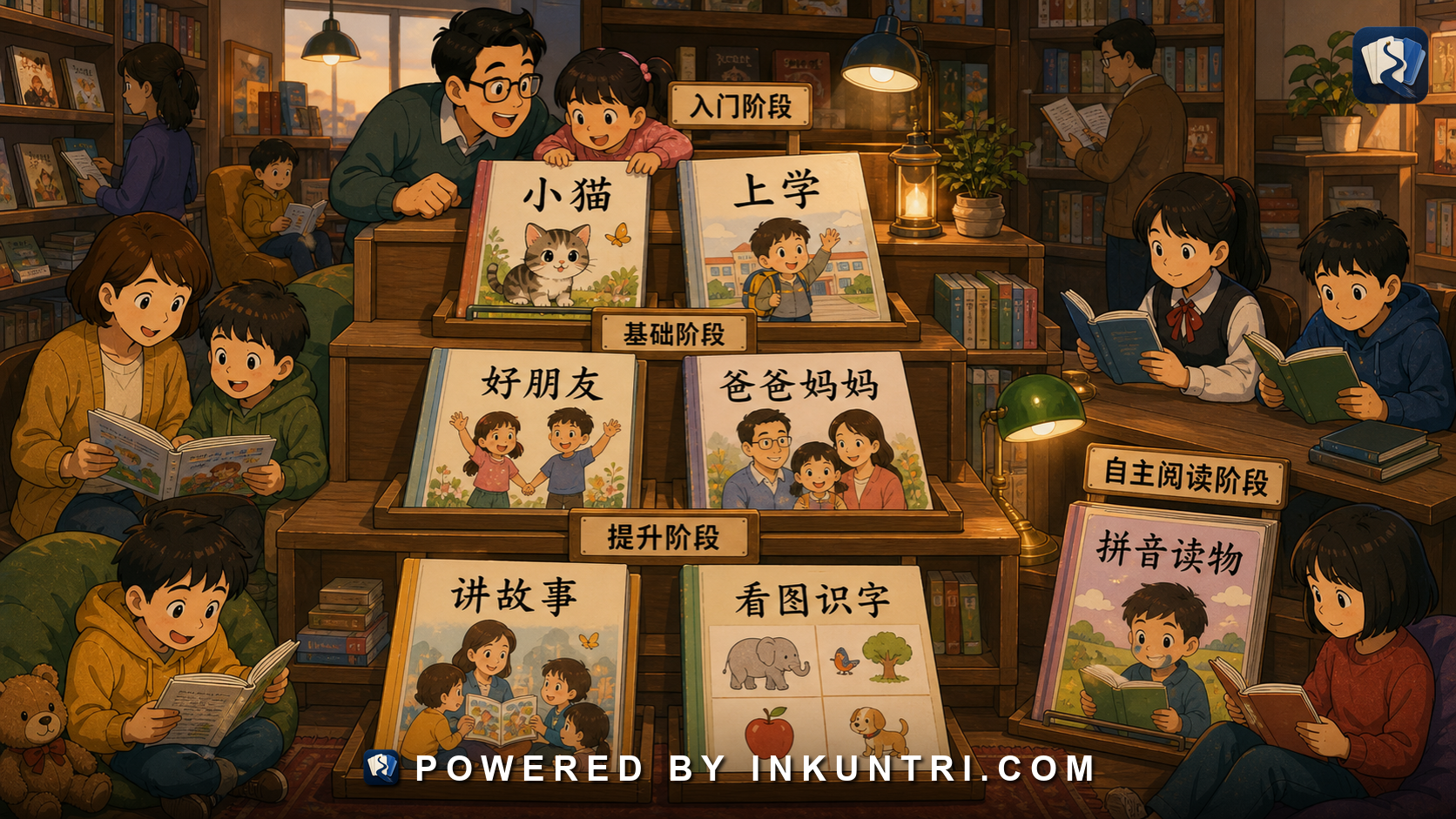
Core examples: 小猫, 上学, 好朋友, 爸爸妈妈, 讲故事, 看图识字, 拼音读物. Recommended feature module: Reading-level dashboard: character frequency, sentence length, Pinyin/Zhuyin support, new-word density, repetition, and picture dependence. Related internal articles: 003, 010, 025, 026, 031, 033, 064.
Children’s books are not automatically easy
Adult learners often say, “I’ll just read Chinese children’s books.” It sounds reasonable. Children’s books are short. They have pictures. The topics seem simple.
Then the learner opens a book and meets:
小兔蹦蹦跳跳地跑进森林。or:
狐狸狡猾地笑了笑。or a culturally familiar but linguistically odd storybook phrase that no adult textbook bothered to teach.
Chinese children’s readers are designed for native-speaking children learning literacy, not for adult second-language learners. Native children already know a large amount of spoken Chinese before they learn to read. They know family words, animal words, daily verbs, emotional expressions, story logic, and cultural routines. Their challenge is mapping known language onto characters.
Adult foreign learners often have the opposite problem. They may know characters from textbooks but not the child-centered vocabulary, oral idioms, rhythm, or cultural assumptions of children’s books.
The useful stance:
Children’s readers are literacy tools, not automatic beginner texts.
Study what they sequence, but do not assume they match adult learner difficulty.
1. Native-child literacy and adult L2 literacy solve different problems
A Chinese-speaking child entering school may already understand sentences like:
妈妈给我讲故事。
小狗跑到门口。
今天我们去公园玩。
The child’s challenge is:
spoken word → written character/wordAn adult learner’s challenge may be:
new sound + new word + new character + new grammar + new cultural contextThat is a much heavier stack.
This is why a book for a six-year-old native speaker can be hard for an adult beginner. The grammar may be simple, but the vocabulary may not be the adult learner’s vocabulary.
| Native child likely knows | Adult learner may not know |
|---|---|
| animal names | 小兔, 松鼠, 狐狸, 乌龟 |
| story verbs | 蹦, 跳, 摔, 追, 躲 |
| kinship nuance | 奶奶, 外婆, 舅舅, 阿姨 |
| emotional words | 委屈, 害羞, 得意 |
| school routines | 排队, 值日, 课间 |
| nursery style | 乖乖, 慢吞吞, 笑眯眯 |
Children’s readers are easy only if your vocabulary overlaps with children’s lives.
2. Early readers often rely on scaffolding
Chinese literacy materials for children may use several support systems:
- pictures
- repeated sentence frames
- high-frequency characters
- controlled vocabulary
- Pinyin above characters in Mainland materials
- Zhuyin beside characters in Taiwan materials
- large fonts
- short lines
- predictable story structure
- moral/social themes
Example frame:
小猫在睡觉。
小狗在跑步。
小鸟在唱歌。
This teaches:
小 + animal
在 + verb
simple subject-predicate structure
repeated visual pattern
The repetition is not childish filler. It is literacy engineering.
Adult learners can borrow this. Repetition builds automaticity. Seeing 小猫, 小狗, 小鸟 in repeated patterns helps you stop decoding 小 every time and start reading chunks.
3. Pinyin and Zhuyin support are bridges, not the destination
Children’s readers may include pronunciation notation.
Mainland-style Pinyin support:
xiǎo māo zài shuì jiào
小猫在睡觉。
Taiwan-style Zhuyin support may place symbols beside characters:
小 ㄒㄧㄠˇ
貓 ㄇㄠ
This support helps children connect speech and print. For adult learners, it can help pronunciation and lookup, but it can also become a crutch.
If your eyes always read the Pinyin, you may not actually learn the characters. If you ignore the notation entirely, you may reinforce wrong pronunciation.
Use a staged approach:
- Read with notation for new material.
- Cover notation and reread characters.
- Listen to audio if available.
- Read aloud without notation.
- Revisit after delay.
The goal is:
notation-supported reading → character-led reading4. Character progression is not just frequency
A good children’s reader does not only ask, “What are the most frequent characters?” It also asks:
- Can the child understand the word orally?
- Is the character visually simple enough?
- Is the word useful in daily life?
- Can it appear in repeated frames?
- Does the story context make it inferable?
- Does it combine with characters already learned?
For example:
人, 口, 手, 大, 小, 上, 下, 日, 月, 水These are visually and conceptually teachable early characters.
But a frequent character like 的 is abstract. It is common, but it is not picture-friendly. Children still learn it early because it is unavoidable, but its function is grammatical rather than concrete.
Adult learners should notice both types:
| Type | Examples | Learning issue |
|---|---|---|
| concrete/picturable | 人, 山, 水, 火, 手 | Easier to illustrate and remember. |
| high-frequency grammar | 的, 了, 在, 是, 和 | Essential but abstract. |
| story vocabulary | 猫, 狗, 跑, 笑, 哭 | Useful in children’s texts. |
| school/social vocabulary | 上学, 老师, 同学, 排队 | Context-specific. |
A reading-level dashboard should measure more than character count. It should measure grammar density, abstraction, and new-word load.
5. Repetition teaches fluency
Children’s books often repeat sentence patterns:
我有一只小猫。
我有一只小狗。
我有一只小鸟。
or:
爸爸在看书。
妈妈在做饭。
哥哥在写字。
This repetition may bore an adult who wants “real content.” That impatience is counterproductive. Repetition builds the reading reflex.
The learner’s job is not only to understand once. It is to read without effort.
A useful metric:
Can I read this sentence at near-speaking speed without translating in my head?If not, the text is still teaching you.
6. Pictures can help or hide weakness
Pictures in children’s readers are powerful. They provide context, reduce ambiguity, and make stories emotionally clear.
But pictures can also let learners guess without reading.
If the picture shows a cat sleeping, and the sentence says:
小猫在睡觉。You may “understand” without actually recognizing 睡觉.
Use pictures in two passes:
- With picture: predict meaning and enjoy the story.
- Without picture: verify that you can read the sentence itself.
A good digital reader could include a “hide image” mode for review.
7. Children’s readers teach cultural scripts
Many Chinese children’s materials are not just literacy exercises. They teach social behavior:
- respect elders
- help classmates
- love family
- study hard
- share toys
- protect nature
- follow rules
- be brave but modest
- value friendship
Example phrases:
尊敬老师
帮助同学
爱护环境
好好学习
天天向上
These may sound moralistic or formulaic to adult learners. But they are part of the discourse environment. School texts, children’s songs, slogans, and early readers share a culture of social instruction.
Do not dismiss this as irrelevant. It helps explain the register of school notices, public signs, children’s media, and moral education language.
8. What adult learners can borrow
You do not need to read only children’s books. But you can borrow their design principles.
| Children’s reader principle | Adult learner adaptation |
|---|---|
| repeated frames | Read 10 sentences using the same grammar pattern. |
| topic clusters | Learn words by domain: kitchen, school, transit, weather. |
| picture support | Use images for first exposure, then remove them. |
| notation support | Use Pinyin/Zhuyin early, then hide it. |
| high-frequency characters | Prioritize characters that unlock many words. |
| predictable stories | Reread until fluent. |
| short lines | Avoid dense walls of text at early stages. |
Adult learners often chase novelty too early. Children’s literacy materials remind us that controlled repetition is not a weakness. It is how reading becomes automatic.
9. What adult learners should not borrow blindly
Children’s readers can also mislead.
Avoid these traps:
| Trap | Why it is a problem |
|---|---|
| Overusing childish vocabulary | Words like 小兔乖乖 may not fit adult communication. |
| Assuming short = easy | Short texts can contain rare animals, idioms, or literary rhythm. |
| Depending on Pinyin forever | You may read the notation, not the Chinese. |
| Ignoring register | Children’s moral language may sound strange in adult contexts. |
| Reading below your interests forever | Motivation suffers if content feels irrelevant. |
| Treating native-child grade level as L2 level | The learning paths are different. |
A children’s book can be good reading practice without being your whole curriculum.
10. Tool concept: reading-level dashboard
An Inkuntri module for this article should analyze a text and display:
- total characters
- unique characters
- estimated character frequency level
- number of new words
- average sentence length
- repeated sentence frames
- Pinyin/Zhuyin support
- picture dependence
- grammar density
- child-register vocabulary
- adult-usefulness score
Example:
小猫在睡觉。小狗在跑步。小鸟在唱歌。Dashboard:
| Metric | Result |
|---|---|
| Sentences | 3 |
| Pattern | 小 + animal + 在 + activity |
| New vocabulary | 小猫, 睡觉, 小狗, 跑步, 小鸟, 唱歌 |
| Grammar | 在 progressive/location-like frame |
| Repetition | high |
| Adult usefulness | medium; good for 在 + verb pattern |
| Child-register risk | low |
This would help adult learners choose children’s materials intelligently.
10. How to evaluate a Chinese reader before using it
Not every “easy Chinese” book is easy for the same reason. A children’s book, a graded reader for foreign learners, a Pinyin reader, a picture book, and a school textbook may all look simple from the outside. They train different skills.
Use this checklist before committing to a reader:
| Feature | Helpful when… | Risk when… |
|---|---|---|
| Pinyin/Zhuyin support | pronunciation scaffolding is needed | learner stops looking at characters |
| Repeated sentence frames | building fluency and confidence | content becomes too predictable |
| Pictures | context supports unknown words | learner guesses without reading |
| Controlled vocabulary | learner needs extensive reading | language feels artificial |
| Native-child themes | learning culture and school literacy | adult learner finds it childish or culturally opaque |
| Moral/social lessons | reading school-style discourse | tone feels unnatural outside children’s materials |
| Large font/ruby text | early literacy support | difficult to transition to normal layout |
| Glossaries | independent reading | too much lookup interrupts flow |
The question is not “Is this book easy?” The question is:
Easy in what way, for whom, and for which skill?11. Native-child literacy is not adult L2 literacy
Chinese children usually arrive at school with years of spoken-language experience. Many adult learners do not. That changes everything.
A native child using a beginner reader may already know words like:
老师, 同学, 回家, 生日, 朋友, 玩具, 高兴, 害怕The child is learning to map known spoken words onto characters. The adult learner may be learning the word, the pronunciation, the character, the grammar, and the cultural context all at once.
That is why children’s readers can be surprisingly hard. They may contain:
- animal-story vocabulary not common in adult textbooks
- kinship and school-life assumptions
- literary repetition
- moralizing endings
- sound-symbol play
- rare verbs used in picture-book narration
- cultural routines around family, classroom, festivals, or politeness
Example:
小兔蹦蹦跳跳地跑回家。A child may know the situation. An adult learner may need:
| Item | Issue |
|---|---|
| 小兔 | not just “small rabbit”; child-story animal character |
| 蹦蹦跳跳 | reduplicated vivid motion; not basic textbook vocabulary |
| 地 | adverbial marker |
| 跑回家 | directional complement |
So the sentence is “easy” only if the learner has the right background.
12. Graded readers should lower lookup friction
For adult learners, the most useful reader is often not a native children’s book. It is a well-designed graded reader with restricted vocabulary and enough repetition to make reading flow.
A good graded reader should make most sentences readable without stopping:
Known words + a few new words + repeated patterns + meaningful storyA weak graded reader may fail in either direction:
| Failure | What it feels like |
|---|---|
| Too easy | “I can read it, but I am not learning much.” |
| Too dense | “I am using a dictionary every line.” |
| Too artificial | “The Chinese is controlled but lifeless.” |
| Too childish | “The words are simple but not useful to me.” |
| Too Pinyin-dependent | “I read the Pinyin and ignore the characters.” |
A practical rule:
If you cannot read a page with at least 90–95% comfort, it is intensive reading, not extensive reading.Both modes are valuable, but do not confuse them.
13. What children’s readers can still teach adults
Even when the content is childish, the design logic is useful.
| Children’s-reader feature | Adult learner adaptation |
|---|---|
| Repetition | reread short scenes until character recognition becomes fast |
| Picture support | use images to predict before dictionary lookup |
| Short lines | shadow aloud and notice rhythm |
| Topic clusters | read several texts about school, food, animals, weather, family |
| Pinyin/Zhuyin support | hide support first, reveal only after trying |
| Familiar scripts | learn routine expressions like 我可以…, 你要不要…, 我觉得… |
For example, a sequence like this is powerful:
小猫在桌子上。
小猫在椅子下。
小猫在门后。
小猫在哪里?
The sentence pattern is simple, but the reading practice is rich:
- location words
- 在 structure
- question form
- repeated character recognition
- visual confirmation
- rhythm of short sentences
Adult learners often underestimate this kind of fluency work. They chase harder text too early and never build automaticity with common structures.
14. A reading-level dashboard for Inkuntri
The article’s tool concept should not only label words. It should diagnose why a text feels easy or hard.
Suggested metrics:
| Metric | What it measures | Why it matters |
|---|---|---|
| Character frequency | proportion of high-frequency characters | raw recognition load |
| Word frequency | common versus rare vocabulary | practical readability |
| New-word density | new words per 100 characters | lookup burden |
| Sentence length | characters per sentence | working-memory load |
| Grammar density | particles, complements, relative clauses | structural difficulty |
| Notation support | Pinyin/Zhuyin present or absent | pronunciation scaffolding |
| Repetition score | repeated words and frames | fluency support |
| Cultural load | school/family/festival references | background knowledge |
| Layout difficulty | font, ruby text, spacing, line length | visual accessibility |
The dashboard should produce learner advice, not just numbers:
This text is vocabulary-light but grammar-heavy.
Use it for sentence-pattern review.

This text has many rare animal/story words.
Use it for intensive reading, not fluency.

This text is high-frequency and repetitive.
Good for extensive rereading.
That would make the article actionable for teachers and self-learners.
15. A four-stage adult path using children’s materials
A serious adult learner can use children’s readers without infantilizing the whole curriculum.
| Stage | Material | Goal |
|---|---|---|
| 1. Pattern fluency | very short picture readers | automatic recognition of common structures |
| 2. Character consolidation | repetitive graded stories | strengthen high-frequency characters |
| 3. Topic expansion | school/family/weather/food readers | build everyday domains |
| 4. Bridge reading | short native-child stories without full notation | move toward normal prose |
The mistake is to live forever in stage 1. The opposite mistake is to skip stage 1 because it feels “too easy.”
A useful weekly routine:
One easy reread for speed.
One slightly harder graded chapter for vocabulary.
One short native-child text for cultural/literary exposure.
One adult-interest text for motivation.
That gives learners repetition without boredom and challenge without constant failure.
Final learner takeaway
Chinese children’s readers are carefully scaffolded literacy materials, but they are designed for native-speaking children, not automatically for adult beginners.
Use them for what they teach best:
repetition
character-word mapping
short sentence frames
notation support
visual context
topic clustering
reading fluency
But do not assume:
for children = easy for meThe serious move is to study how children’s literacy is built, then adapt those methods to adult goals.
Related reading
From Flashcards to Literacy: When Chinese Study Must Leave the Card
The reader can recognize when flashcards are helping and when they are delaying real Chinese literacy, then shift toward connected reading and listening.
A Serious Learner’s Guide to Chinese Dictionaries
The reader can use Chinese dictionaries more deeply by reading definitions, parts of speech, usage notes, examples, synonyms, variants, and register labels.
Chinese Pronunciation Self-Diagnosis With Recording and Native Models
The reader can diagnose Mandarin pronunciation problems through recording, comparison, targeted drills, and structured feedback rather than vague “tone practice.”
How Chinese Language Policy Shows Up in School Textbooks
The reader can see textbooks as language-policy artifacts that teach vocabulary, values, standard pronunciation, literacy, and national narratives.
Building a Cross-CJK Cognate Deck Without Teaching Yourself Errors
The reader can build a Chinese-Japanese-Korean vocabulary comparison system that captures useful cognates without reinforcing false friends or fake equivalences.
A Research Stack for Chinese Learners: Dictionaries, Corpora, Standards, and Archives
The reader can assemble a serious Chinese research stack for verifying words, usage, standards, historical context, public documents, and domain terminology.