
The Typography of Chinese News Headlines
The reader learns how Chinese headlines compress grammar, highlight actors, and use layout conventions differently from body text.
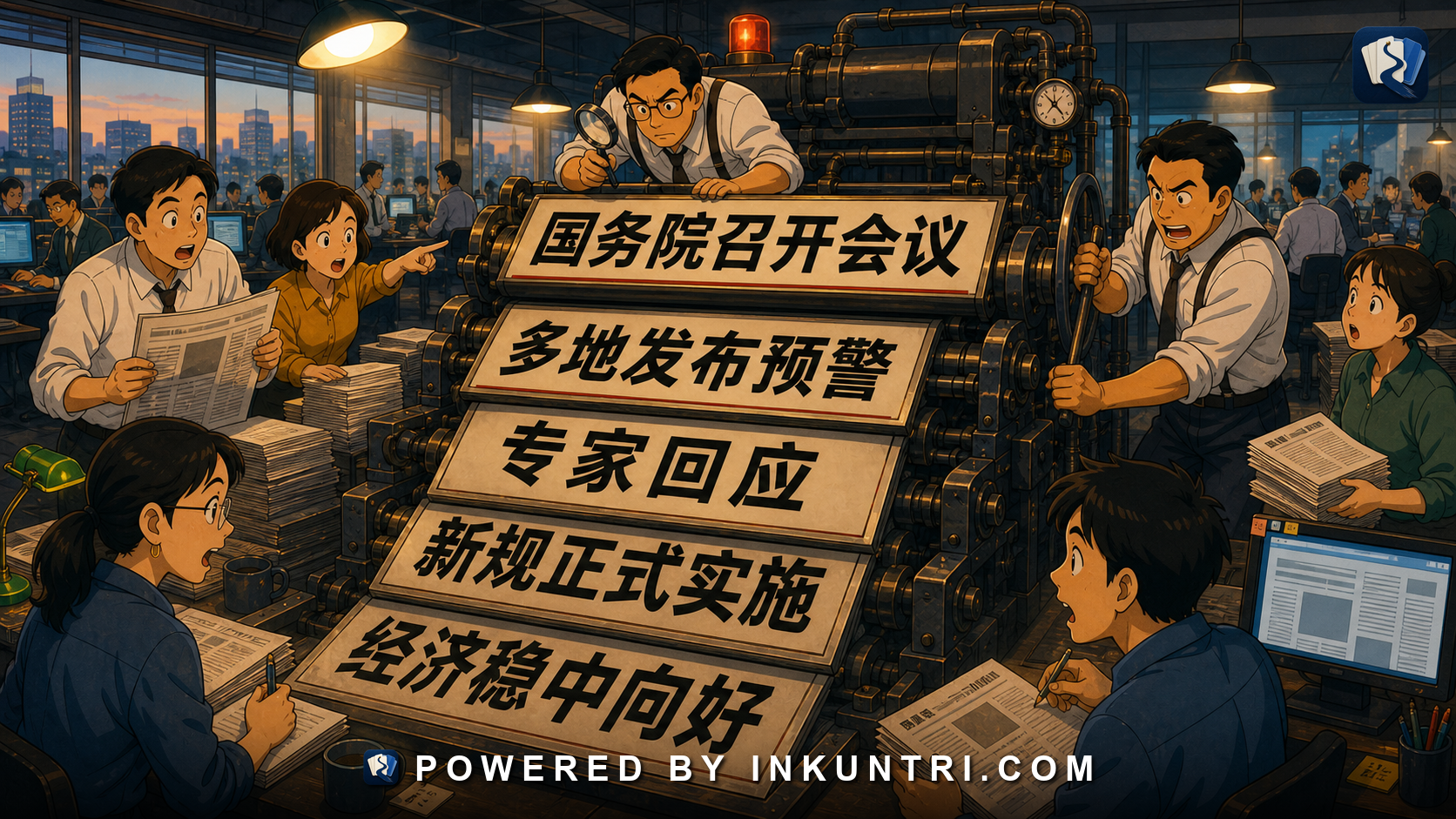
Core examples: 国务院召开会议, 多地发布预警, 专家回应, 新规正式实施, 经济稳中向好. Recommended feature module: News-headline anatomy diagram: headline, deck, source, date line, image caption, actor/event/object/stance labels, and expansion toggle. Related internal articles: 007, 008, 015, 016, 026, 034, 076, 090.
Headlines are not normal sentences wearing bigger type
Chinese news headlines look short. That does not mean they are easy.
A headline may say:
多地发布高温预警This looks simple, but it compresses a full news frame:
多个地区发布了高温天气预警。
Several regions issued heat warnings.
The headline leaves out elements that ordinary prose might include. It uses compact nouns, institutional verbs, abbreviated place references, and layout cues to tell readers what kind of news they are looking at.
For learners, headlines can be harder than body text because they often omit the grammatical material that would make the sentence friendlier. They assume background knowledge and rely on genre habits.
The useful stance:
A headline is a compressed interface.
Read it by identifying actor, action, object, scope, and news frame.
1. The visual hierarchy matters
A Chinese news page is not just one title and an article. It often has several layers:
| Element | Chinese terms you may see | Function |
|---|---|---|
| Headline | 标题 | Main news hook. |
| Subheadline/deck | 副标题, 导语-like deck | Adds scope, consequence, or angle. |
| Source label | 来源, 作者, 记者 | Tells institution or reporter. |
| Date/time line | 发布时间, 更新时间 | Places the report in time. |
| Photo caption | 图说, 图片说明 | Explains image. |
| Section label | 国内, 国际, 财经, 教育 | Frames topic. |
| Related links | 相关新闻, 延伸阅读 | Builds topic cluster. |
Learners often read only the headline and miss the deck or source label. That is dangerous because the headline may be intentionally compressed or vague.
Example:
新规正式实施On its own, this means:
New regulations officially take effect.But which regulations? The subheadline may answer:
涉及电动自行车充电、停放等管理要求Now the headline becomes specific.
Read the whole headline block, not only the largest characters.
2. Headline Chinese loves dense noun phrases
Headlines often pack information into noun phrases rather than full clauses.
Example:
高校毕业生就业服务专项行动启动Chunk it:
高校毕业生 / 就业服务 / 专项行动 / 启动
college graduates / employment service / special action/campaign / launched
A natural English version:
Special employment-service campaign for college graduates launched.There may be no explicit subject. The actor might be an agency named in the article body. The headline foregrounds the policy object and event.
Common dense headline nouns:
| Phrase | Meaning |
|---|---|
| 高质量发展 | high-quality development |
| 民生保障 | people’s livelihood protection/support |
| 就业服务 | employment services |
| 专项行动 | special campaign/action |
| 安全隐患 | safety hazard |
| 应急响应 | emergency response |
| 重点项目 | key project |
| 政策措施 | policy measures |
Do not translate these character by character. Learn them as news-register chunks.
3. Common headline verbs form a genre vocabulary
Chinese headlines use certain verbs again and again because news institutions repeatedly report meetings, policies, warnings, responses, investigations, launches, and implementation.
High-frequency verbs include:
| Verb | Typical object | Learner sense |
|---|---|---|
| 召开 | 会议 | convene/hold a meeting |
| 发布 | 通知, 预警, 数据, 报告 | issue, release, publish |
| 推进 | 工作, 改革, 建设 | advance, push forward |
| 落实 | 政策, 措施, 要求 | implement, put into effect |
| 回应 | 质疑, 关切, 问题 | respond to |
| 通报 | 情况, 案件, 结果 | report publicly, notify |
| 启动 | 项目, 机制, 行动 | launch, start |
| 实施 | 新规, 政策, 措施 | implement; take effect |
| 加强 | 管理, 监管, 保护 | strengthen |
| 开展 | 活动, 检查, 调查 | carry out |
Example:
多地发布暴雨预警Formula:
scope + 发布 + warning typeExample:
专家回应网传说法Formula:
expert/institution + 回应 + circulated claimOnce you learn these verbs, headlines become much less mysterious.
4. Function words disappear
In body text, a sentence might say:
国务院召开了一次会议,研究部署有关工作。Headline:
国务院召开会议研究部署有关工作Common omissions:
| Omitted or reduced item | Body prose | Headline tendency |
|---|---|---|
| 了 | 召开了会议 | 召开会议 |
| 的 | 有关的工作 | 有关工作 |
| 一次/一个 | 召开一次会议 | 召开会议 |
| 是 | 这是重要举措 | 重要举措 |
| pronouns | 他表示 | source name or omitted |
| conjunctions | 并且, 但是 | punctuation or juxtaposition |
This is not “bad grammar.” It is headline compression.
Learner method: expand the headline mentally.
Headline:
新规正式实施Expansion:
新的规定已经正式开始实施。Headline:
多地发布预警Expansion:
多个地区发布了相关预警。Expansion is not translation; it is a reading technique.
5. Punctuation does structural work
Chinese headlines use punctuation strategically:
| Mark | Use in headlines |
|---|---|
| : | introduces quote, explanation, or topic-comment relation |
| —— | adds subtitle, source framing, or explanation |
| “ ” | quoted phrase, slogan, coined expression, contested wording |
| 《 》 | titles of laws, policies, books, films, documents |
| ! | rare in formal news; more common in features or social media headlines |
| ? | question headline, often explanatory or click-oriented |
| 、 | compact lists |
Examples:
专家:短期波动不改长期趋势Structure:
speaker/source: claimExample:
《办法》将于下月施行Structure:
document title + future implementationExample:
稳中向好,底气何来?This is more rhetorical and explanatory. It asks a question the article will answer.
6. Numbers and abbreviations carry heavy load
Chinese headlines frequently use numbers because they are compact and authoritative-looking.
Examples:
前三季度GDP同比增长5.2%3部门联合发布通知“十四五”规划重点项目加快推进Numbers may mark:
- dates
- policy periods
- percentages
- rankings
- counts of agencies
- route numbers
- document numbers
- economic indicators
- emergency levels
Learners should be comfortable reading Arabic numerals embedded in Chinese syntax.
Abbreviations are also common:
| Abbreviation | Expanded idea |
|---|---|
| 两会 | National/major political meetings, depending context |
| 三农 | agriculture, rural areas, farmers |
| 京津冀 | Beijing-Tianjin-Hebei region |
| 长三角 | Yangtze River Delta |
| 粤港澳 | Guangdong-Hong Kong-Macao |
| 高铁 | high-speed rail |
| 医保 | medical insurance |
A headline may assume you know these. If you do not, the article body often expands or clarifies them.
7. Institutional actors may be hidden in plain sight
Chinese news headlines often use institutional subjects:
教育部发布通知国家统计局公布数据市场监管总局通报典型案例But sometimes the actor is absent:
新一轮专项检查启动Who launched it? The article body will say.
Sometimes the actor is broad:
多地优化住房政策多地 means multiple localities; it is intentionally nonspecific in the headline. The body may list provinces or cities.
Sometimes the actor is a label:
专家回应Which expert? The body supplies name, institution, and credentials.
Learner rule:
If the headline does not give the actor, do not invent one.
Read the lead.
8. Headline stance can be subtle
A headline may seem descriptive but still frame an event.
Compare:
新规正式实施Neutral implementation frame.
新规落地,影响几何?Explanatory impact frame.
新规引发热议Public reaction frame.
专家解读新规Authority/explanation frame.
一图读懂新规Service/explainer frame.
The verbs and formats tell you what the article is doing: reporting, explaining, defending, promoting, questioning, summarizing, or guiding.
9. A parsing method for Chinese headlines
When you see a headline, mark five things:
Actor / Event / Object / Scope / FrameExample:
多地发布高温预警| Role | Fill |
|---|---|
| Actor/scope | 多地 |
| Event/action | 发布 |
| Object | 高温预警 |
| Time | not in headline |
| Frame | public warning/service news |
Example:
国务院召开会议研究部署防汛救灾工作| Role | Fill |
|---|---|
| Actor | 国务院 |
| Event | 召开会议 |
| Secondary action | 研究部署 |
| Object | 防汛救灾工作 |
| Frame | official meeting/policy coordination |
Natural expansion:
国务院召开会议,研究并部署防汛救灾相关工作。This method prevents you from drowning in compounds.
10. Tool concept: headline anatomy diagram
An Inkuntri module should let users paste a headline and receive:
- word segmentation
- actor/event/object labels
- genre label: policy, warning, explainer, economy, public notice, feature
- expansion into ordinary prose
- headline verb explanation
- abbreviation expansion
- typography notes for source, deck, and date line
Example:
多地发布预警 强降雨天气持续Output:
| Element | Function |
|---|---|
| 多地 | scope; multiple localities |
| 发布预警 | action; issue warnings |
| 强降雨天气 | weather event |
| 持续 | state; continues |
| Space between clauses | headline juxtaposition; could be read as two linked clauses |
Expanded:
多个地区发布了预警,强降雨天气仍在持续。10. Headline parsing drills and register warnings
Chinese news headlines are not just shorter sentences. They are a register. They often omit function words, stack nouns, use institutional verbs, and assume the reader can infer relationships.
A useful first move is to classify the headline type.
| Headline type | Example | Main reading task |
|---|---|---|
| Official event | 国务院召开常务会议 | identify institution + action |
| Policy release | 新规正式实施 | identify rule + implementation status |
| Weather/public alert | 多地发布暴雨预警 | identify places + alert type |
| Market/economic | A股三大指数集体上涨 | identify subject + movement |
| Expert response | 专家回应网传说法 | identify speaker + claim frame |
| Human-interest/social | 女子误转账后追回 | identify actor + event chain |
| International | 多国呼吁恢复谈判 | identify actors + diplomatic action |
Once you classify the type, vocabulary becomes less mysterious. Headlines recycle genre-specific verbs.
| Verb | Common headline role | Typical expansion |
|---|---|---|
| 召开 | meeting held | 某机构召开会议 |
| 发布 | release/issue | 发布政策、数据、预警、通知 |
| 启动 | launch | 启动项目、机制、调查 |
| 推进 | advance/promote | 推进改革、建设、合作 |
| 落实 | implement | 落实政策、要求、责任 |
| 回应 | respond | 对争议、传闻、问题作回应 |
| 通报 | officially report | 通报情况、处理结果 |
| 披露 | disclose | 披露信息、数据、细节 |
| 约谈 | summon for regulatory talk | common in official/regulatory news |
| 查处 | investigate and punish | enforcement frame |
Learners should build headline verb lists by genre rather than memorizing random words.
11. Expand the headline into a sentence
A strong parsing method is to rewrite the headline as a full sentence. This reveals what has been compressed.
Headline:
多地发布高温橙色预警Expanded:
多个地区发布了高温橙色预警。Questions:
| Question | Answer |
|---|---|
| Actor | 多地 = multiple places/localities |
| Action | 发布 = issued |
| Object | 高温橙色预警 = orange high-temperature warning |
| Omitted grammar | 了 may be omitted; 地区 is compressed to 地 |
| Genre | weather/public alert |
Headline:
专家回应“AI取代教师”说法Expanded:
专家对“AI取代教师”的说法作出了回应。Questions:
| Question | Answer |
|---|---|
| Actor | 专家 |
| Action | 回应 |
| Object/topic | “AI取代教师”说法 |
| Omitted structure | 对…作出回应 |
| Quotation role | names the claim being discussed, not necessarily endorsed |
This method also prevents overtranslation. Do not mechanically translate 回应 as “reply” every time. In news headlines, 回应 often means “responds to claims/concerns/controversy.”
12. Quotation marks in headlines often mark claims, not endorsement
Chinese headlines frequently put a phrase in quotation marks to identify a slogan, claim, disputed expression, policy phrase, or exact wording.
| Headline fragment | Likely function |
|---|---|
| “低价游”乱象 | topic label; may signal criticism |
| “AI取代教师”说法 | claim being discussed |
| “一老一小”服务 | policy/social-service phrase |
| “黑科技”产品 | popular/media label, possibly promotional |
| “打卡式旅游” | social trend label |
Quotation marks do not always mean a direct quote from a speaker. They can mark a term under discussion.
Example:
多部门整治“天价彩礼”问题A learner should not parse this as someone saying “sky-high bride price” in a direct quote. The phrase is a public-topic label.
A useful warning:
In headlines, quoted phrases may be labels, slogans, claims, nicknames, disputed terms, or direct quotations. Check the body text before deciding.13. Numerals, abbreviations, and compression
Chinese headlines often prefer numerals and compact policy phrases because they fit small spaces and signal newsworthiness.
| Pattern | Example | How to read |
|---|---|---|
| Number + measure | 5月起施行 | takes effect from May |
| Number + policy list | 三项措施出台 | three measures issued |
| Abbreviation | 京津冀协同发展 | Beijing-Tianjin-Hebei coordinated development |
| Four-character rhythm | 稳中向好 | stable with positive momentum |
| Institutional shorthand | 多部门联合发文 | multiple departments jointly issued a document |
| Range phrase | 1至4月 | January through April |
Headlines may compress administrative units too:
沪深两市震荡走高Here 沪深 means Shanghai and Shenzhen stock markets, not two random characters. A learner who only knows single-character meanings will struggle. Abbreviation literacy matters.
14. Register: headline language is not everyday speech
Do not speak like a headline in daily conversation.
| Headline style | Natural conversation |
|---|---|
| 多地发布预警 | 很多地方都发了预警。 |
| 新规正式实施 | 新规定开始实行了。 |
| 专家回应争议 | 有专家出来回应了这个争议。 |
| 项目稳步推进 | 这个项目在慢慢往前做。 |
| 消费持续回暖 | 消费情况慢慢好起来了。 |
Headline vocabulary is useful for reading news, official notices, financial reporting, and policy discussion. But if a learner uses too much of it in casual conversation, the result can sound stiff, bureaucratic, or comic.
The article should teach two-way movement:
headline → expanded formal sentence → natural spoken paraphraseExample:
Headline: 多地推出促消费举措
Formal: 多个地区推出了促进消费的措施。
Spoken: 很多地方出台了一些刺激消费的办法。
This is far more useful than one English gloss.
15. Stronger tool spec: headline anatomy diagram
The headline module should let users label:
actor / institution
verb / action
object / policy / event
time
place
stance or frame
quotation label
omitted grammar
expanded sentence
spoken paraphrase
Example input:
多部门联合发文规范网络直播营销Output:
| Segment | Label | Explanation |
|---|---|---|
| 多部门 | actor | multiple departments/agencies |
| 联合 | action modifier | jointly |
| 发文 | official action | issue a document |
| 规范 | policy verb | regulate/standardize |
| 网络直播营销 | object | livestream marketing |
Expanded sentence:
多个部门联合发布文件,对网络直播营销进行规范。Spoken paraphrase:
好几个部门一起发了文件,要规范直播带货这类营销。That three-layer output teaches headline grammar, official register, and everyday comprehension at once.
Final learner takeaway
Chinese news headlines are compressed, typographically staged, and genre-driven. They omit function words, pack noun phrases, reuse institutional verbs, and rely on layout cues.
Do not read them character by character. Read them as headline machines:
Who or what is the actor?
What happened?
What is the object?
What is the scope?
What frame does the headline choose?
Once you learn that anatomy, Chinese headlines become less opaque and much more useful.
Related reading
Building a Mandarin Reader Workflow From News, Documents, and Literature
The reader can build a sustainable Mandarin reading workflow that combines current news, practical documents, essays, and literature without drowning in vocabulary.
Chinese Characters Abroad: Hanzi, Kanji, Hanja, and the Shared Scriptworld
The reader understands the shared character tradition across China, Japan, and Korea while respecting each language’s independent grammar, pronunciation, and history.
How to Build a Personal Mandarin Shadowing Corpus
The reader can build a focused, repeatable set of audio materials for pronunciation, rhythm, vocabulary, and register practice.
Comparing Word Order: Chinese SVO vs Japanese and Korean SOV
The reader sees why shared vocabulary does not make sentence structure shared, especially when comparing Mandarin with Japanese and Korean.
Political Slogans and Four-Character Style Across East Asia
The reader understands how four-character rhythm and classical-style compression shape political and public language across Chinese, Japanese, and Korean contexts.
From Flashcards to Literacy: When Chinese Study Must Leave the Card
The reader can recognize when flashcards are helping and when they are delaying real Chinese literacy, then shift toward connected reading and listening.