
Seal Script in Modern China: Where Ancient Forms Still Appear
The reader recognizes seal script as a living visual register in stamps, logos, art, institutions, and cultural branding.
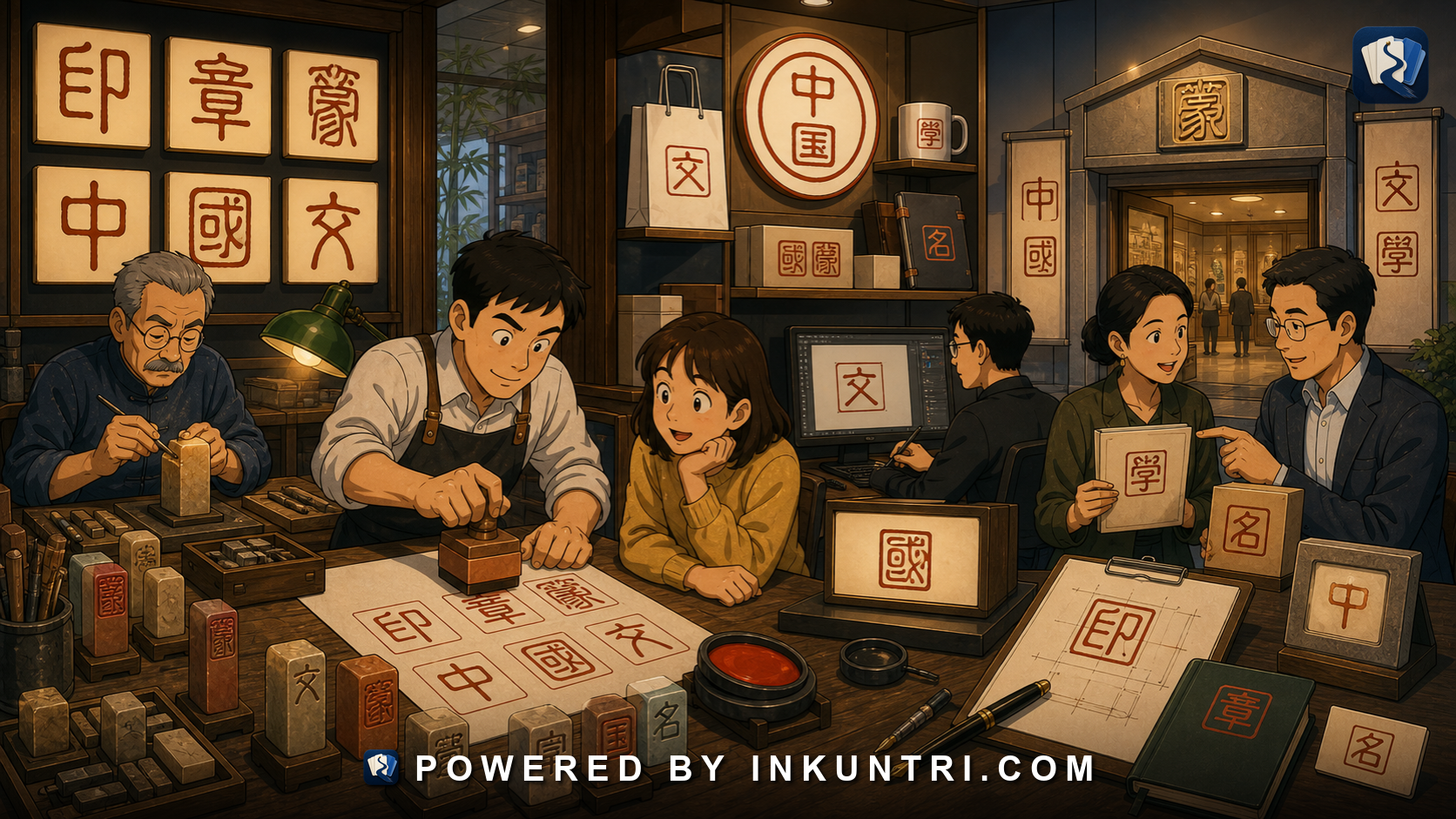
Core examples: 印, 章, 篆, 中, 国, 文, 学, 名, personal seals, museum inscriptions. Recommended feature module: Seal-script decoder: show a seal-style character or four-character square inscription, then animate it into regular script with labels for orientation, carving style, positive/negative space, and likely reading order. Related internal articles: 006, 008, 009, 022, 034.
Seal script is ancient-looking, not dead
Seal script looks ancient because it is ancient in origin. But it is not dead.
You still see seal-script forms in modern Chinese visual life: personal seals, artist seals, museum logos, cultural brands, tea packaging, book covers, plaque designs, school emblems, calligraphy exhibitions, souvenir stamps, and decorative institutional marks. Even when ordinary readers cannot read every character instantly, seal script still communicates something: tradition, authority, scholarship, artistry, age, authenticity, or cultural depth.
That is why learners should know what seal script is. Not because you need to read ancient inscriptions fluently, but because you will keep seeing ancient-looking characters in modern places.
The key idea:
Seal script is a historical script style that survives as a modern visual register.It is not the default way people write Chinese. It is a special-looking layer used when the visual effect matters.
1. What 篆书 means
篆书 is usually translated as “seal script.” The word appears in several useful terms:
| Term | Pinyin | Meaning | Learner note |
|---|---|---|---|
| 篆书 | zhuànshū | seal script | The script style. |
| 篆体 | zhuàntǐ | seal-script style/form | Often used when describing a font or style. |
| 篆刻 | zhuànkè | seal carving | The art/practice of carving seals. |
| 印章 | yìnzhāng | seal; stamp; chop | The physical object or its impression. |
| 印 | yìn | seal; print; mark | Also means to print/impress. |
| 章 | zhāng | seal; chapter; regulation mark | In this context, seal/stamp. |
| 落款 | luòkuǎn | inscription/signature area | Often accompanied by seals on artwork. |
Seal script is associated with earlier forms of Chinese writing, especially the standardized small-seal script of the Qin period. But in modern life, you do not usually meet seal script as a normal paragraph of text. You meet it as a visual style.
A learner should separate three questions:
- Historical question: Where did this form come from?
- Graphic question: How does this seal-script shape correspond to the modern character?
- Modern-use question: Why did someone choose this style here?
For practical reading, the third question is often the most important.
2. Large seal and small seal: useful distinction, not a beginner rabbit hole
Seal script is not one single shape system. Traditional discussion often distinguishes:
| Term | Chinese | Basic idea | Learner-level use |
|---|---|---|---|
| Large seal script | 大篆 | Earlier, broader category associated with pre-Qin forms, including bronze-inscription traditions | Know that it can be more varied and archaic. |
| Small seal script | 小篆 | More regularized form associated with Qin standardization | Know that it often looks more symmetrical and systematized. |
For beginning and intermediate learners, the important point is not to master paleography. The important point is to understand why seal script can be hard:
- The shapes may preserve older forms.
- The lines are often rounded and even.
- Components may be arranged differently from modern forms.
- Characters may be stretched or compressed to fit a square.
- A seal may prioritize composition over easy reading.
A modern learner sees 国 and expects a square enclosure with 玉 inside. A seal-script design may point toward older/traditional forms and may not look like simplified 国 at all. If the text is intended to feel classical, the designer may choose forms closer to 國 or even more archaic shapes.
That is not an error. It is part of the style.
3. Where seal script appears today
Seal script survives because it does a job. It makes writing look official, old, scholarly, handmade, or culturally rooted.
Personal seals and artist seals
A personal seal may contain a name, studio name, courtesy-style phrase, or artistic motto. On paintings and calligraphy works, seals often appear in red and interact with the composition. They can mark authorship, ownership, appreciation, collection history, or artistic identity.
Typical words around seals include:
印 章 之印 私印 名章 闲章 斋 堂A four-character name seal may use a layout like:
王明之印or a shorter form such as:
王明印The exact layout depends on seal size, name length, carving convention, and artistic taste.
Company chops and institutional stamps
Modern Chinese-speaking business and administrative life uses seals/stamps in many contexts, but do not overgeneralize: not every official stamp uses archaic seal script. Many modern institutional stamps use clear modern characters arranged in a circular or oval format.
Still, seal-script aesthetics remain associated with authority and stamped identity, especially in cultural or artistic settings.
A useful distinction:
Legal/administrative stamp ≠ necessarily seal-script calligraphy.
Cultural/artistic seal ≈ often seal-script or seal-inspired.
Logos and cultural institutions
Museums, universities, publishers, tea companies, cultural foundations, and heritage brands may use seal-style forms to create an identity. The logo may not be meant to function like ordinary text. It may be an emblem.
A museum logo using seal-script-like 文, 博, or 中 may signal “history” before a reader decodes each stroke.
Packaging and cultural products
Tea tins, liquor labels, incense packages, stationery, brush shops, and souvenir products often use seal-style type. The style tells the buyer: this object belongs to a traditional cultural world.
The product may be modern, mass-produced, and digitally designed. The script style still carries the old-style signal.
Inscriptions and monuments
On monuments, stone inscriptions, commemorative tablets, and historical-site signage, seal script may appear as a title, heading, or decorative reference. Sometimes it appears alongside regular script or printed explanatory text.
For learners, the explanatory text is usually the easier path. Read the modern caption first, then return to the seal-script heading.
4. Why seal script is hard to read
Seal script is hard for several different reasons. Naming the difficulty helps.
It may use older character structure
Modern characters have undergone long histories of graphic change. Seal script may preserve older arrangements or component shapes. The character may be historically related to the modern form without looking like its modern printed version.
It may flatten stroke contrast
Regular script makes stroke types visible: horizontal, vertical, dot, hook, left-falling, right-falling. Seal script often uses more even, rounded lines. That can hide stroke-order cues learners rely on.
It may be composed for a square seal
A seal face is a small square or rectangle. Characters may be stretched, bent, compressed, or interlocked to fill the space. The composition may matter more than ordinary line-by-line reading.
It may use positive and negative space
Seals can be carved so the characters print red, or so the background prints red and the characters remain white. This changes the reading experience.
Common terms:
| Term | Pinyin | Rough meaning | Visual result |
|---|---|---|---|
| 朱文 | zhūwén | red-character seal | Character strokes appear red in the impression. |
| 白文 | báiwén | white-character seal | Character strokes appear white, with red background. |
| 阳文 | yángwén | relief/raised carving | Often associated with red-character impressions. |
| 阴文 | yīnwén | intaglio/incised carving | Often associated with white-character impressions. |
Different traditions and explanations may pair these terms with carving/impression details in slightly different ways, so learners should treat them as a visual vocabulary, not as a legalistic formula.
It may be rotated or arranged nonlinearly
A four-character seal may not read like left-to-right modern text. It may be arranged in columns, read top-to-bottom and right-to-left, or composed in a square layout that requires convention.
Before reading a seal, ask:
Where is the top?
How many characters are there?
Are they arranged as columns?
Is there a border?
Is this a name seal, studio seal, or decorative seal?
It may be deliberately archaic
Some seal designs are not trying to help beginners. They are trying to look ancient, elegant, dense, playful, or learned. A designer may choose unusual forms precisely because they feel more classical.
Again: not reading it instantly is normal.
5. A practical decoder for seal-script text
When you see seal-script text, use a slow method.
Step 1: Identify the object type
Is it:
- a personal seal?
- a company/institution stamp?
- a museum logo?
- a decorative brand mark?
- a book cover?
- a calligraphy-work seal?
- a historical inscription?
Object type predicts content. A seal on a painting is likely a name, studio, collector mark, or motto. A tea package logo is likely a brand or poetic phrase. A museum sign may include 文, 博, 館/馆, 藏, or the institution name.
Step 2: Count the characters
Many seals contain one, two, three, or four characters. Count visible blocks before guessing.
1 character: often emblematic, such as 福, 寿, 印, 文
2 characters: name, brand, studio, short label
3 characters: name + 印/章, place/name formula
4 characters: full name + 之印, institution abbreviation, motto
This is only a heuristic, but it helps.
Step 3: Locate likely formula characters
In name seals, look for:
印 章 之 氏 私 名If you can identify 印 at the end, the rest may be a name.
Example:
王明之印If 之印 is recognizable, the first two characters are likely the personal name.
Step 4: Compare with regular script
Once you have a guess, compare the seal form with regular script. Use a seal-script dictionary or a reliable character-form database if available. For learners, even a web image search can help, but final identification should be cautious.
Do not assume that the first visual match is correct. Seal forms can be similar, and stylized forms can mislead.
Step 5: Use surrounding text
A seal rarely appears alone in a vacuum. A painting may have a signature. A package has a printed brand name elsewhere. A museum sign has explanatory captions. A plaque may have smaller modern text below.
Read the easy text first. It often tells you what the hard text says.
6. Example: 印, 章, and 篆
Three characters are especially useful for this topic.
印
印 can mean seal, mark, print, or impression. You may see it in:
印章 印刷 印记 私印 之印In seal contexts, 印 often tells you that the surrounding characters identify the owner or function of the seal.
章
章 can mean chapter, regulation, badge, or seal. In 印章, it simply helps form the word “seal/stamp.” In an official context, 公章 is an official seal or company/institution stamp.
篆
篆 points to seal script or seal carving. It appears in:
篆书 篆刻 篆体 小篆 大篆If a museum label says 篆书, it is telling you the script style. If an art class advertises 篆刻, it is about seal carving.
7. Example: a four-character name seal
Suppose you see a square red seal on a calligraphy work. The seal has four characters arranged as two columns. The regular-script equivalent is:
李华之印A learner can parse it as:
| Character | Function |
|---|---|
| 李 | surname |
| 华 | given-name character |
| 之 | linking/classical possessive marker |
| 印 | seal |
The natural interpretation:
The seal of Li Hua.Important: the seal-script forms of 李, 华/華, 之, and 印 may not look like the printed characters. The formula helps you read them.
If the same seal appears on a painting with a written signature 李华, that context confirms the reading.
8. Example: cultural logo using 中 and 文
A logo may use seal-style forms of characters such as:
中文
中国文化
文博
书院
In regular script, these may be easy. In seal style, the characters may become square, rounded, symmetrical, and abstract.
Your reading method:
- Identify the context: cultural organization or brand.
- Look for known cultural keywords: 中, 文, 国/國, 学/學, 书/書, 院, 博.
- Compare the logo with nearby printed text.
- Treat the seal-style logo as an emblem, not the main reading source.
This is how native readers often handle stylized logos too. They rely on brand context, repetition, and accompanying text.
9. Seal script, simplified/traditional forms, and variants
Seal script complicates the simplified/traditional distinction.
A learner may ask: “Is this seal-script character simplified or traditional?” Often, that is the wrong first question. Seal script belongs to an older graphic layer. It may correspond more naturally to a traditional form, an archaic form, or a stylized form that does not map cleanly onto modern simplified vs traditional categories.
For example:
| Modern simplified | Modern traditional | Seal-script issue |
|---|---|---|
| 国 | 國 | Seal-script forms may align more with older enclosure/internal structures. |
| 学 | 學 | A seal-style form may preserve elements hidden by simplification. |
| 书 | 書 | Seal/clerical/calligraphic forms may not resemble simplified 书 closely. |
| 门 | 門 | Older/style forms often connect more obviously to 門. |
This is why article 006 on variants and article 012 on semantic compression matter. Character history, calligraphic style, and modern standardization are different layers.
For practical learners:
Do not use seal script as your primary source for simplified/traditional learning.
Use it as evidence that Chinese character forms have historical depth and visual variation.
10. Do not confuse authenticity with aesthetics
A red seal looks official. A seal-script logo looks ancient. A square stamp looks authoritative.
That does not automatically mean the object is authentic, legally valid, old, or trustworthy.
Modern designers can generate seal-style fonts digitally. Tourist products can use seal-like marks decoratively. A personal art seal can look official without being an administrative stamp. A company chop can be legally important even if it uses plain modern characters.
So learners should avoid two opposite mistakes:
- Naive awe: “It has a seal, so it must be authentic.”
- Naive dismissal: “I cannot read it, so it is just decoration.”
The mature view:
A seal is a visual mark with possible artistic, personal, institutional, commercial, or legal meaning. Context decides how seriously to treat it.11. Field guide: common seal-script contexts
| Context | What you may see | What to do |
|---|---|---|
| Painting/calligraphy | Red seals near signature or composition | Read main inscription first; identify seals as name/studio/collector/motto if possible. |
| Museum object | Seal-script label or ancient-looking inscription | Use the modern museum caption first. |
| Tea packaging | Square seal-style brand mark | Look for printed brand name elsewhere. |
| Restaurant/shop sign | Brush or seal-style name | Use context and nearby printed text. |
| Company document | Official stamp | Do not assume seal-script; identify institution name and document function. |
| Tourist souvenir | Decorative name seal | Treat as cultural object; quality and accuracy vary. |
| School/institution logo | Seal-style emblem | Compare with official name in regular type. |
| Book cover | Seal-style title or publisher mark | Look for spine, subtitle, or ISBN metadata. |
12. Tool build: seal-script overlay and decoder
The interactive module for this article should help users learn how to decode without pretending seal script is easy.
Core features:
- Modern-to-seal animation: 中, 国/國, 文, 学/學, 名, 印, 章, 書/书, 福.
- Seal layout mode: one-character, two-character, four-character square, vertical columns, right-to-left column order.
- Positive/negative space toggle: show 朱文 vs 白文 impressions.
- Context mode: personal seal, artist seal, museum logo, company stamp, tea package, book cover.
- Formula detector: highlight common endings such as 印, 之印, 私印, 章.
- Regular-script reveal: click a seal character to show 楷书, simplified/traditional equivalents, pinyin, and meaning.
- Uncertainty label: warn users when a stylized form is too ambiguous for confident automatic reading.
- Variant note: explain when a seal form corresponds more closely to a traditional or archaic form than to modern simplified shape.
Example UI parse:
Seal impression: 王明之印
Layout: four-character square, two columns
Likely reading order: top-right → bottom-right → top-left → bottom-left
Formula: 之印 = “the seal of”
Name: 王明
Regular-script display: 王明之印
Learner note: identify formula characters before guessing the name.
13. What to remember
Seal script is not just museum history. It is still active as a visual register.
Remember:
- 篆书 signals antiquity, authority, artistry, or cultural depth.
- Modern seal-script use is often emblematic, not ordinary prose.
- Seals may use positive or negative space, making reading harder.
- Four-character seals often contain names plus formula characters.
- Simplified/traditional categories do not fully explain seal-script forms.
- Context is your best decoder.
If you can recognize seal script as a living visual register, you will understand a large part of the Chinese visual environment that textbooks usually skip.
- Built from outline 023 in the Inkuntri Chinese article outline set.
- Main source anchors to check during final editorial review:
- Smithsonian National Museum of Asian Art, “Seal Script (篆書),” especially the distinction between large-seal and small-seal script and the description of small seal as symmetrical with thin, even lines: https://asia-archive.si.edu/learn/chinas-calligraphic-arts/seal-script/
- Smithsonian National Museum of Asian Art, “China’s Calligraphic Arts,” especially the description of seal-script visual structure and the place of early writing on bones, stones, and metal artifacts: https://asia-archive.si.edu/learn/chinas-calligraphic-arts/
- Smithsonian National Museum of Asian Art, “Writing, Carving, and Rubbing: China’s Calligraphic Arts,” especially the inclusion of seals and seal paste among the calligraphic arts context: https://asia-archive.si.edu/exhibition/writing-carving-and-rubbing-chinas-calligraphic-arts/
- British Museum collection entries for Chinese/Japanese seals with seal-script inscriptions in relief, useful as object examples rather than general theory: https://www.britishmuseum.org/collection/object/A_SLMisc-898 and https://www.britishmuseum.org/collection/object/A_1906-0613-1
- Taipei City Government English article on seal carving as a Chinese art form and identity/status marker. Treat as cultural-explanatory, not as a technical standard: https://english.gov.taipei/News_Content.aspx?n=8988BC727AE3A8A3&s=6CCFB6BAAD59BE4D
- Be careful not to imply that all modern official seals use seal script. Many modern administrative stamps use modern printed characters.
- If building the decoder, do not rely on OCR alone. Seal-script recognition needs curated character-form data and human-verifiable uncertainty.
Related reading
Building a Mandarin Reader Workflow From News, Documents, and Literature
The reader can build a sustainable Mandarin reading workflow that combines current news, practical documents, essays, and literature without drowning in vocabulary.
Memes, Homophones, and Political Caution in Chinese Online Culture
The reader can understand how Chinese online users use homophones, euphemisms, abbreviations, and layered jokes to manage sensitivity, moderation, and community recognition.
Chinese Characters Abroad: Hanzi, Kanji, Hanja, and the Shared Scriptworld
The reader understands the shared character tradition across China, Japan, and Korea while respecting each language’s independent grammar, pronunciation, and history.
Comparing Word Order: Chinese SVO vs Japanese and Korean SOV
The reader sees why shared vocabulary does not make sentence structure shared, especially when comparing Mandarin with Japanese and Korean.
Political Slogans and Four-Character Style Across East Asia
The reader understands how four-character rhythm and classical-style compression shape political and public language across Chinese, Japanese, and Korean contexts.
From Flashcards to Literacy: When Chinese Study Must Leave the Card
The reader can recognize when flashcards are helping and when they are delaying real Chinese literacy, then shift toward connected reading and listening.