
The Real Work of 部首 in Reading, Lookup, and Education
The reader learns that 部首 are not simply “meaning parts” and sees how radicals function in dictionaries, schooling, and learner memory.
Core examples: 氵, 讠, 扌, 忄, 心, 月, 肉, 阝, 辶, 貝/贝, 青-series characters.
The radical myth
Many learners are told a comforting story:
A radical is the meaning part of a Chinese character.
This is useful for about ten minutes. Then it starts causing damage.
It helps with 江, 河, 湖, 海, because 氵 often points toward water or liquid. It helps with 说, 语, 读, 话, because 讠/言 often points toward speech or language. It helps with 打, 推, 拉, 拿, because hand-related components often appear in action verbs.
But the story breaks quickly.
A radical can be an indexing category. A component can be semantic. A component can be phonetic. A component can be a shape remnant from history. A component can be decorative in the modern learner’s practical sense. A component can be meaningful in one character and merely conventional in another. And a dictionary radical can be chosen for lookup even when it is not the most helpful meaning clue.
If you reduce 部首 to “meaning parts,” you will overinterpret characters and invent stories that feel clever but do not survive contact with real dictionaries.
The better rule is:
部首 are dictionary and educational handles. Some are also useful semantic clues. They are not a universal code for character meaning.
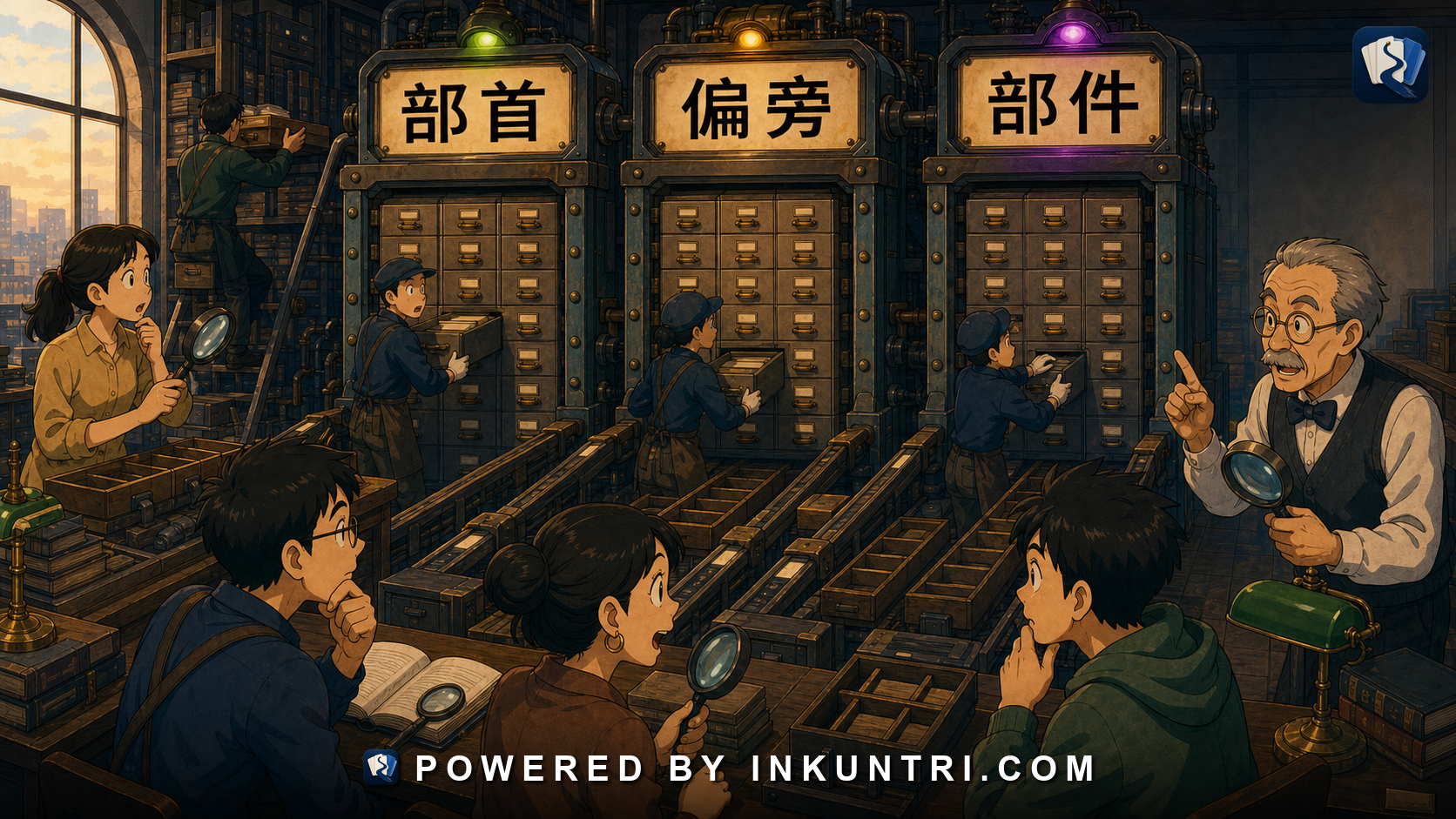
部首, 偏旁, 部件: three words learners should separate
Chinese discussions of character structure use several terms. They overlap in everyday speech, but serious learners should keep the distinctions available.
| Term | Practical learner definition | Example |
|---|---|---|
| 部首 | The indexing component under which a dictionary classifies a character. | 语 may be indexed under 讠. |
| 偏旁 | A visible side/part of a character, often used informally for components. | 语 has 讠 on the left and 吾 on the right. |
| 部件 | A structural component used to build or analyze characters. | 青 is a component in 清, 晴, 情, 请. |
A 部首 is always a kind of component in the broad practical sense, but not every component is the dictionary radical. In 请, both 讠 and 青 are important. But 讠 is the dictionary radical in many simplified dictionaries, while 青 is the phonetic component that helps explain the sound family.
请 = 讠 + 青If you label only 讠 and ignore 青, you miss the sound clue. If you label only 青 and ignore 讠, you miss the semantic field and lookup path. If you say both are “radicals,” you blur the system.
What 部首 actually do
部首 do at least five kinds of work.
1. They index characters in dictionaries
This is the core job. A dictionary needs a way to file characters.部首 provide categories. When combined with stroke count, they let readers find characters whose pronunciation they do not know.
This is not just an ancient habit. Modern standards and digital databases still record radical-stroke information because it remains useful for sorting, searching, education, and character processing.
2. They organize school learning
Children learning Chinese often learn common radical names:
三点水 氵
言字旁 讠
提手旁 扌
竖心旁 忄
走之底 辶
贝字旁 贝
双耳旁 阝
These names make characters discussable. A teacher can say “这个字是三点水” or “不要把言字旁写错.” That is a practical classroom technology.
3. They support memory
A component can give a learner a hook. If 清, 河, 湖, 洗, 流 all contain 氵, the learner begins to see a water/liquid family. If 说, 话, 语, 读, 请 contain 讠, the learner sees speech/language associations.
This does not prove the meaning of every character. It gives a memory route.
4. They help detect errors
Radical awareness helps you notice wrong characters.
晴 / 情 / 清 / 请These characters sound related but belong to different semantic domains:
| Character | Component | Domain clue |
|---|---|---|
| 晴 | 日 | sun/weather |
| 情 | 忄 | feeling/state of mind |
| 清 | 氵 | water/clear/liquid-associated history |
| 请 | 讠 | speech/request |
If you write 请天 instead of 晴天, the speech radical is a warning sign. If you write 情水 instead of 清水, the heart radical is a warning sign.
5. They introduce broad semantic fields
Radicals often preserve old semantic groupings.贝/貝 often points toward value, money, trade, or shell-derived meanings.肉/月 often points toward body and flesh.辶 often points toward movement or path.阝 can point toward terrain, place, city, or mound depending on side and history.
But “often” is not “always.” Radical knowledge is probabilistic.
The friendly cases
Start with radicals that usually help.
氵: water, liquid, wetness, flow
河 湖 海 洋 江 洗 流 清The component 氵 is historically related to 水. It commonly appears in characters connected with water, liquid, wetness, washing, rivers, seas, or flow.
| Character | Word example | Learner clue |
|---|---|---|
| 河 | 河流 | river/water domain |
| 湖 | 湖水 | lake/water domain |
| 海 | 大海 | sea/water domain |
| 洗 | 洗手 | washing/liquid domain |
| 清 | 清水 | clear water / clarity domain |
This is exactly the kind of radical pattern learners should use. It supports recognition and memory.
But do not turn it into a literal translation machine. 法 contains 氵, but modern 法 means law, method, or French-related in compounds such as 法国. The water component has historical explanation, but the modern learner should not translate 法 as “water-law.”
讠 / 言: speech, words, language
说 话 语 读 讲 请 认 记In simplified characters, 讠 is the side form of 言. It often points toward speech, words, language, reading, asking, recognizing, or recording.
| Character | Word example | Learner clue |
|---|---|---|
| 说 | 说话 | speech |
| 话 | 电话, 说话 | words/speech |
| 语 | 汉语, 语言 | language |
| 读 | 读书 | reading |
| 请 | 请问 | requesting/speech act |
Again, the radical helps. But 请 also has 青 as a phonetic component. That dual structure is the real win.
请 = 讠 semantic domain + 青 sound-family clue扌: hand and handled actions
打 拉 推 拿 把 找 按 排扌 is the side form of 手. It often appears in verbs involving the hand or physical manipulation.
| Character | Example | Domain |
|---|---|---|
| 打 | 打电话, 打球 | strike/do/perform actions, historically hand-related |
| 拉 | 拉门 | pull |
| 推 | 推开 | push |
| 找 | 找人 | search, action |
| 按 | 按钮 | press |
This is high-value for learners because many everyday verbs use 扌. It also helps distinguish visually similar characters.
忄 / 心: feelings and mental states
忙 快 怕 情 想 念 忘忄 is a side form of 心. Many characters with 忄 relate to feeling, thought, mental state, emotion, or attitude.
| Character | Example | Domain |
|---|---|---|
| 忙 | 很忙 | mental/active state |
| 快 | 快乐, 快速 | mood/speed extensions |
| 怕 | 害怕 | fear |
| 情 | 情况, 感情 | feeling/situation |
The full 心 can also appear below or inside characters:
想 念 忘 恭Learner warning: 忄 and 心 are related forms, but their position affects shape and stroke count. In dictionary lookup, the side form matters.
贝 / 貝: value, money, transaction
财 账 货 贵 费 购 贷 赚貝 originally depicts a shell, historically associated with value and exchange. In simplified characters, 貝 often becomes 贝.
| Character | Example | Domain |
|---|---|---|
| 财 | 财富 | wealth |
| 账 | 账单 | account |
| 货 | 货物 | goods |
| 贵 | 贵重, 很贵 | value/expensive |
| 费 | 学费 | expense |
| 购 | 购买 | purchase |
This is one of the most useful semantic families for modern readers because money, commerce, and administrative vocabulary are everywhere.
The tricky cases
The friendly cases are real, but they are not the whole system.
月 can be moon or meat-like
The component 月 is a major source of learner confusion.
In some characters, 月 is truly moon-related:
明 期 朔In many body-related characters, the 月-looking component represents 肉, flesh/meat, in a side form:
肝 胃 背 肩 胖 脚 腿 脸A beginner sees 月 and says “moon.” That may be wrong. In 胖, 脚, 肝, 胃, the practical domain is body/flesh, not the moon.
So instead of “月 always means moon,” learn:
A 月-shaped component may represent moon or flesh/body, depending on the character family and dictionary tradition.
This matters for reading and lookup. It also matters for not inventing absurd mnemonics.
阝 changes meaning by side
阝 is called 双耳旁 in school language, but left-side and right-side 阝 come from different sources.
Very broadly:
| Position | Historical source | Common domain associations |
|---|---|---|
| Left 阝 | 阜 | mound, slope, landform, terrain, obstruction |
| Right 阝 | 邑 | city, settlement, place, administrative unit |
Examples:
左阝: 院 险 陆 降
右阝: 都 郊 部 邮
The modern printed shape can look similar, but the historical and dictionary categories differ. Learners should notice side and position, not just shape.
辶 points to movement, but not every meaning is physical
辶 appears in many characters connected to movement, roads, going, passing, returning, or abstract extension:
这 进 过 还 远 近 送 选Sometimes the movement idea is obvious, as in 进, 过, 送. Sometimes it has become abstract or grammatical, as in 这 and 还. Use 辶 as a clue, not a definition.
青 as a sound component
The 青 series is one of the best examples for separating semantic radical from phonetic component.
清 晴 情 请 精These characters share 青, but their radicals differ.
| Character | Radical / semantic component | Phonetic component | Common word | Practical reading |
|---|---|---|---|---|
| 清 | 氵 | 青 | 清水, 清楚 | water/clarity domain |
| 晴 | 日 | 青 | 晴天 | sun/weather domain |
| 情 | 忄 | 青 | 感情, 情况 | feeling/state domain |
| 请 | 讠 | 青 | 请问 | speech/request domain |
| 精 | 米 | 青 | 精神, 精确 | refined/essence domain; not simply “rice” in modern meaning |
If you call 青 the radical in all of these, you miss what the dictionary is doing. If you ignore 青, you miss the sound relationship.
The real lesson is this:
A character can have one component that helps with meaning and another that helps with sound. The 部首 may be only one part of the story.
Why the same component changes function
A visible component can perform different roles in different characters.
It may be semantic:
氵 in 河: water domainIt may be phonetic:
青 in 请: sound-family clueIt may be both historically meaningful and practically opaque:
法 has 氵, but modern 法 is not learned by translating 氵 literally.It may be an indexing radical chosen by dictionary convention:
A dictionary may file a character under a component that is not the learner’s best meaning clue.It may be a shape component created by script evolution:
Modern regular script can preserve shapes whose original relationship is no longer transparent.This is why honest character teaching must avoid two extremes.
The first extreme says radicals are useless. That is false. Radicals are extremely useful for lookup, memory, and pattern recognition.
The second extreme says radicals explain everything. That is also false. They explain some things, point toward others, and merely index still others.
部首 in education
In Chinese-language education, radicals do several practical jobs.
Children learn radical names partly because they make writing teachable. A teacher can say:
“清”是三点水,不是日字旁。
“请”是言字旁,不是三点水。
“情”是竖心旁。
This builds visual discrimination. It also links characters into groups.
A radical lesson might group characters like this:
| Radical | Characters | Classroom association |
|---|---|---|
| 氵 | 江 河 湖 海 | water |
| 扌 | 打 拉 推 抬 | hand/action |
| 讠 | 说 话 语 读 | speech/language |
| 忄 | 怕 忙 快 情 | feeling/mental state |
| 贝 | 财 货 贵 费 | money/value |
This grouping is not advanced historical linguistics. It is practical school literacy. It gives children and learners a way to notice, compare, and remember.
The problem begins when educational shortcuts are mistaken for full explanations.
Where radical knowledge helps most
Lookup
This is the oldest and most direct use. If you can identify a likely radical, you can use a paper dictionary or radical index.
Recognition
Radicals help you distinguish similar characters.
请 清 情 晴A learner who sees only “qing sound” will mix these up. A learner who sees the semantic component has a better chance.
Vocabulary expansion
Radical families help you grow vocabulary by domain.
贝 → 财, 货, 贵, 费, 购, 贷, 赚This does not mean all words are transparent. It means the group is worth studying together.
Error detection
Wrong radical often signals wrong word.
清楚 is not 情楚.
晴天 is not 请天.
说话 is not 说画, unless you are talking about painting in another construction.
Handwriting
Radicals give repeatable stroke chunks. Writing 讠, 氵, 扌, 忄, 辶 correctly makes many characters easier to produce.
Reading unfamiliar text
When you meet a new character, the radical may tell you the broad semantic neighborhood. That can make a sentence less opaque even before dictionary lookup.
Where radical knowledge misleads
Over-literal interpretation
Do not translate every component into a tiny story.
法 ≠ water + go = lawStories can help memory, but they should not pretend to be etymology unless they are checked.
Ignoring phonetic components
If you focus only on the radical, you miss half the writing system. Many characters are phono-semantic compounds. Their phonetic components are often crucial for recognition and pronunciation guesses.
请 清 晴 情 all contain 青.The different radicals separate meaning fields; 青 links the sound family.
Assuming all radicals are equally productive
Some radicals are common and useful. Others are rare, historical, or mainly relevant for lookup. Learners should prioritize high-frequency radicals first.
High-value early radicals include:
氵 讠 扌 忄 亻 女 口 心 木 火 土 金/钅 贝/貝 辶 阝 艹 宀A rare Kangxi radical may matter for specialist lookup but not for early reading fluency.
Confusing simplified and traditional forms
Simplification changed many component forms:
言 → 讠
食 → 饣
金 → 钅
貝 → 贝
門 → 门
馬 → 马
A learner reading both simplified and traditional needs to connect these pairs. Otherwise the same radical family looks like two unrelated systems.
Treating dictionary radical as historical truth
A dictionary’s radical assignment is designed for lookup. It may not always match the most historically informative analysis. Modern standards may also assign radicals differently from older dictionaries.
This is normal. Dictionaries are tools, not sacred fossils.
A layered way to analyze characters
Instead of asking “what is the radical?” ask four questions.
1. What is the dictionary radical?
This helps lookup.
请 → often indexed under 讠2. What component gives a semantic hint?
This helps meaning and memory.
请 → 讠 suggests speech/request3. What component gives a phonetic hint?
This helps pronunciation families.
请 → 青 suggests a qing-like sound family4. What modern word should I actually learn?
This prevents character-level overthinking.
请问
请坐
请客
申请
This four-layer method is better than radical-only study.
Example bank: radicals in action
氵
河 湖 海 洗 流 清High practical value. Often water/liquid/flow-related. But check modern words.
讠
说 话 语 读 请 认 记High practical value. Speech, language, words, asking, recording, recognizing. Connect to traditional 言.
扌
打 拉 推 找 拿 按 排High practical value. Physical action, handling, manipulation; also extended uses.
忄 / 心
怕 忙 快 情 想 念 忘High practical value. Feeling, thought, mental state. Note side and bottom forms.
月 / 肉
明 月 期
肝 胃 胖 脚 脸
Do not assume moon. In body-part characters, the 月-looking form often represents 肉.
阝
院 险 陆 降
都 郊 部 邮
Notice left vs right. Shape similarity hides historical difference.
辶
进 过 还 远 近 送 选Movement/path often helps, but many meanings are abstract or grammaticalized.
贝 / 貝
财 账 货 贵 费 购 贷 赚Money/value family. Very useful for practical reading.
青 series
清 晴 情 请 精Do not call 青 the meaning radical in all of them. It is the shared phonetic component; the semantic components differ.
Learner workflow
Use this workflow for new characters.
Step 1: Identify the obvious components
Write what you see:
请: 讠 + 青
清: 氵 + 青
晴: 日 + 青
情: 忄 + 青
Step 2: Label likely semantic and phonetic roles
讠, 氵, 日, 忄 = domain clues
青 = sound-family clue
Step 3: Confirm in a dictionary
Check radical, pronunciation, and word examples.
Step 4: Learn words, not isolated symbols
请问
清楚
晴天
感情
精神
Step 5: Record traps
Make a small note:
请/清/晴/情: same phonetic 青, different radicals and meanings.This kind of note is more useful than a made-up mnemonic for every character.
What to memorize vs what to notice
Memorize high-frequency radical forms and names:
氵 三点水
讠 言字旁
扌 提手旁
忄 竖心旁
辶 走之底
贝 贝字旁
钅 金字旁
饣 食字旁
阝 双耳旁, but left/right matter
Notice recurring components and series:
青 → 清 晴 情 请 精
也 → 他 地 池 她
寺 → 诗 持 待 特
令 → 领 铃 冷 零
Do not memorize every radical table before reading. That is a poor use of time for most learners. Learn the high-frequency patterns, then let real texts reveal which components matter.
What to remember
部首 are not just meaning parts. They are dictionary categories, classroom labels, memory hooks, writing chunks, and sometimes semantic clues. The same visible component can be meaningful, phonetic, historical, decorative, or merely conventional for lookup.
The serious learner’s goal is not to worship radicals. It is to use them accurately: identify the lookup handle, notice the semantic domain, notice the phonetic series, and then learn real words.
Build an interactive component tree with four toggle layers.
Layer 1: Dictionary radical
Shows the radical under which a dictionary files the character.
请 → 讠
清 → 氵
晴 → 日
情 → 忄
Layer 2: Semantic hint
Shows the domain clue.
讠: speech/request
氵: water/clarity
日: sun/weather
忄: feeling/state
Layer 3: Phonetic component
Shows sound-family relationship.
青: qing-like phonetic seriesLayer 4: Not useful for literal meaning
Flags cases where component stories are likely to mislead.
法: do not teach as a literal water story for modern meaning.
月 in 胖: body/flesh, not moon.
Add a “confidence meter” rather than a binary answer:
| Character | Radical helps meaning? | Phonetic helps sound? | Notes |
|---|---|---|---|
| 河 | high | medium | 氵 useful; 可 phonetic historically. |
| 请 | high | high | 讠 + 青 both useful. |
| 法 | low for modern meaning | variable | historical explanation needed. |
| 胖 | medium if 月 understood as 肉 | low | Do not read 月 as moon. |
For production fact-checking, consult:
- GF 0011-2009, 《汉字部首表》: https://archive.org/details/GF0011-2009
- GF 0012-2009, 《GB13000.1字符集汉字部首归部规范》: https://archive.org/details/GF0012-2009
- Unicode Standard Annex #38, Unicode Han Database (Unihan): https://www.unicode.org/reports/tr38/
- 香港教育局, 《漢字的部首和部件》: https://www.edb.gov.hk/attachment/tc/curriculum-development/kla/chi-edu/second-lang/Radicals.pdf
- 教育部异体字字典 radical search interface: https://dict.variants.moe.edu.tw/searchR.jsp
- 教育部重編國語辭典修訂本 for radical-indexed examples: https://dict.revised.moe.edu.tw/
Related reading
Korean Hangul-Only Writing and the Invisible Hanja Layer
The reader sees why Korean text can look alphabetic while still containing a deep Sino-Korean vocabulary layer that matters for Chinese learners comparing the languages.
Two-Character Compounds: The Engine of Modern Chinese Vocabulary
The reader understands why disyllabic compounds dominate modern Mandarin and how their internal structures work.
A Research Stack for Chinese Learners: Dictionaries, Corpora, Standards, and Archives
The reader can assemble a serious Chinese research stack for verifying words, usage, standards, historical context, public documents, and domain terminology.
Literary Chinese in Today’s Signs, Names, and Slogans
The reader can spot literary or classical-style language embedded in modern public Chinese.
Chinese Internet Humor as Linguistic Compression
The reader can understand Chinese internet humor as a system of compression, quotation, rhythm, homophones, stance-taking, and shared cultural context.
How to Compare Mainland, Taiwan, and Diaspora Usage Responsibly
The reader can compare Mainland, Taiwan, Hong Kong, Singapore, and diaspora Chinese usage without collapsing everything into “same Chinese” or exaggerating difference.