
Reading Chinese Addresses Without Getting Lost
The reader can parse Chinese addresses from largest unit to smallest and understand the writing logic behind them.
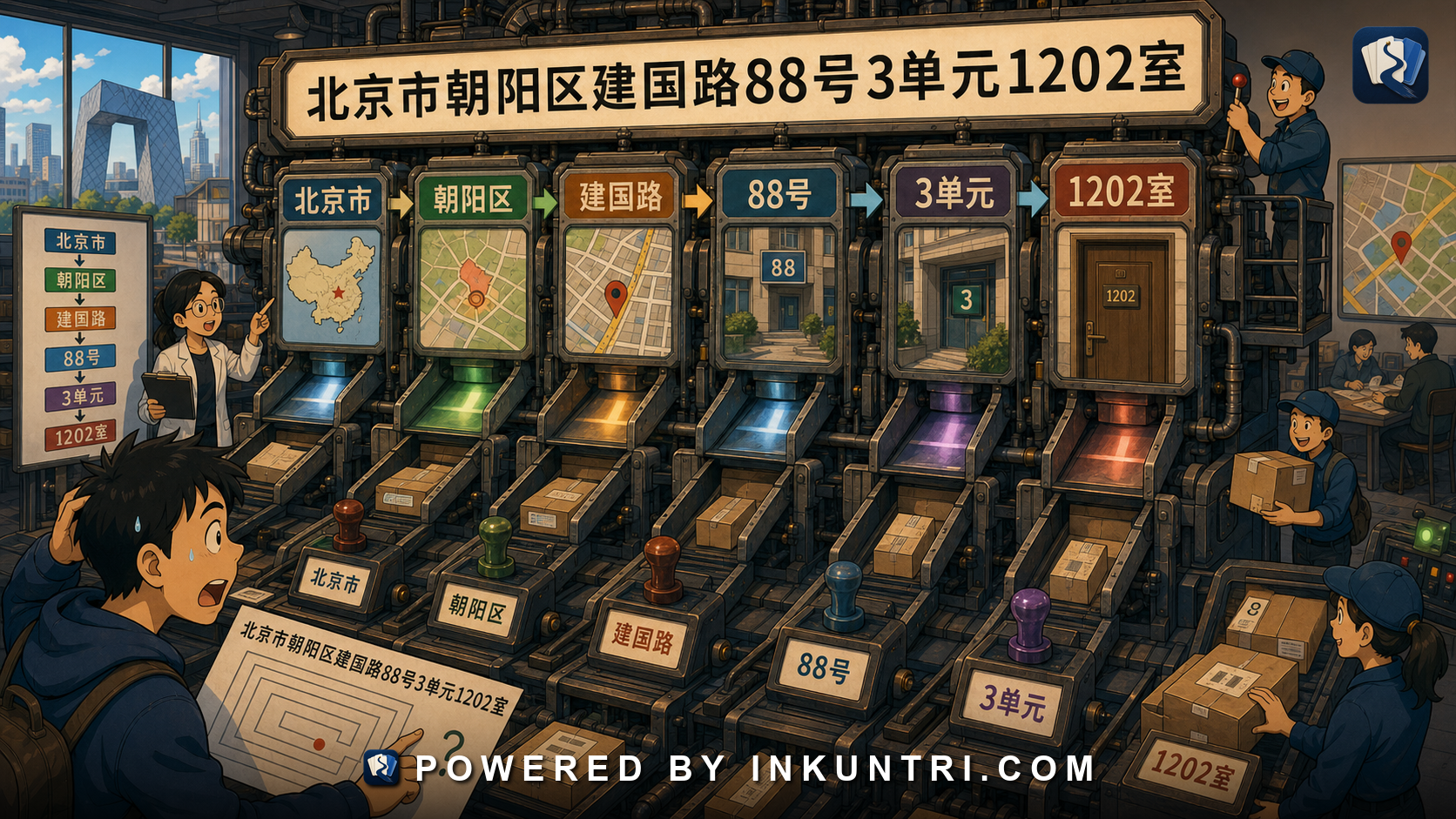
Recommended feature module: Address hierarchy tree: users paste an address, expand each layer, and reorder it into English-style format. Related internal articles: 017, 020, 032, 034, 035.
Summary for readers
A Chinese address is a map compressed into a line of text. The normal Chinese order moves from the largest geographic unit to the smallest: province or municipality, city, district or county, street or road, number, building, unit, room, and finally the person or organization.
English-language addresses often start with the door and move outward. Chinese addresses usually start with the larger place and move inward. Once you understand that hierarchy, a long address stops looking like a string of random characters.
The most important skill is not translation. It is segmentation: knowing where one layer ends and the next begins.
1. The big idea: largest to smallest
A Chinese address usually works like this:
large place → smaller place → local street/compound → building → unit → room → recipient
Example:
广东省深圳市南山区科技园科苑路15号3栋2单元601室
Parse:
- 广东省 — Guangdong Province
- 深圳市 — Shenzhen City
- 南山区 — Nanshan District
- 科技园 — Science and Technology Park / Technology Park area
- 科苑路 — Keyuan Road
- 15号 — No. 15
- 3栋 — Building 3
- 2单元 — Unit 2 / Entrance 2
- 601室 — Room/Apartment 601
A natural English-style rendering would reverse much of the order:
Room 601, Unit 2, Building 3, No. 15 Keyuan Road, Science and Technology Park, Nanshan District, Shenzhen, Guangdong.
The Chinese version guides you inward. The English version often guides you outward.
2. Address components as a hierarchy
Not every address contains every layer, but the following ladder is the basic mental model.
| Layer | Common labels | Example | Notes |
|---|---|---|---|
| Country | 中国 | 中国 | Often omitted for domestic use. Needed internationally. |
| Province-level unit | 省, 自治区, 直辖市, 特别行政区 | 广东省, 北京市 | 北京市, 上海市, 天津市, 重庆市 are province-level municipalities. |
| Prefecture/city level | 市, 州, 地区, 盟 | 深圳市, 成都市, 延边州 | Not always present under municipalities. |
| County/district level | 区, 县, 县级市, 旗 | 南山区, 朝阳区, 阳朔县, 伊金霍洛旗 | Very important for delivery and navigation. |
| Township/subdistrict | 镇, 乡, 街道 | 高田镇, 粤海街道 | Often omitted in urban shorthand, included in formal or courier addresses. |
| Community/village | 社区, 村, 居委会 | 科技园社区, 凤楼村 | Common in residential and rural addresses. |
| Road/lane/alley | 路, 街, 大道, 巷, 弄, 胡同 | 建国路, 南京东路, 愚园路某弄 | Road label may contain direction words. |
| Street number | 号 | 88号, 15号 | Door/street/premises number. |
| Compound/building | 小区, 花园, 园, 苑, 大厦, 栋, 幢, 座, 楼 | 某小区3栋, A座 | Residential and commercial compounds vary. |
| Unit/floor/room | 单元, 层, 楼, 室, 房, 号房 | 2单元601室 | Position determines whether 楼 means building or floor. |
| Recipient | 收件人姓名, 单位名 | 张三, 某公司 | Often followed by phone number in courier contexts. |
The hierarchy matters more than any single English translation.
3. Why Chinese address order feels backward to English readers
English addresses often begin with the most specific location:
Room 601, Building 3, 15 Keyuan Road, Nanshan District, Shenzhen, Guangdong, China
Chinese addresses usually begin with the broader location:
中国广东省深圳市南山区科苑路15号3栋2单元601室
Neither order is inherently more logical. Each reflects a convention. The Chinese convention is especially helpful when moving from region to city to district to road to door.
The danger for learners is half-reversing the address. For example, a learner may move the room number to the front but leave province and city in Chinese order, creating a confusing hybrid. If you are writing for domestic Chinese delivery, use the Chinese address as provided. If you are writing an English or Pinyin international address, follow the carrier or postal format and keep all components clear.
4. The address words that matter most
号: the number marker
号 marks a number: street number, building number, room number, document number, phone number, or general numbered item depending on context.
In addresses:
- 建国路88号 — No. 88 Jianguo Road
- 科苑路15号 — No. 15 Keyuan Road
- 601号房 — Room 601
Do not ignore 号. It often marks the transition from named place to numbered location.
栋 and 幢: building block
栋 and 幢 often mark a building within a residential compound or campus.
- 3栋 — Building 3
- 5幢 — Building 5
In ordinary Mainland residential addresses, 栋 is very common. 幢 appears too, especially in formal or regional contexts.
单元: unit or entrance section
单元 usually marks the section/entrance of an apartment building.
- 2单元 — Unit 2 / Entrance 2
A building may have several stairwell entrances, each with its own unit number. If you omit 单元, the courier may reach the right building and still fail to find the apartment.
室: room, office, apartment unit
室 is a final precision marker.
- 601室 — Room/Apartment 601
- 1208室 — Room 1208 / Office 1208
In office towers, 室 may be an office suite. In residential buildings, it may be the apartment unit.
楼: building or floor
楼 is context-sensitive.
- 3号楼 — Building No. 3
- 6楼 — sixth floor
- A楼 — Building A
- 教学楼 — teaching building
If 楼 appears with a number before 室, it may mean floor: 6楼601室. If it appears as 3号楼 or A楼, it is more likely a building.
层: floor
层 is a clearer floor marker than 楼 in formal addresses.
- 10层 — 10th floor
- 3层302室 — Room 302 on the third floor
In everyday speech, people may say 楼 for floor; in written building directories, 层 is common.
小区: residential compound
小区 is one of the most important real-life address terms. It often means a residential compound or community, not a “small district” in the administrative sense.
- 阳光花园小区 — Sunshine Garden residential compound
- 某某小区东门 — east gate of a residential compound
For couriers and ride-hailing, the compound name and gate may matter as much as the street number.
门: gate or entrance
门 can mark gates and entrances:
- 东门 — east gate
- 南门 — south gate
- 北门 — north gate
- 1号门 — Gate 1
In a large campus, hospital, park, or residential compound, the gate is often the practical meeting point.
5. Four complete address walkthroughs
Address 1: 北京市朝阳区建国路88号
Parse:
- 北京市 — Beijing Municipality
- 朝阳区 — Chaoyang District
- 建国路 — Jianguo Road
- 88号 — No. 88
Natural reading:
No. 88 Jianguo Road, Chaoyang District, Beijing.
Notes:
- 北京市 is already a province-level municipality, so no province appears before it.
- 朝阳区 is a district; do not omit it if there are many similarly named roads or buildings.
Address 2: 上海市浦东新区世纪大道100号
Parse:
- 上海市 — Shanghai Municipality
- 浦东新区 — Pudong New Area
- 世纪大道 — Century Avenue
- 100号 — No. 100
Natural reading:
No. 100 Century Avenue, Pudong New Area, Shanghai.
Notes:
- 新区 literally means “new area,” but 浦东新区 is an official place name. Treat the full name as a unit.
- 大道 is a road-type suffix similar to avenue or boulevard.
Address 3: 广东省深圳市南山区科技园科苑路15号3栋2单元601室
Parse:
- 广东省 — Guangdong Province
- 深圳市 — Shenzhen City
- 南山区 — Nanshan District
- 科技园 — Technology Park area
- 科苑路 — Keyuan Road
- 15号 — No. 15
- 3栋 — Building 3
- 2单元 — Unit 2
- 601室 — Room/Apartment 601
Natural reading:
Room 601, Unit 2, Building 3, No. 15 Keyuan Road, Technology Park, Nanshan District, Shenzhen, Guangdong.
Notes:
- 科技园 may function as an area, park, or compound-like locality depending on context.
- The final building/unit/room sequence is essential.
Address 4: 广西壮族自治区桂林市阳朔县高田镇凤楼村
Parse:
- 广西壮族自治区 — Guangxi Zhuang Autonomous Region
- 桂林市 — Guilin City
- 阳朔县 — Yangshuo County
- 高田镇 — Gaotian Town
- 凤楼村 — Fenglou Village
Natural reading:
Fenglou Village, Gaotian Town, Yangshuo County, Guilin City, Guangxi Zhuang Autonomous Region.
Notes:
- Rural addresses may not behave like urban street-number addresses.
- Village, group, landmark, recipient phone number, and local knowledge may be important.
6. Practical complications that textbooks often skip
1. Residential compounds can dominate the real address
In many cities, the practical address is not just the road and number. It is the compound, gate, building, unit, and room.
A courier may care about:
- 小区名 — compound name
- 几号门 — which gate
- 几栋 / 几号楼 — which building
- 几单元 — which unit entrance
- 几楼 / 几室 — which floor and room
- 电话 — phone number
A ride-hailing driver may ask you to meet at 东门 or 南门 because the official address points to the compound, not to your exact standing location.
2. Campuses and hospitals have internal geography
Large institutions have their own internal address logic:
- 校区 — campus
- 教学楼 — teaching building
- 实验楼 — laboratory building
- 门诊楼 — outpatient building
- 住院部 — inpatient department
- A座 / B座 — Tower A / Tower B
- 东门 / 西门 — east/west gate
The street address gets you to the institution. Internal signs get you to the actual room.
3. Rural addresses may use village groups and landmarks
A rural address may include:
- 村 — village
- 组 — group/neighborhood team
- 屯, 庄, 湾, 沟, 坝, 寨 — local settlement terms
- near a school, bridge, shop, temple, or committee office
Do not expect every rural address to have a road number like an urban address.
4. Development zones and parks can be address units
Names like 开发区, 高新区, 科技园, 产业园, and 工业园 may function as practical locality labels.
Examples:
- 高新区 — high-tech zone
- 经济技术开发区 — economic and technological development zone
- 科技园 — science and technology park
- 工业园 — industrial park
These may or may not align neatly with ordinary district names. In logistics, include them if they are part of the address.
5. Old names and local names still circulate
A road, district, market, gate, or neighborhood may have an official name and a commonly used local name. Older residents, taxi drivers, restaurant staff, and map apps may not all use the same version. For historical texts, the older name may be exactly what you need. For delivery, use the current address from a map or the recipient.
7. How to rewrite a Chinese address into English-style order
Use this carefully. The goal is not to produce a beautiful translation; the goal is to preserve deliverability.
Chinese:
广东省深圳市南山区科技园科苑路15号3栋2单元601室 张伟 收
Step 1: Segment the address.
- 广东省
- 深圳市
- 南山区
- 科技园
- 科苑路15号
- 3栋
- 2单元
- 601室
- 张伟
Step 2: Reverse from smallest practical unit outward.
Zhang Wei Room 601, Unit 2, Building 3 No. 15 Keyuan Road, Science and Technology Park Nanshan District, Shenzhen, Guangdong P.R. China
Step 3: Preserve ambiguous proper names.
Do not get too creative. 科苑路 can be written as Keyuan Road. 科技园 can be Science and Technology Park or Kejiyuan/Technology Park depending on local convention. If the recipient gives a preferred English or Pinyin address, use it.
Step 4: Include phone number for courier contexts.
Domestic Chinese delivery often depends on phone contact. For international mail, follow the carrier’s rules, but do not remove the recipient phone if it is requested.
8. Chinese characters, Pinyin, or English?
For addresses in Mainland China, Chinese characters are usually the most reliable form for domestic delivery. Pinyin or English may be useful for international senders and systems that cannot handle Chinese, but it can introduce ambiguity.
Consider 朝阳区. In Pinyin it is Chaoyang Qu. In English it may be Chaoyang District. Both can work, but a Chinese-character address is clearer to local couriers.
A practical format for international use is often:
- recipient name
- room/unit/building
- street number and road
- district/city/province/postcode
- country in an internationally recognized language
When possible, include the Chinese address as provided by the recipient, even if you also include a romanized version.
9. Address abbreviations and shorthand
Chinese addresses often use shorthand, especially in apps, forms, and messages.
| Short form | Full/common meaning | Example |
|---|---|---|
| 省 | province | 粤省 is rare in formal address; 广东省 is normal. |
| 市 | city / municipality | 深圳市 |
| 区 | district | 南山区 |
| 县 | county | 阳朔县 |
| 镇 | town | 高田镇 |
| 街道 | subdistrict | 粤海街道 |
| 路 | road | 科苑路 |
| 号 | number | 15号 |
| 栋 | building | 3栋 |
| 单元 | unit | 2单元 |
| 室 | room | 601室 |
| 收 | received by / care of recipient | 张伟收 |
| 转 | transfer/care of | 李明转张伟, context-dependent |
You may also see province or city abbreviations in other contexts, such as 京 for Beijing or 沪 for Shanghai, but ordinary addresses usually use full names unless space is constrained or context is clear.
10. A field checklist for not getting lost
When someone sends you a Chinese address, mark it in this order:
- Province-level unit: Is there a 省, 自治区, or municipality like 北京市/上海市?
- City: Is there a 市 below the province?
- District/county: Find 区, 县, 县级市, 旗.
- Town/subdistrict: Look for 镇, 乡, 街道.
- Road or locality: Look for 路, 街, 大道, 巷, 弄, 胡同, 科技园, 开发区, 小区.
- Number: Find 号.
- Building: Find 栋, 幢, 号楼, 座.
- Unit/floor/room: Find 单元, 楼, 层, 室.
- Gate or entrance: Look for 东门, 南门, 北门, 西门, 1号门.
- Recipient and phone: Keep them attached to the address.
If any middle layer is missing, do not panic. Real addresses omit layers when context makes them obvious. But for delivery, more complete is usually safer.
11. Practice drills
Drill 1: Mark the layers
Address:
浙江省杭州市西湖区文三路90号
Parse:
- 浙江省 — province
- 杭州市 — city
- 西湖区 — district
- 文三路 — road
- 90号 — number
Natural English-style order:
No. 90 Wensan Road, Xihu District, Hangzhou, Zhejiang.
Drill 2: Find the building/unit/room
Address:
成都市武侯区人民南路四段12号A座18层1803室
Parse:
- 成都市 — Chengdu City
- 武侯区 — Wuhou District
- 人民南路四段 — Section 4, Renmin South Road
- 12号 — No. 12
- A座 — Tower/Block A
- 18层 — 18th floor
- 1803室 — Room 1803
Natural reading:
Room 1803, 18th Floor, Tower A, No. 12, Section 4 Renmin South Road, Wuhou District, Chengdu.
Drill 3: Identify rural hierarchy
Address:
云南省大理白族自治州大理市喜洲镇周城村
Parse:
- 云南省 — Yunnan Province
- 大理白族自治州 — Dali Bai Autonomous Prefecture
- 大理市 — Dali City
- 喜洲镇 — Xizhou Town
- 周城村 — Zhoucheng Village
Natural reading:
Zhoucheng Village, Xizhou Town, Dali City, Dali Bai Autonomous Prefecture, Yunnan.
Drill 4: Spot the Shanghai lane marker
Address:
上海市徐汇区武康路某弄某号
Parse:
- 上海市 — Shanghai Municipality
- 徐汇区 — Xuhui District
- 武康路 — Wukang Road
- 某弄 — lane number
- 某号 — house/building number
Natural reading:
No. X, Lane X, Wukang Road, Xuhui District, Shanghai.
12. What to memorize first
Start with these address characters and words:
Administrative layers
省, 市, 区, 县, 镇, 乡, 街道, 村, 社区, 自治区, 自治州, 旗
Urban navigation
路, 街, 大道, 巷, 弄, 胡同, 号, 门, 东门, 南门, 西门, 北门
Building precision
小区, 大厦, 栋, 幢, 座, 楼, 层, 单元, 室, 房
Delivery context
收件人, 电话, 邮编, 地址, 收, 转, 快递, 外卖
These words are more valuable than a long list of famous landmarks. They let you parse unfamiliar addresses wherever you are.
Module goal: Turn a full Chinese address into a visual hierarchy and teach users how to reorder it for English-style mailing.
Input examples:
- 北京市朝阳区建国路88号
- 上海市浦东新区世纪大道100号
- 广东省深圳市南山区科技园科苑路15号3栋2单元601室
- 广西壮族自治区桂林市阳朔县高田镇凤楼村
User actions:
- Paste or choose an address.
- Highlight suffixes.
- Assign each component to a layer.
- Expand/collapse hierarchy.
- Toggle Chinese order and English-style order.
- Add recipient, phone, postcode, and country.
Feedback:
- Warn if a building/unit/room sequence is incomplete.
- Explain special labels such as 自治区, 新区, 旗, 弄, 胡同, 小区.
- Produce a clean segmented version for reading practice.
Advanced mode: Add a courier mode that asks for gate, phone number, and map pin; add a postal mode that asks for postcode and country line.
Editorial notes for Article 021
- Keep practical examples concrete. Address literacy is easier when readers can see exact strings being segmented.
- Avoid promising universal delivery success. Real-world delivery depends on current maps, local naming, carrier systems, phone contact, and recipient instructions.
- When discussing international mail, defer to postal/carrier requirements. The article should teach reading logic, not replace official mailing instructions.
- Good visual aid: large-to-small address ladder plus a reversible English-order view.
Batch-level source and verification notes
These drafts were developed from the uploaded Inkuntri outline file for articles 019–021 and checked against stable reference material for terminology and address/place-name framing. The article body intentionally remains learner-facing rather than citation-heavy; these notes are for editorial review and fact-checking.
- Chinese cooking-method terminology was checked against culinary-method references, including World Federation of Chinese Catering Industry material surfaced through Google Arts & Culture’s Chinese cooking technique explainer. The article uses cooking terms as menu-literacy clues, not as exhaustive culinary definitions.
- Dish-name explanations such as 鱼香肉丝, 宫保鸡丁, 麻婆豆腐, 红烧牛肉, 清蒸鲈鱼, 干锅花菜, 酸辣汤, and 炒饭 should be reviewed against the house style of any restaurant examples used in final publication.
- Avoid food photography unless licensing is clear. Prefer original diagrams.
- Administrative-division terminology was checked against GB/T 2260-2007, Codes for the administrative divisions of the People’s Republic of China, and official PRC geoname-management sources.
- The 2022 revised Regulations on the Administration of Geographical Names define regulated geonames broadly, including natural geographic entities, administrative divisions, village/resident committee localities, street/lane names, residential areas and buildings with important location significance, and other geographic entities.
- National Bureau of Statistics rules for statistical division codes distinguish county-and-above administrative codes from below-county codes; this supports the article’s distinction between administrative hierarchy and smaller locality labels, but the article does not attempt to teach statistical coding.
- Address-order framing was checked against Universal Postal Union China addressing guidance: Chinese-character addresses begin with the largest geographic component and end with the smallest/addressee; Roman-letter versions for the same address may use smallest-to-largest ordering for international mail.
- UPU examples also support practical labels such as door/room, floor, building, residential area, road, district, postcode, province, and country.
- The article’s examples are pedagogical and should not be treated as live delivery addresses.
Reference links for editorial staff
- GB/T 2260-2007, 全国标准信息公共服务平台: https://openstd.samr.gov.cn/bzgk/std/newGbInfo?hcno=C9C488FD717AFDCD52157F41C3302C6D
- 地名管理条例, 国务院令第753号 / 中国政府网 mirror: https://www.mee.gov.cn/zcwj/gwywj/202204/t20220421_975554.shtml
- 国家统计局, 统计用区划代码和城乡划分代码编制规则: https://www.stats.gov.cn/sj/tjbz/gjtjbz/202302/t20230213_1902741.html
- Universal Postal Union, China addressing guidance PDF: https://www.upu.int/UPU/media/upu/PostalEntitiesFiles/addressingUnit/chnEn.pdf
- Google Arts & Culture, Chinese cooking techniques explainer: https://artsandculture.google.com/story/UwWRhjdHD8k_hA?hl=zh-CN
Related reading
Building a Mandarin Reader Workflow From News, Documents, and Literature
The reader can build a sustainable Mandarin reading workflow that combines current news, practical documents, essays, and literature without drowning in vocabulary.
CJK Numerals, Counters, and Measure Words: Similar Surface, Different Grammar
The reader can compare Chinese measure words with Japanese counters and Korean counters without flattening the three systems into one.
Influencer Commerce Vocabulary in Mandarin
The reader can understand Chinese influencer-commerce language across live streams, product promotion, affiliate links, commissions, and buyer claims.
The Vocabulary of Chinese Food Culture: 烹, 炒, 炖, 蒸, 煮
The reader can read menus and food writing through cooking verbs, ingredient categories, regional terms, and texture vocabulary.
Memes, Homophones, and Political Caution in Chinese Online Culture
The reader can understand how Chinese online users use homophones, euphemisms, abbreviations, and layered jokes to manage sensitivity, moderation, and community recognition.
Chinese Characters Abroad: Hanzi, Kanji, Hanja, and the Shared Scriptworld
The reader understands the shared character tradition across China, Japan, and Korea while respecting each language’s independent grammar, pronunciation, and history.