
Polyphonic Characters in Real Sentences: 行, 重, 乐, 长, and Beyond
The reader can use sentence context to disambiguate common polyphonic characters in authentic reading.
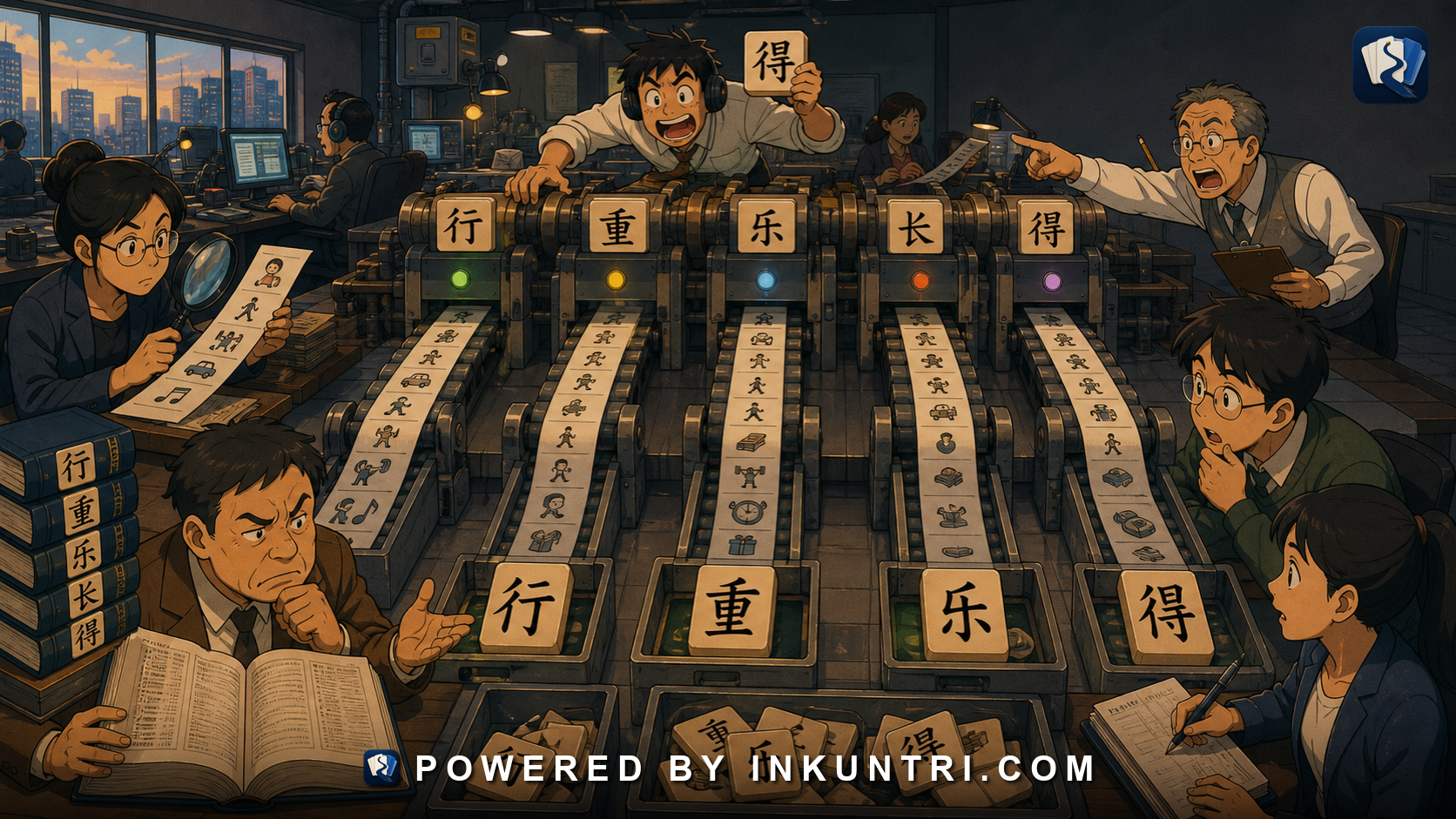
Core examples: 银行, 行人, 行业, 重新, 重量, 音乐, 快乐, 长城, 长大, 得到/得 děi/得 de.
Dictionary lists are not enough
A dictionary can tell you that 行 is read xíng or háng. It can tell you that 重 is read zhòng or chóng. It can tell you that 乐 is read lè or yuè, 长 is read cháng or zhǎng, and 得 is read de, dé, or děi.
But a dictionary list does not read the sentence for you.
Real reading happens under pressure. You see a headline, subtitle, sign, menu item, school notice, business card, or text message. There is no pause where the character politely announces its reading. You must use surrounding words.
That is why 多音字 should be trained in sentences, not only in character tables.
Consider this sentence:
银行行长说,这个方案可行。A learner may freeze because 行 appears three times. But the sentence is completely readable once the words are segmented:
银行 / 行长 / 说,/ 这个 / 方案 / 可行。Now the readings are clear:
| Word | Pronunciation | Meaning |
|---|---|---|
| 银行 | yínháng | bank |
| 行长 | hángzhǎng | bank president; head of a bank/line |
| 可行 | kěxíng | feasible |
The sentence is:
Yínháng hángzhǎng shuō, zhège fāng'àn kěxíng.
The bank president said this plan is feasible.
The character 行 did not become easier. The sentence became easier once we stopped reading character by character.
The working rule: mark word boundaries first
When a polyphonic character appears, the first move is not pronunciation. The first move is segmentation.
Use this protocol:
1. Locate the suspicious character.
2. Identify the word or phrase it belongs to.
3. Ask what that word means.
4. Choose the reading attached to that word family.
5. Confirm if the word is unfamiliar, formal, or a name.
That sequence matters. If you skip word boundaries, you guess from a single character and usually guess the reading you learned first.
A bad workflow:
I see 行. I learned xíng first. I will say xíng.A good workflow:
I see 行. It is part of 银行. 银行 is bank. Read háng.The rest of this article applies that method to the high-frequency characters learners actually misread.
Case study 1: 行
行 is a perfect test of whether you are reading words or characters.
The xíng family
The xíng reading often appears in words related to movement, action, conduct, possibility, or acceptability.
| Sentence | Segmentation | Reading | Explanation |
|---|---|---|---|
| 行人请走人行道。 | 行人 / 请 / 走 / 人行道 | xíng | 行人 and 人行道 relate to walking. |
| 这个办法可行。 | 这个 / 办法 / 可行 | xíng | 可行 means feasible. |
| 他的行为很奇怪。 | 他的 / 行为 / 很 / 奇怪 | xíng | 行为 means behavior/conduct. |
| 明天我们去旅行。 | 明天 / 我们 / 去 / 旅行 | xíng | 旅行 is travel. |
| 这样不行。 | 这样 / 不行 | xíng | 不行 means not okay/will not work. |
Example:
行人请走人行道。
Xíngrén qǐng zǒu rénxíngdào.
Pedestrians, please use the sidewalk.
Both 行 characters are xíng because both belong to walking/movement words.
The háng family
The háng reading often appears in words related to lines, rows, trades, industries, professions, and banks.
| Sentence | Segmentation | Reading | Explanation |
|---|---|---|---|
| 我在银行工作。 | 我 / 在 / 银行 / 工作 | háng | 银行 means bank. |
| 这个行业竞争很激烈。 | 这个 / 行业 / 竞争 / 很 / 激烈 | háng | 行业 means industry. |
| 他是这一行的行家。 | 他 / 是 / 这一行 / 的 / 行家 | háng | 行 and 行家 mean line/trade/expert. |
| 请把名字写在第一行。 | 请 / 把 / 名字 / 写在 / 第一行 | háng | 行 means line/row of text. |
| 同行之间也要互相学习。 | 同行 / 之间 / 也 / 要 / 互相 / 学习 | háng | 同行 means people in the same trade. |
Example:
请把地址写在第二行。
Qǐng bǎ dìzhǐ xiě zài dì-èr háng.
Please write the address on the second line.
Here 行 is not walking. It is a line in written layout, so háng.
A mixed 行 sentence
银行行长认为,这项改革可行,但整个行业还需要时间。Segment:
银行 / 行长 / 认为,/ 这项 / 改革 / 可行,/ 但 / 整个 / 行业 / 还 / 需要 / 时间。Read:
Yínháng hángzhǎng rènwéi, zhè xiàng gǎigé kěxíng, dàn zhěnggè hángyè hái xūyào shíjiān.Breakdown:
| Word | Reading | Why |
|---|---|---|
| 银行 | yínháng | bank |
| 行长 | hángzhǎng | head of a bank/line |
| 可行 | kěxíng | feasible |
| 行业 | hángyè | industry |
A reader who pronounces every 行 as xíng will miss the institutional vocabulary. A reader who pronounces every 行 as háng will miss the feasibility word. The sentence itself decides.
Case study 2: 重
重 has two major families that are usually easy once you see the word.
The zhòng family: heavy, important, serious
| Sentence | Word | Reading | Meaning |
|---|---|---|---|
| 这个箱子很重。 | 重 | zhòng | heavy |
| 这是一个重要问题。 | 重要 | zhòngyào | important |
| 他很重视这件事。 | 重视 | zhòngshì | take seriously; attach importance to |
| 这次事故很严重。 | 严重 | yánzhòng | serious |
| 请注意重量限制。 | 重量 | zhòngliàng | weight |
| 这里是军事重地。 | 重地 | zhòngdì | important/restricted place |
Example:
请不要携带超重行李。
Qǐng búyào xiédài chāozhòng xíngli.
Please do not carry overweight luggage.
重 in 超重 is zhòng because it means weight/heaviness.
The chóng family: again, repeat, layer
| Sentence | Word | Reading | Meaning |
|---|---|---|---|
| 请重新填写。 | 重新 | chóngxīn | again; anew |
| 这个词重复了。 | 重复 | chóngfù | repeat; duplicate |
| 我们明天重来一次。 | 重来 | chónglái | do again |
| 文件需要重写。 | 重写 | chóngxiě | rewrite |
| 两个图层重叠了。 | 重叠 | chóngdié | overlap; stack |
Example:
表格填错了,请重新填写。
Biǎogé tián cuò le, qǐng chóngxīn tiánxiě.
The form was filled out incorrectly. Please fill it in again.
重 in 重新 is chóng because the meaning is “again.”
A mixed 重 sentence
重庆重新启动重大项目。Segment:
重庆 / 重新 / 启动 / 重大 / 项目。Read:
Chóngqìng chóngxīn qǐdòng zhòngdà xiàngmù.
Chongqing restarted major projects.
Breakdown:
| Word | Reading | Why |
|---|---|---|
| 重庆 | Chóngqìng | established place name |
| 重新 | chóngxīn | again/anew |
| 重大 | zhòngdà | major/important |
The character appears three times. The readings are not chosen by position. They are chosen by words.
Case study 3: 乐
乐 is a learner-friendly 多音字 because the main split is clean.
The lè family: happiness and enjoyment
| Sentence | Word | Reading | Meaning |
|---|---|---|---|
| 祝你生日快乐。 | 快乐 | kuàilè | happy |
| 他一直很乐观。 | 乐观 | lèguān | optimistic |
| 我很乐意帮忙。 | 乐意 | lèyì | be willing; glad to |
| 孩子们玩得很快乐。 | 快乐 | kuàilè | happy/joyful |
| 他以助人为乐。 | 乐 | lè | take pleasure in |
Example:
我很乐意帮你。
Wǒ hěn lèyì bāng nǐ.
I’d be happy to help you.
乐 is lè because the word is about willingness or pleasure.
The yuè family: music
| Sentence | Word | Reading | Meaning |
|---|---|---|---|
| 我喜欢中国音乐。 | 音乐 | yīnyuè | music |
| 她会演奏很多乐器。 | 乐器 | yuèqì | musical instrument |
| 这个乐队很有名。 | 乐队 | yuèduì | band; orchestra group |
| 他在音乐学院学习。 | 音乐 | yīnyuè | music |
| 这首民乐很好听。 | 民乐 | mínyuè | folk/traditional music |
Example:
这个乐队的音乐很快乐。
Zhège yuèduì de yīnyuè hěn kuàilè.
This band’s music is very cheerful.
This sentence contains both readings:
| Word | Reading |
|---|---|
| 乐队 | yuèduì |
| 音乐 | yīnyuè |
| 快乐 | kuàilè |
A learner may be tempted to pronounce every 乐 in the sentence the same way. The word families prevent that.
Case study 4: 长
长 is another high-frequency character with a mostly clean meaning split.
The cháng family: long and lasting
| Sentence | Word | Reading | Meaning |
|---|---|---|---|
| 长城很有名。 | 长城 | Chángchéng | Great Wall |
| 这条路很长。 | 长 | cháng | long |
| 我们需要长期合作。 | 长期 | chángqī | long-term |
| 请比较长短。 | 长短 | chángduǎn | length; long and short |
| 长时间看屏幕会累。 | 长时间 | cháng shíjiān | a long time |
Example:
他在中国住了很长时间。
Tā zài Zhōngguó zhù le hěn cháng shíjiān.
He lived in China for a long time.
长 describes duration, so cháng.
The zhǎng family: grow, leader, senior
| Sentence | Word | Reading | Meaning |
|---|---|---|---|
| 孩子长大了。 | 长大 | zhǎngdà | grow up |
| 植物生长很快。 | 生长 | shēngzhǎng | grow |
| 他是我们学校的校长。 | 校长 | xiàozhǎng | principal |
| 家长需要签字。 | 家长 | jiāzhǎng | parent/guardian |
| 我很尊敬长辈。 | 长辈 | zhǎngbèi | elder generation |
Example:
这位校长在学校工作了很长时间。
Zhè wèi xiàozhǎng zài xuéxiào gōngzuò le hěn cháng shíjiān.
This principal has worked at the school for a long time.
The sentence contains both readings:
| Word | Reading | Why |
|---|---|---|
| 校长 | xiàozhǎng | school leader |
| 长时间 | cháng shíjiān | long duration |
Again, words decide.
Case study 5: 得
得 deserves special treatment because the readings are grammatical.
得 de: structural particle
得 is read neutral-tone de when it introduces a complement after a verb or adjective.
| Sentence | Structure | Reading |
|---|---|---|
| 他说得很清楚。 | 说 + 得 + 很清楚 | de |
| 她跑得很快。 | 跑 + 得 + 很快 | de |
| 我累得不行。 | 累 + 得 + 不行 | de |
| 这件事办得不错。 | 办 + 得 + 不错 | de |
Example:
他说得很慢,所以我听懂了。
Tā shuō de hěn màn, suǒyǐ wǒ tīngdǒng le.
He spoke slowly, so I understood.
得 is not “get” here. It is a structural particle.
得 dé: get, obtain, result
得 is read dé in words where it means get, obtain, gain, or produce a result.
| Sentence | Word | Reading |
|---|---|---|
| 他得到了机会。 | 得到 | dédào |
| 这个队得分很高。 | 得分 | défēn |
| 她获得了奖学金。 | 获得 | huòdé |
| 他很得意。 | 得意 | déyì |
Example:
他终于得到了大家的认可。
Tā zhōngyú dédào le dàjiā de rènkě.
He finally received everyone’s recognition.
得 is part of 得到, so dé.
得 děi: must, have to
得 is read děi in colloquial speech when it means must or have to.
| Sentence | Reading | Meaning |
|---|---|---|
| 我得走了。 | děi | I have to leave. |
| 你得小心。 | děi | You have to be careful. |
| 这事儿得问老师。 | děi | We need to ask the teacher about this. |
| 明天得早点儿起。 | děi | Tomorrow I have to get up earlier. |
Example:
我明天得早起,但是今天累得不行。
Wǒ míngtiān děi zǎoqǐ, dànshì jīntiān lèi de bùxíng.
I have to get up early tomorrow, but today I’m exhausted.
Two 得 characters, two readings:
| Word/function | Reading | Why |
|---|---|---|
| 得早起 | děi | must/have to |
| 累得不行 | de | complement marker |
Case study 6: 好 and 还
好 and 还 are useful because learners often learn their common readings early and then miss alternate readings in familiar-looking words.
好 hǎo vs hào
| Sentence | Reading | Meaning |
|---|---|---|
| 这是一个好问题。 | hǎo | good |
| 这家店很好吃。 | hǎo | good/tasty |
| 他很好学。 | hào | fond of learning; studious |
| 孩子都很好奇。 | hào | curious; fond of asking/exploring |
| 他有很多爱好。 | hào | hobbies/interests |
| 他们非常好客。 | hào | hospitable; fond of guests |
The key clue is that hào often means “to like,” “to be fond of,” or “to be inclined toward.”
Compare:
好学生
hǎo xuésheng
 good student
好学的学生
hàoxué de xuésheng
studious student; student fond of learningThe characters overlap, but the word is different.
还 hái vs huán
| Sentence | Reading | Meaning |
|---|---|---|
| 他还没来。 | hái | still/yet |
| 我还有一个问题。 | hái | also/still have |
| 还是这个比较好。 | hái | still/rather |
| 请还书。 | huán | return books |
| 他还钱了。 | huán | repay money |
| 请把钥匙还给我。 | huán | give back |
Compare:
他还没还钱。
Tā hái méi huán qián.
He still has not repaid the money.
The first 还 means still, so hái. The second 还 means return/repay, so huán.
Common failure cases
Failure case 1: subtitles
Subtitles move quickly. Learners may read by character shape and choose the most familiar pronunciation.
你还没还我钱呢!Correct reading:
Nǐ hái méi huán wǒ qián ne!
You still haven’t paid me back!
The first 还 is an adverb. The second 还 is a verb.
Failure case 2: signs
Signs are short and formulaic, so context may be minimal.
请在第一行填写姓名。Correct reading:
Qǐng zài dì-yī háng tiánxiě xìngmíng.
Please write your name on the first line.
行 is a line of text, so háng.
Failure case 3: headlines
Headlines compress grammar, omit function words, and stack nouns.
重庆重启重点项目。Correct reading:
Chóngqìng chóngqǐ zhòngdiǎn xiàngmù.
Chongqing restarts key projects.| Word | Reading |
|---|---|
| 重庆 | Chóngqìng |
| 重启 | chóngqǐ |
| 重点 | zhòngdiǎn |
Do not let repeated characters trick you into repeated pronunciation.
Failure case 4: names and titles
王乐乐是音乐老师。The name 王乐乐 may be Lè Lè, Yuè Yuè, or another established personal pronunciation depending on the person. 音乐 is definitely yīnyuè. Names require verification. Ordinary words follow dictionary patterns.
This distinction matters socially. It is better to ask “你的名字怎么读?” than to guess confidently and be wrong.
Practice protocol: mark, choose, explain
Use the following practice method with any short text.
Step 1: Highlight known polyphonic characters
他还没还书,因为今天银行不营业,只能明天再去。这样安排可行吗?Potential problem characters:
还 / 还 / 行 / 行Step 2: Segment words
他 / 还没 / 还书,/ 因为 / 今天 / 银行 / 不营业,/ 只能 / 明天 / 再去。/ 这样 / 安排 / 可行 / 吗?Step 3: Choose readings
| Word | Reading | Reason |
|---|---|---|
| 还没 | hái méi | still not / not yet |
| 还书 | huán shū | return books |
| 银行 | yínháng | bank |
| 可行 | kěxíng | feasible |
Step 4: Read the whole sentence
Tā hái méi huán shū, yīnwèi jīntiān yínháng bù yíngyè, zhǐ néng míngtiān zài qù. Zhèyàng ānpái kěxíng ma?Step 5: Save a useful sentence
A good flashcard is not:
还 = hái/huánA better flashcard is:
他还没还书。
Tā hái méi huán shū.
He still hasn’t returned the book.
This gives you both readings in one sentence with a clear contrast.
Sentence drills
Use these for practice. First segment the sentence. Then choose the readings.
| Sentence | Correct reading guide |
|---|---|
| 银行行长觉得这个办法可行。 | 银行 yínháng; 行长 hángzhǎng; 可行 kěxíng |
| 重庆重新发布重要通知。 | 重庆 Chóngqìng; 重新 chóngxīn; 重要 zhòngyào |
| 这个乐队的音乐让人很快乐。 | 乐队 yuèduì; 音乐 yīnyuè; 快乐 kuàilè |
| 校长说,长时间看手机不好。 | 校长 xiàozhǎng; 长时间 cháng shíjiān; 好 hǎo |
| 他很好学,也很好奇。 | 好学 hàoxué; 好奇 hàoqí |
| 我还没还钱。 | hái méi huán qián |
| 他说得很好,但我得再听一遍。 | 说得 shuō de; 很好 hěn hǎo; 得 děi |
| 这篇文章需要重写,重点也要重新安排。 | 重写 chóngxiě; 重点 zhòngdiǎn; 重新 chóngxīn |
The point is not speed at first. The point is evidence. Make yourself explain why the reading is correct.
How reader tools should handle this
A good Chinese reader overlay should not merely attach Pinyin to every character. It should attach Pinyin to the correct word.
Bad display:
银 yín 行 xíngGood display:
银行 yínháng = bankBad display:
音 yīn 乐 lèGood display:
音乐 yīnyuè = musicThis is not a minor interface detail. If a tool fails to segment words correctly, it can give the learner the wrong pronunciation. This is one reason Chinese word segmentation matters for dictionaries, search engines, reading tools, subtitles, and text-to-speech.
For inkuntri.com, polyphonic-character support should be word-centered:
Character → possible readings → word clusters → sentence examples → audionot:
Character → flat pronunciation listWhat to remember
Real sentences resolve most polyphonic characters through word boundaries, meaning, grammar, and genre.
When you see 行, do not ask “xíng or háng?” first. Ask whether the word is 银行, 行业, 一行字, 可行, 行走, 行为, or 不行.
When you see 重, ask whether the word means heavy/important or again/repeat.
When you see 乐, ask whether the word belongs to happiness or music.
When you see 长, ask whether it means long or grow/leader.
When you see 得, ask what grammatical job it is doing.
The best practice is simple and demanding: mark word boundaries first, choose pronunciation second, and explain the evidence. That is how 多音字 stop being exceptions and become a normal part of reading Chinese.
Build a sentence board that asks users to choose readings in context.
Mode 1: guided segmentation
Input:
银行行长认为这个方案可行。The user drags boundaries:
银行 / 行长 / 认为 / 这个 / 方案 / 可行。The tool then displays pronunciations:
银行 yínháng
行长 hángzhǎng
可行 kěxíng
Mode 2: reading choice
The user sees:
重庆重新发布重要通知。The tool highlights each 重 and asks for the reading.
After the user answers, the board reveals:
| Word | Reading | Explanation |
|---|---|---|
| 重庆 | Chóngqìng | established place name |
| 重新 | chóngxīn | again/anew |
| 重要 | zhòngyào | important |
Mode 3: error replay
If the user chooses the wrong reading, the tool should not merely say “wrong.” It should show the mistaken word family.
Example:
You chose xíng for 银行.
But 银行 is a bank word. In this family, 行 is read háng.
Content design note
Use repeated-character sentences intentionally. They train the skill better than isolated examples:
他还没还钱。
银行行长觉得可行。
重庆重新发布重要通知。
这个乐队的音乐很快乐。
校长工作了很长时间。
For production fact-checking, consult:
- 国家语委科研网, 《普通话异读词审音表》查询: https://gf.ywky.edu.cn/yi_du_ci
- 全国标准信息公共服务平台, GB/T 16159-2012《汉语拼音正词法基本规则》: https://std.samr.gov.cn/gb/search/gbDetailed?id=71F772D7E196D3A7E05397BE0A0AB82A
- 《现代汉语词典》第7版 or later available edition, for word-level pronunciations such as 银行, 行长, 可行, 重新, 重要, 音乐, 快乐, 长大, 长期, 得到.
- 《新华字典》第12版 or later available edition, for character-level entries and common reading labels.
- CC-CEDICT, Unihan, or another machine-readable lexical resource may help build draft tooling, but final reader-facing pronunciations should be checked against a current standard dictionary.
Related reading
Chinese Characters Abroad: Hanzi, Kanji, Hanja, and the Shared Scriptworld
The reader understands the shared character tradition across China, Japan, and Korea while respecting each language’s independent grammar, pronunciation, and history.
Political Slogans and Four-Character Style Across East Asia
The reader understands how four-character rhythm and classical-style compression shape political and public language across Chinese, Japanese, and Korean contexts.
From Flashcards to Literacy: When Chinese Study Must Leave the Card
The reader can recognize when flashcards are helping and when they are delaying real Chinese literacy, then shift toward connected reading and listening.
A Serious Learner’s Guide to Chinese Dictionaries
The reader can use Chinese dictionaries more deeply by reading definitions, parts of speech, usage notes, examples, synonyms, variants, and register labels.
Chinese Pronunciation Self-Diagnosis With Recording and Native Models
The reader can diagnose Mandarin pronunciation problems through recording, comparison, targeted drills, and structured feedback rather than vague “tone practice.”
Korean Hangul-Only Writing and the Invisible Hanja Layer
The reader sees why Korean text can look alphabetic while still containing a deep Sino-Korean vocabulary layer that matters for Chinese learners comparing the languages.