
Numbers in Chinese Writing: Arabic Digits, Suzhou Numerals, Financial Numerals
The reader can recognize the major number-writing systems encountered in modern and historical Chinese contexts.
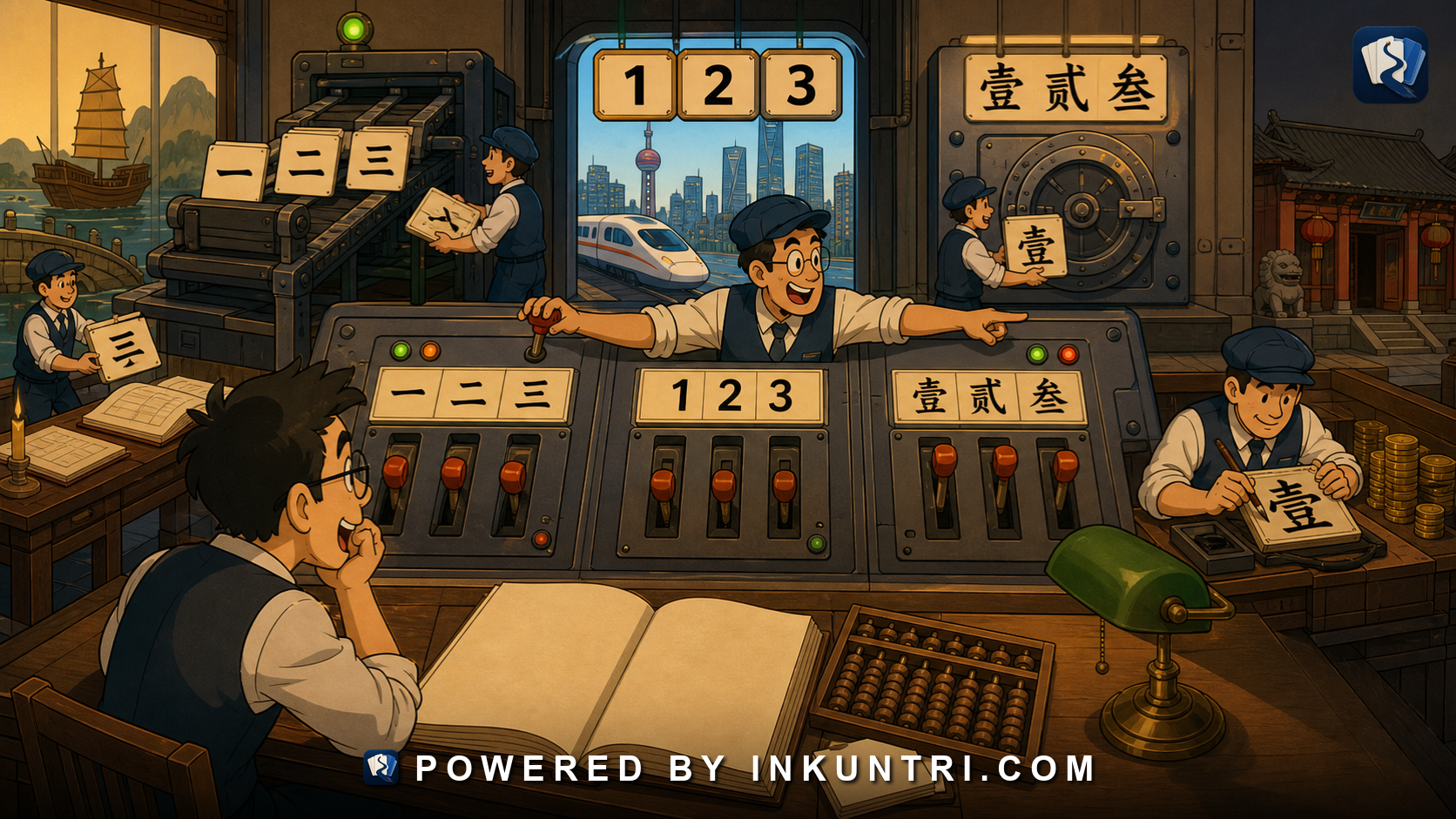
Core examples: 一二三, 壹贰叁, 〇, 两/二, 2026年5月23日, ¥88.00, 苏州码子.
Chinese number literacy is not just arithmetic
If you can count in Mandarin, you can say 一, 二, 三. That is useful, but it is not enough for real reading.
In Chinese writing, numbers appear in several systems:
Arabic digits:        1, 2, 3, 2026, ¥88.00
Ordinary Chinese:     一, 二, 三, 十, 百, 千, 万, 亿
Formal financial:     壹, 贰, 叁, 拾, 佰, 仟, 萬/万, 億/亿
Suzhou numerals:      〡, 〢, 〣, 〤, 〥, 〦, 〧, 〨, 〩
These are not decorative variants. They belong to different contexts.
A date in a news article may use Arabic digits. A holiday name may use Chinese numerals. A receipt may mix Arabic prices with Chinese unit words. A contract may require uppercase financial numerals. An old market tag, shop ledger, or historical document may use Suzhou numerals. A formal amount may write both small-form digits and uppercase Chinese side by side.
So number writing is a literacy issue. It tells you what kind of text you are reading.
Four systems at a glance
| System | Examples | Main contexts | Learner danger |
|---|---|---|---|
| Arabic digits | 2026, 5月23日, ¥88.00, 30元 | Modern dates, prices, quantities, statistics, forms, product labels, ticketing, codes | Assuming all numbers should be read digit-by-digit. |
| Ordinary Chinese numerals | 一, 二, 三, 十, 百, 千, 万, 亿, 〇, 零 | Counting, approximate quantities, idioms, traditional dates, names of events, prose style | Confusing 二 and 两; confusing 〇 and 零. |
| Financial numerals | 壹, 贰, 叁, 肆, 伍, 陆, 柒, 捌, 玖, 拾 | Contracts, invoices, checks, accounting, donation records, legal/financial documents | Treating them as archaic decoration rather than anti-alteration forms. |
| Suzhou numerals | 〡, 〢, 〣, 〤, 〥, 〦, 〧, 〨, 〩, 〸, 〹, 〺 | Historical commercial writing, old price tags, market/shop notation, archival materials | Not recognizing them as numbers at all. |
The same value can be written differently depending on context:
| Value | Possible written forms | Typical context |
|---|---|---|
| 3 | 3 / 三 / 叁 / 〣 | Arabic, ordinary, financial, Suzhou. |
| 20 | 20 / 二十 / 贰拾 / 〹 | Modern digit, ordinary, financial, Suzhou. |
| 88 yuan | ¥88.00 / 八十八元 / 捌拾捌元整 | Price, prose, formal amount. |
| May 23, 2026 | 2026年5月23日 / 二〇二六年五月二十三日 | Modern date; formal/prose date. |
A strong reader learns not only the value, but the writing register.
Arabic digits in modern Chinese
Arabic digits are everywhere in modern Chinese text. They are used in ticketing apps, train stations, product labels, phone numbers, addresses, percentages, dates, tables, scientific writing, official forms, and online interfaces.
Examples:
2026年5月23日
¥88.00
3号线
12:30
500克
100—150公里
第2页
身份证号码:110101199001011234
In modern publishing and public writing, Arabic digits are especially favored when the number needs to be visually precise, easy to compare, or easy to process in tables and forms.
Compare:
| Chinese text | Reader effect |
|---|---|
| 共有1480人参加。 | Fast to scan; good for statistics. |
| 共有一千四百八十人参加。 | More prose-like; slower to scan. |
| ¥88.00 | Price-like; machine-readable. |
| 八十八元 | Spoken/prose form. |
| 捌拾捌元整 | Formal financial form. |
The Arabic digit is not “less Chinese.” It is part of modern Chinese written practice.
Ordinary Chinese numerals
The ordinary Chinese numeral system uses characters:
| Value | Character | Pinyin |
|---|---|---|
| 0 | 零 / 〇 | líng |
| 1 | 一 | yī |
| 2 | 二 / 两 | èr / liǎng |
| 3 | 三 | sān |
| 4 | 四 | sì |
| 5 | 五 | wǔ |
| 6 | 六 | liù |
| 7 | 七 | qī |
| 8 | 八 | bā |
| 9 | 九 | jiǔ |
| 10 | 十 | shí |
| 100 | 百 | bǎi |
| 1,000 | 千 | qiān |
| 10,000 | 万 | wàn |
| 100,000,000 | 亿 | yì |
Chinese groups large numbers by 万 and 亿, not by thousands in the same way English does.
| Number | Chinese structure | Literal grouping |
|---|---|---|
| 10 | 十 | ten |
| 20 | 二十 | two tens |
| 101 | 一百零一 | one hundred zero one |
| 1,001 | 一千零一 | one thousand zero one |
| 10,000 | 一万 | one ten-thousand |
| 100,000 | 十万 | ten ten-thousands |
| 1,000,000 | 一百万 | one hundred ten-thousands |
| 100,000,000 | 一亿 | one hundred-million |
For English speakers, 万 is the first serious mental adjustment. 一万 is not “one thousand.” It is ten thousand. A price like 3.5万 means 35,000, not 3,500.
二 and 两: the “two” problem
Both 二 and 两 can mean two, but they are not interchangeable.
A rough learner rule:
Use 二 for digits, order, and many fixed numeral forms.
Use 两 before measure words and in many quantity expressions.
Examples:
| Natural | Less natural or different | Why |
|---|---|---|
| 两个人 | 二个人 | 两 is standard before 个 in ordinary counting. |
| 两本书 | 二本书 | 两 before classifier 本. |
| 两天 | 二天 | 两 is normal for “two days.” |
| 二楼 | 两楼 | 二 marks sequence/order: second floor. |
| 二号线 | 两号线 | Route/line number; digit-like. |
| 二十 | 两十 | 二十 is the normal form for twenty. |
| 两百 / 二百 | both common | 两百 is common in speech; 二百 also exists. |
| 两千 / 二千 | both possible | 两千 is very common in speech. |
| 两万 / 二万 | both possible, register varies | 两万 common in speech; 二万 may sound more formal/list-like. |
The safest practical advice is to learn 二 and 两 in phrases, not as abstract rules. Say 两个人, 两本书, 两天, 两点. Say 二楼, 二号, 第二, 二十.
〇 and 零: two written zeros
Chinese has two common zero forms in modern writing:
| Form | Typical use | Example |
|---|---|---|
| 〇 | Digit-like zero, especially in years and serial digit reading | 二〇二六年 |
| 零 | Ordinary zero in full numeral reading and financial writing | 一百零一; 零元 |
For years, each digit is often read separately:
2026年 = 二〇二六年For full numbers, 零 marks a skipped place:
101 = 一百零一
1001 = 一千零一
1008 = 一千零八
Do not write 二零二六年 in formal Chinese date style if the expected convention is 二〇二六年. You may see both in informal contexts, but 〇 is the cleaner digit-zero character for years.
Dates: digits, characters, and event names
Modern dates commonly use Arabic digits:
2026年5月23日
2026-05-23
5月23日
But date-like expressions in names, events, festivals, and historical references often use Chinese numerals:
五四运动
七七事变
五一劳动节
十一假期
腊月二十三
正月初五
This is why learners should not force one system everywhere.
Compare:
| Form | Meaning/use |
|---|---|
| 5月4日 | Calendar date. |
| 五四运动 | Historical event name. |
| 7月7日 | Calendar date. |
| 七七事变 | Historical event name. |
| 10月1日 | Calendar date. |
| 十一假期 | National Day holiday period in Mainland usage. |
In event names, the number becomes part of a lexicalized expression. It behaves more like a name than a raw date.
Prices, quantities, rankings, and lists
Modern Chinese often mixes Arabic digits with Chinese measure words and units:
¥88.00
88元
500克
2件8折
3号窗口
第2名
10公里
7天无理由退货
For prices and quantities, the Arabic number usually improves scanning. For approximate or idiomatic quantities, Chinese numerals may be more natural:
| Meaning | Natural written form | Note |
|---|---|---|
| three or four months | 三四个月 | Approximate; no 顿号 between 三 and 四. |
| ten-plus days | 十几天 | Approximate. |
| several thousand people | 几千人 | Approximate. |
| 48 people | 48人 | Exact count, table/news friendly. |
| one person | 一个人 | Ordinary count; Chinese numeral natural. |
| product model X100 | X100 | Code/model; Arabic digits retained. |
Policy documents and official notices often number items using Chinese numerals in headings:
一、总体要求
二、主要任务
三、保障措施
Subpoints may then use Arabic or Chinese punctuation systems:
(一)加强组织领导
(二)完善工作机制
1. 建立台账
2. 定期检查
Reading these lists is not about math. It is about recognizing document structure.
Financial numerals: numbers built to resist alteration
Financial numerals are formal uppercase Chinese number characters:
| Ordinary | Financial | Why it matters |
|---|---|---|
| 一 | 壹 | Harder to alter by adding strokes. |
| 二 | 贰 | More complex than 二. |
| 三 | 叁 | More complex than 三. |
| 四 | 肆 | More complex than 四. |
| 五 | 伍 | More complex than 五. |
| 六 | 陆 | More complex than 六. |
| 七 | 柒 | More complex than 七. |
| 八 | 捌 | More complex than 八. |
| 九 | 玖 | More complex than 九. |
| 十 | 拾 | More formal than 十. |
| 百 | 佰 | Formal unit. |
| 千 | 仟 | Formal unit. |
The goal is not elegance. The goal is control. In financial and legal writing, small numbers can be dangerously easy to alter. 一 can become 十. 二 can become 三. Financial numerals reduce that risk.
You will see them in:
- contracts
- checks
- invoices
- receipts
- reimbursement forms
- donation records
- court and accounting documents
- bank-related forms
A typical formal amount:
人民币壹仟贰佰叁拾肆元整This means:
RMB 1,234.00Article 018 gives the full system and conversion rules. For article 017, the important point is recognition: 壹贰叁 is not ancient flavor text. It is a living formal numeral system.
Suzhou numerals: the old commercial code learners still meet in archives
Suzhou numerals, also called 苏州码子 or 花码 in many discussions, are a historical commercial numeral system used in Chinese communities before Arabic digits became dominant in modern commerce.
A learner may meet them in:
- old shop signs
- handwritten price tags
- market notation
- account books
- archival records
- older printed materials
- museum displays
- discussions of historical commerce
Core forms include:
| Value | Suzhou numeral |
|---|---|
| 1 | 〡 |
| 2 | 〢 |
| 3 | 〣 |
| 4 | 〤 |
| 5 | 〥 |
| 6 | 〦 |
| 7 | 〧 |
| 8 | 〨 |
| 9 | 〩 |
| 10 | 〸 |
| 20 | 〹 |
| 30 | 〺 |
Suzhou numerals are easy to miss because several forms look like marks rather than modern digits. 〡, 〢, and 〣 can look like tally strokes. 〤 looks like a symbol. 〩 has had glyph variation in standards and fonts. In modern digital text, support depends on fonts and encoding.
Do not overlearn them before ordinary numerals and financial numerals. But do learn to recognize the category. If you are reading family records, old receipts, local history materials, or shop ephemera, Suzhou numerals may suddenly matter.
How numeral systems mix in real text
Chinese writing often combines systems in the same document.
Example: product label
净含量:500克
保质期:12个月
生产日期:2026年5月23日
Arabic digits carry precise quantities and dates. Chinese characters carry labels and units.
Example: official outline
一、工作目标
(一)完成年度任务
1. 建立项目清单
2. 完成数据核验
Chinese numerals organize high-level sections. Arabic digits may organize lower-level operational lists.
Example: contract amount
合同金额:¥12,340.00(人民币壹万贰仟叁佰肆拾元整)Arabic digits support fast comparison and calculation. Financial numerals support formal anti-alteration reading.
Example: historical shop note
〢〥 文The reader must recognize the possibility of Suzhou numeral notation before interpreting the value.
Field guide for travelers and archival readers
| Where you are reading | Likely number forms | What to watch for |
|---|---|---|
| Train station/app | Arabic digits + Chinese units | 车次, 时间, 座位, 检票口, 站台. |
| Restaurant menu | Arabic prices; Chinese dish names | ¥ may be omitted; prices may be bare digits. |
| Supermarket label | Arabic digits + 克/斤/瓶/袋/件 | Discounts like 2件8折. |
| Museum label | Arabic dates plus Chinese reign/historical dates | 公元, 朝代, 年号. |
| Contract | Arabic amount + financial numeral amount | The two should match. |
| Receipt/invoice | Arabic digits, 元/角/分, sometimes 大写金额 | Check decimal and unit. |
| Old shop sign/archive | Ordinary Chinese, Suzhou numerals, older forms | Font and context matter. |
| Official notice | Chinese section numerals + Arabic dates/codes | 一、二、三 and (一)(二) are structure markers. |
Practice conversions
Convert between systems:
| Arabic | Ordinary Chinese | Financial Chinese |
|---|---|---|
| 8 | 八 | 捌 |
| 20 | 二十 | 贰拾 |
| 88 | 八十八 | 捌拾捌 |
| 101 | 一百零一 | 壹佰零壹 |
| 1,234 | 一千二百三十四 | 壹仟贰佰叁拾肆 |
| 10,000 | 一万 | 壹万 |
| 100,000,000 | 一亿 | 壹亿 |
Read these in context:
| Text | What kind of number writing is it? |
|---|---|
| 二〇二六年五月二十三日 | Chinese date style using 〇. |
| 2026年5月23日 | Arabic digit date in Chinese text. |
| 人民币壹仟贰佰叁拾肆元整 | Financial uppercase amount. |
| 2件8折 | Arabic digits in retail promotion. |
| 三四个月 | Approximate Chinese numeral expression. |
| 〡〢〣 | Suzhou numeral forms for 1, 2, 3. |
Learner framework: value, system, context
When reading numbers in Chinese, ask three questions:
1. What is the numeric value?
2. Which writing system is being used?
3. Why is that system being used in this context?
The third question is the one learners skip. It is also the one that builds literacy.
- Arabic digits often signal precision, tables, commerce, time, codes, and modern interface design.
- Ordinary Chinese numerals often signal prose, approximate numbers, idioms, section structure, and named events.
- Financial numerals signal formal money and anti-alteration practice.
- Suzhou numerals signal historical or specialized commercial notation.
You do not need to romanticize any one system. You need to recognize the job each system does.
Suggested interactive/tool module
Module name: Chinese Number Systems Converter
Core behavior: Convert a value among Arabic digits, ordinary Chinese numerals, formal financial numerals, and Suzhou numeral display.
Modes:
- Date mode: 2026年5月23日 ↔ 二〇二六年五月二十三日.
- Money mode: ¥1,234.56 ↔ 人民币壹仟贰佰叁拾肆元伍角陆分.
- Quantity mode: 500克, 三四个月, 几千人.
- Document-outline mode: 1 / 一 / (一) / 1. / 第一.
- Historical mode: display Suzhou numerals with font warnings.
Error highlighter:
- flags 二个人 and suggests 两个人 in most ordinary contexts
- flags 二〇二六 written with 零 if formal date style is expected
- flags financial amount ending in 分 followed by 整
- warns when Arabic and 大写金额 do not match
- Built from outline 017 in the Inkuntri Chinese article outline set.
- Key standards background: GB/T 15835-2011 《出版物上数字用法》 for modern public-text number usage; official standard record: https://openstd.samr.gov.cn/bzgk/std/newGbInfo?hcno=F5DAC3377DA99C8D78AE66735B6359C7
- Financial-numeral context cross-references bill/document-writing practices; article 018 expands this in detail.
- Suzhou numeral encoding note: Unicode’s CJK Symbols and Punctuation chart identifies Suzhou numerals and includes U+3021..U+3029 and U+3038..U+303A, while retaining HANGZHOU NUMERAL character names: https://www.unicode.org/charts/PDF/U3000.pdf
- Because glyphs and fonts vary, screenshots or font-specific examples should be checked before publishing visual assets.
- For live product design, do not treat number conversion as purely linguistic. Legal, accounting, banking, and publication standards can impose context-specific rules.
Related reading
Building a Mandarin Reader Workflow From News, Documents, and Literature
The reader can build a sustainable Mandarin reading workflow that combines current news, practical documents, essays, and literature without drowning in vocabulary.
CJK Numerals, Counters, and Measure Words: Similar Surface, Different Grammar
The reader can compare Chinese measure words with Japanese counters and Korean counters without flattening the three systems into one.
Influencer Commerce Vocabulary in Mandarin
The reader can understand Chinese influencer-commerce language across live streams, product promotion, affiliate links, commissions, and buyer claims.
The Vocabulary of Chinese Food Culture: 烹, 炒, 炖, 蒸, 煮
The reader can read menus and food writing through cooking verbs, ingredient categories, regional terms, and texture vocabulary.
Memes, Homophones, and Political Caution in Chinese Online Culture
The reader can understand how Chinese online users use homophones, euphemisms, abbreviations, and layered jokes to manage sensitivity, moderation, and community recognition.
Chinese Characters Abroad: Hanzi, Kanji, Hanja, and the Shared Scriptworld
The reader understands the shared character tradition across China, Japan, and Korea while respecting each language’s independent grammar, pronunciation, and history.