
How Chinese Subtitles Compress Speech Into Readable Lines
The reader understands subtitles as edited written language, not a full transcript of speech.
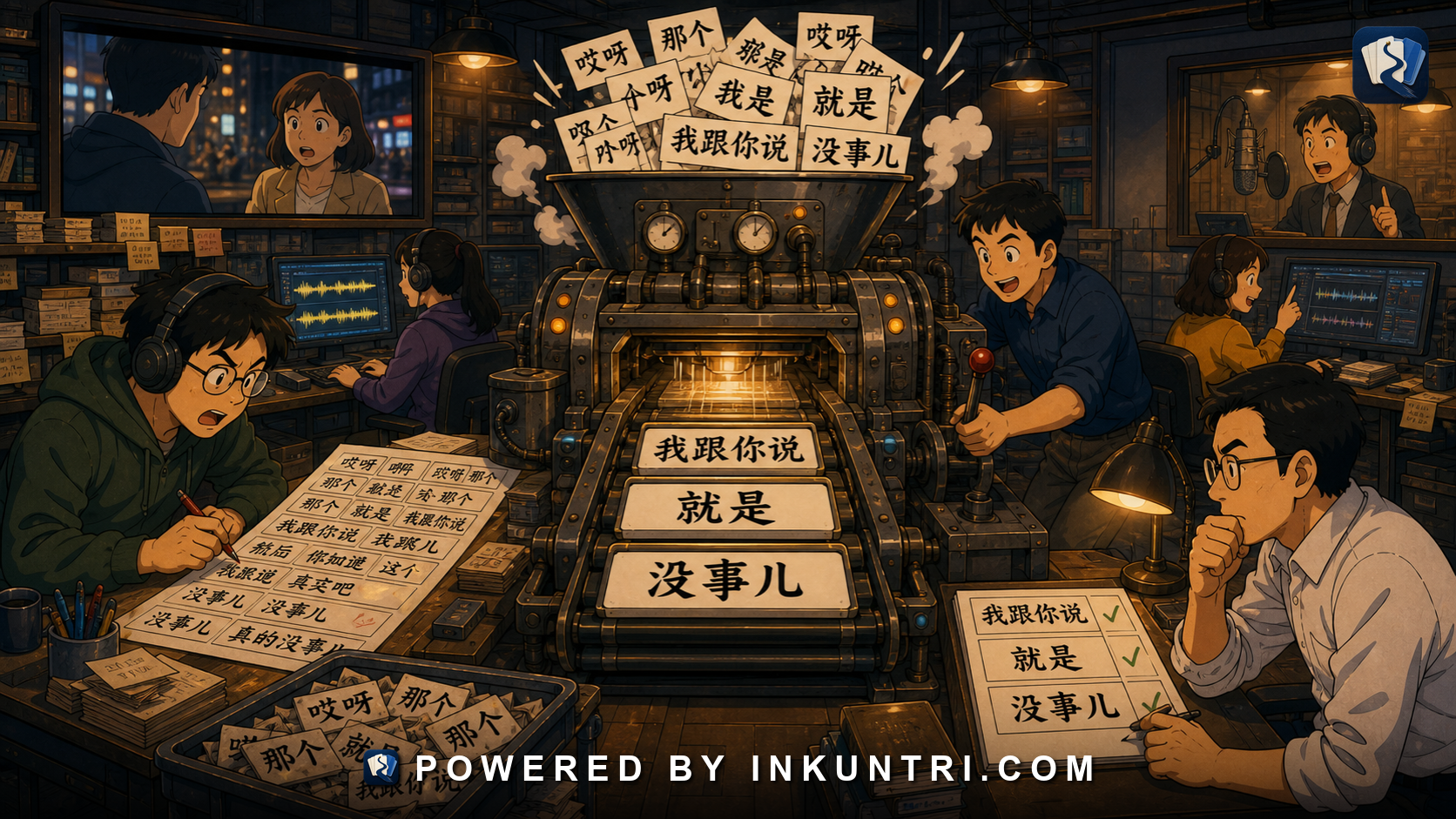
Core examples: 哎呀, 那个, 就是, 我跟你说, 没事儿, rapid exchanges, variety-show captions. Recommended feature module: Subtitle compression viewer: side-by-side spoken transcript, edited subtitle, omitted fillers, normalized grammar, and learner notes. Related internal articles: 007, 008, 024, 026, 027, 046, 047, 062.
Subtitles are not transcripts
Learners love subtitles because subtitles seem to solve listening. You hear speech, see characters, and suddenly the language feels manageable.
But subtitles are not full transcripts. They are edited text designed to fit time, screen space, reading speed, platform rules, censorship/review constraints, visual layout, and audience expectations.
A person may say:
哎呀,我跟你说啊,那个,今天这事儿吧,真的不是我不想帮你,就是……怎么说呢,有点麻烦。A subtitle might show:
这事不是我不想帮你,是有点麻烦。The subtitle is not “wrong.” It is doing a different job. It converts messy spoken language into a readable line.
For learners, this is both helpful and dangerous. Helpful because subtitles expose you to written forms of speech. Dangerous because they can hide exactly the things that make listening hard: fillers, reductions, hesitations, particles, repairs, overlap, and speed.
The useful stance:
Subtitles are edited reading aids.
They are not the spoken language itself.
1. Why subtitles must compress
Chinese subtitles face several constraints at once.
| Constraint | Effect on subtitle writing |
|---|---|
| Screen space | Lines must be short enough to read without covering important visuals. |
| Timing | Text must appear and disappear with speech. |
| Reading speed | Viewers need time to process the line. |
| Visual hierarchy | Captions must not compete too much with faces, action, or on-screen text. |
| Review/platform rules | Certain wording, names, punctuation, or style choices may be standardized. |
| Genre | Film, drama, documentary, variety show, livestream, and classroom video use different conventions. |
| Audience | Children, general viewers, fans, and learners need different density. |
Chinese characters carry a lot of information in compact space, but that does not mean subtitles can include everything. Rapid Mandarin speech can still outrun readable subtitles.
Subtitlers often must choose:
meaning over exact wording
readability over completeness
clarity over spoken messiness
2. Fillers are often removed
Spoken Mandarin uses fillers and discourse markers constantly:
那个
就是
然后
你知道吧
我跟你说
怎么说呢
哎呀
嗯
啊
这个
These can be meaningful. They manage timing, stance, politeness, hesitation, and interpersonal alignment. But subtitles often remove them unless they matter to character voice or plot.
Example:
Spoken:
那个,我今天可能,嗯,稍微晚一点到。Subtitle:
我今天可能晚一点到。What was removed?
| Removed element | Function in speech |
|---|---|
| 那个 | hesitation/soft opening |
| 嗯 | planning pause |
| 稍微 | softener, sometimes kept depending timing |
The subtitle gives the proposition. The speech gives the interpersonal texture.
Learner consequence: if you only read subtitles, you may understand the message but miss how Mandarin speakers manage hesitation and softness.
3. Repetition gets shortened
Real speech repeats. Subtitles usually do not.
Spoken:
不是不是不是,我不是这个意思。Subtitle:
不是,我不是这个意思。or simply:
我不是这个意思。Spoken:
走走走,快点快点。Subtitle:
快走。The repeated forms carry urgency, panic, excitement, or conversational rhythm. Compression can flatten those effects.
In variety shows, captions may keep repetition for humor or emphasis:
来了来了来了!In serious drama, they may compress it.
So subtitle style is genre-sensitive.
4. Pronouns and particles may disappear
Chinese subtitles often omit material that context makes obvious.
Spoken:
你把那个东西给我拿过来一下吧。Subtitle:
把那个拿过来。Possible omissions:
| Spoken element | Reason it may be omitted |
|---|---|
| 你 | visually obvious addressee |
| 东西 | vague filler noun; object visible or already known |
| 给我 | implied by context |
| 一下 | softening, but removable under time pressure |
| 吧 | stance/softener, sometimes omitted |
A learner reading only the subtitle may think the speaker was more direct than they sounded. That matters. Particles and softeners are central to Mandarin interaction.
Subtitles often preserve 吗, 呢, 吧, 了, and 啊 when they carry crucial stance, but they are not guaranteed to preserve every particle.
5. Spoken grammar may be normalized
People restart sentences, change structure midstream, and leave fragments unfinished. Subtitles often convert that into cleaner written grammar.
Spoken:
我昨天不是去那个,去医院嘛,然后医生说这个情况还得再看。Subtitle:
我昨天去了医院,医生说还得再观察。The subtitle normalized:
- false start: 不是去那个 → 去了医院
- discourse particle: 嘛 removed
- vague noun: 这个情况 simplified
- colloquial 再看 → 再观察
This helps viewers read quickly. But learners should not assume the subtitle is exactly what was said.
A strong listening practice is to ask:
What did the subtitle leave out?
What did it normalize?
What did the actor actually say?
6. Subtitles can make speech look more standard than it is
Mandarin speech varies by region, register, age, genre, and character. A subtitle may standardize all of that.
A Beijing-accented line with 儿化:
您等会儿,我马上回来。Subtitle may keep:
您等会儿,我马上回来。or normalize:
您等一下,我马上回来。A Taiwan Mandarin line might use vocabulary or particles that are retained in Taiwan subtitles but adapted in another edition.
A dialect line may be subtitled into standard written Chinese, meaning you are no longer seeing the actual spoken variety.
Example:
Spoken dialect/regionally flavored line:
你干啥呢?Subtitle:
你在做什么?The meaning is clear, but the flavor changes.
Learner caution: subtitles may erase accent and register differences unless the production intentionally preserves them.
7. Same-language captions differ from translated subtitles
A Chinese film might have Chinese subtitles for Chinese speech. A foreign film might have Chinese subtitles translated from English, Korean, Japanese, or another language. These are different tasks.
Same-language Chinese captions often compress Chinese speech.
Translated Chinese subtitles must solve translation problems:
- proper names
- jokes
- cultural references
- slang
- line timing
- sentence order
- untranslatable wordplay
- honorifics and politeness levels
Example English source:
Are you kidding me?Possible Chinese subtitles:
你开玩笑吧?
真的假的?
不是吧?
The choice depends on scene, character, intensity, and timing. Learners should not treat translated subtitles as direct Chinese equivalents of English structures. They are Chinese lines designed for the scene.
8. Variety-show captions are a different species
Chinese variety shows often add large, colorful, playful captions beyond normal subtitles. These may include:
- reaction words
- jokes
- sound effects
- labels over people
- memes
- exaggerated punctuation
- emoji-like symbols
- internet slang
- playful fonts
Example:
震惊!他真的来了!在线求助These captions are not just transcription. They guide the audience’s emotional reaction. They can turn a pause into a joke, a mistake into a meme, or a glance into a dramatic moment.
For learners, variety captions are useful but noisy. They teach internet-era written expression and reaction language, but they can distract from actual speech.
Use them deliberately:
Normal subtitles: for speech comprehension.
Variety captions: for media rhetoric and internet-style commentary.
9. A learner workflow for using subtitles well
Do not just watch passively with subtitles on. Use a three-pass method.
Pass 1: Listen without subtitles for gist.
Do not panic. Catch names, emotions, obvious words, and scene logic.
Pass 2: Watch with subtitles.
Mark what the subtitle says. Identify key words and sentence structure.
Pass 3: Replay a short section and listen for omitted material.
Ask:
Did the speaker say 那个, 就是, 然后, 啊, 吧, 呢?
Did the subtitle remove repetitions?
Did it normalize slang?
Did it shorten the sentence?
Did it keep or erase accent features?
For a 10-second clip, you can build a table:
| Spoken audio | Subtitle | What changed |
|---|---|---|
| 哎呀我跟你说,这事儿真的有点麻烦 | 这事真的有点麻烦 | 哎呀, 我跟你说 removed; 儿化 not shown if written as 事. |
| 不是不是,我没那个意思 | 我没那个意思 | Repetition removed. |
| 你先别急啊 | 你先别急 | 啊 removed; line becomes slightly more direct. |
This turns subtitles into a listening lab.
10. Tool concept: subtitle compression viewer
A strong Inkuntri module should show three synchronized layers:
- Full spoken transcript
- On-screen subtitle
- Learner notes
Example:
| Layer | Text |
|---|---|
| Spoken | 哎呀,我跟你说啊,这事儿吧,真的有点麻烦。 |
| Subtitle | 这事真的有点麻烦。 |
| Notes | 哎呀 = affect marker; 我跟你说 = discourse opener; 啊/吧 = stance; subtitle keeps core meaning only. |
Controls:
- highlight omitted fillers
- highlight particles
- mark repeated material
- show normalized grammar
- play slow/normal speed
- hide subtitle for listening test
- reveal subtitle after guess
This would teach learners to stop treating subtitles as exact speech.
10. What subtitles leave out—and how to train around it
The most important thing for learners to understand is that subtitles are not transcripts. A transcript tries to represent what was said. A subtitle tries to create readable timed text on a screen.
That means subtitles routinely edit speech.
| Spoken feature | Subtitle treatment | Learner risk |
|---|---|---|
| Fillers: 那个, 就是, 呃 | often removed | learner thinks speakers are more concise than they are |
| Repetition | shortened | learner misses repair and hesitation patterns |
| Overlap | one speaker prioritized | learner misses interactional chaos |
| Dialect/accent | normalized | learner misses regional sound and wording |
| Pronouns | omitted or restored | learner misjudges reference tracking |
| Particles | removed, changed, or retained selectively | learner underestimates stance and softness |
| Slang | normalized or replaced | learner misses register |
| Long sentence | split or compressed | learner mistakes editorial pacing for grammar |
Example:
| Layer | Text |
|---|---|
| Natural speech | 那个,我跟你说啊,这事儿吧,其实没那么简单。 |
| Clean subtitle | 我跟你说,这事其实没那么简单。 |
| Very compressed subtitle | 这事没那么简单。 |
All three are defensible in different subtitle contexts. But they teach different things.
The learner should ask:
What did the subtitle preserve?
What did it normalize?
What did it delete?
11. Chinese subtitles compress differently from English subtitles
Chinese subtitles often look shorter than English subtitles because Chinese characters can pack a lot of lexical information into little screen space. But that does not mean they are uncompressed. They are compressed in a Chinese way.
Compare:
Spoken: 我不是跟你说过了吗?这个地方不能停车,你怎么又停这儿了?
Subtitle: 我不是说过吗?这里不能停车。
The subtitle keeps the conflict and removes repetition, pronoun redundancy, and some emotional force.
A literal-minded learner may complain: “The subtitle is missing words.” That is true but incomplete. The better question is: “What did the subtitler decide was essential for screen reading?”
Common compression strategies:
| Strategy | Spoken line | Subtitle line |
|---|---|---|
| Remove filler | 那个,我想问一下… | 我想问一下… |
| Collapse repetition | 等一下等一下,你先别走 | 等一下,你先别走 |
| Normalize colloquial grammar | 我就说嘛,这不行吧 | 我就说,这不行 |
| Omit vocatives | 小王,你帮我看一下这个 | 帮我看一下这个 |
| Replace vague speech | 那个东西你放哪儿了? | 东西放哪儿了? |
| Compress emotional stance | 你怎么能这样啊? | 你怎么能这样? |
This is why subtitles are excellent for reading support but incomplete as listening evidence.
12. Genre differences: drama, variety, livestream, education
Not all subtitles behave the same way.
| Genre | Subtitle style | Learner caution |
|---|---|---|
| Film/drama | edited for readability and timing | emotional particles may be reduced |
| Variety show | colorful captions, jokes, emphasis text | captions may add jokes not literally spoken |
| News | closer to formal summary | not a casual speech model |
| Livestream | fast, messy, often auto-generated | errors and missing punctuation are common |
| Educational videos | more complete, sometimes pedagogical | may be unnaturally clean |
| Short videos | punchy, meme-like, often stylized | subtitles may be part of the performance |
Variety-show captions are especially tricky. On-screen text may not be a subtitle at all. It may be a joke, reaction label, dramatic emphasis, or editorial commentary.
Example:
Speaker says: 我真的不知道。
Screen caption: 一脸懵
The caption does not transcribe the speech. It labels the situation: “totally confused.”
Learners should separate:
subtitles = spoken content support
captions = editorial/textual layer
on-screen labels = entertainment framing
13. A watching workflow that actually builds listening
A learner who always reads subtitles first trains reading, not listening. A better workflow has phases.
| Phase | Action | Purpose |
|---|---|---|
| 1. Blind listen | Listen without subtitles once. | Train sound and gist. |
| 2. Subtitle read | Watch with Chinese subtitles. | Confirm words and segmentation. |
| 3. Difference check | Ask what the subtitle omitted. | Notice speech reduction. |
| 4. Shadow short chunks | Repeat 5–10 seconds of speech. | Train rhythm and reductions. |
| 5. Transcript note | Write the spoken version if possible. | Build listening-to-text accuracy. |
| 6. Review without subtitles | Rewatch later. | Check whether support has transferred. |
For a 30-minute episode, do not intensively analyze the whole thing. Choose 3–5 short clips where the subtitle helped but did not fully match the speech. Those clips are gold.
A useful clip note:
Clip: 08:14–08:23
Subtitle: 没事,我自己来。
Heard: 没事儿没事儿,我自己来吧。
Omitted: repetition, 儿化, 吧
Learning target: soft refusal / taking over a task politely
This turns entertainment into structured listening.
14. Subtitle translation is not the same as Chinese subtitle compression
A Chinese subtitle for Chinese speech and an English subtitle for Chinese speech solve different problems.
| Subtitle type | Main task |
|---|---|
| Chinese intralingual subtitle | make Chinese speech readable on screen |
| English translated subtitle | transfer meaning for non-Chinese readers |
| Bilingual subtitle | balance two languages, often at cost of precision |
| Dub subtitle | may reflect dubbed script, not original speech |
| SDH/CC caption | may include sound effects, speaker IDs, music cues |
A learner watching with English subtitles may understand the story but miss the Chinese grammar. A learner watching with Chinese subtitles may see the words but miss what was not written. A learner watching both may overload attention.
Suggested sequence:
Beginner: English first for plot, then Chinese clip review.
Intermediate: Chinese subtitles first, English only for confusing scenes.
Advanced: no subtitles first, Chinese subtitles second, transcript work third.
The goal is not purism. The goal is to know what skill each mode trains.
15. Stronger tool spec: subtitle compression viewer
The module should display three aligned layers:
1. Careful transcript
2. Natural speech transcript
3. On-screen subtitle
Example:
| Layer | Text | Notes |
|---|---|---|
| Careful transcript | 我跟你说,这件事情其实没有那么简单。 | textbook-clean version |
| Natural speech | 我跟你说啊,这事儿吧,其实没那么简单。 | particles, 儿化, colloquial compression |
| Subtitle | 这事没那么简单。 | compressed screen text |
Clickable labels:
- filler removed
- particle removed
- noun compressed
- pronoun omitted
- colloquial form normalized
- emotional stance softened
- timing constraint
The tool should include audio at slow, natural, and replay speeds. Learners should be able to hide the subtitle, reveal the transcript, and mark words they heard before reading.
That is how subtitles become a listening bridge instead of a listening crutch.
Final learner takeaway
Chinese subtitles are a gift, but they are not the spoken language itself. They are edited written lines shaped by time, space, readability, genre, and platform norms.
Use subtitles to support listening, but listen beyond them.
Ask:
What did the speaker say that the subtitle removed?
What did the subtitle make cleaner?
What particles, fillers, reductions, or repetitions matter here?
That is how subtitles become a bridge to real Mandarin instead of a crutch that hides it.
Related reading
Chinese Characters Abroad: Hanzi, Kanji, Hanja, and the Shared Scriptworld
The reader understands the shared character tradition across China, Japan, and Korea while respecting each language’s independent grammar, pronunciation, and history.
How to Build a Personal Mandarin Shadowing Corpus
The reader can build a focused, repeatable set of audio materials for pronunciation, rhythm, vocabulary, and register practice.
Political Slogans and Four-Character Style Across East Asia
The reader understands how four-character rhythm and classical-style compression shape political and public language across Chinese, Japanese, and Korean contexts.
From Flashcards to Literacy: When Chinese Study Must Leave the Card
The reader can recognize when flashcards are helping and when they are delaying real Chinese literacy, then shift toward connected reading and listening.
A Serious Learner’s Guide to Chinese Dictionaries
The reader can use Chinese dictionaries more deeply by reading definitions, parts of speech, usage notes, examples, synonyms, variants, and register labels.
Chinese Pronunciation Self-Diagnosis With Recording and Native Models
The reader can diagnose Mandarin pronunciation problems through recording, comparison, targeted drills, and structured feedback rather than vague “tone practice.”