
Chinese Names on Paper: Characters, Generational Names, and Formal Order
The reader can read the structure of Chinese names in formal writing and understand what characters may signal beyond pronunciation.
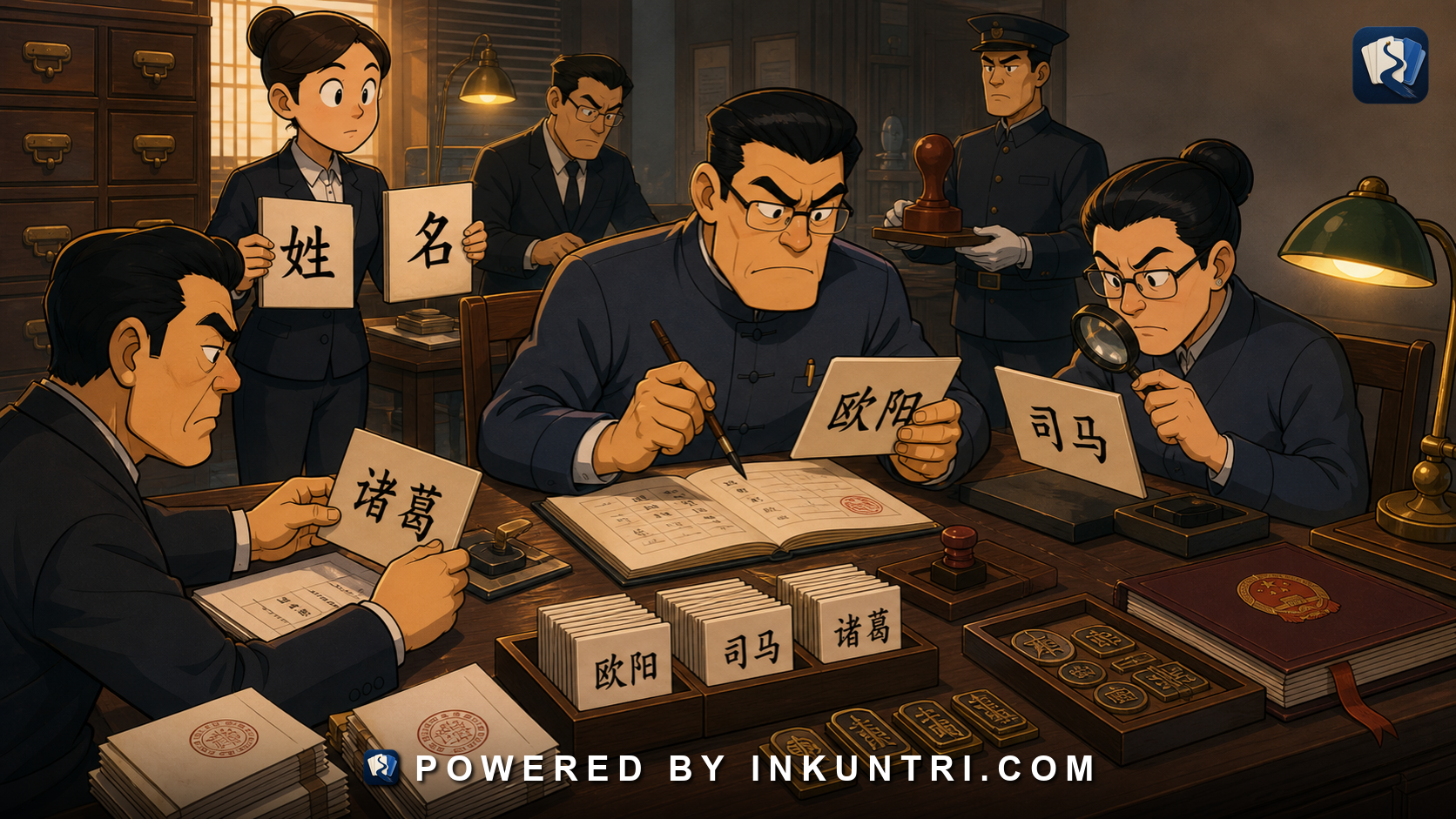
Core examples: 王小明, 李文华, 陈国强, 张伟, 欧阳娜娜, 司马, 诸葛, generational-name poems.
A Chinese name is not just a sound label
A Chinese name on paper is a compact literacy object. It has order. It has characters. It may carry family history, generational position, aspiration, literary taste, regional identity, or simply parental preference. It may be romanized in several ways. It may appear differently on an ID card, business card, school roster, academic paper, passport, seal, or English-language conference badge.
For learners, the first danger is simple: reversing the name.
In Chinese order, the surname comes first:
王小明This is not “Xiaoming Wang” on the Chinese page. It is 王 + 小明:
| Part | Chinese | Function |
|---|---|---|
| 姓 | 王 | family name / surname |
| 名 | 小明 | given name |
English-language contexts may reorder the name as Xiaoming Wang, but Chinese formal writing normally keeps surname first. If you do not know which part is the surname, you can misunderstand citations, rosters, name tags, and introductions.
Names are also not ordinary vocabulary. The characters may have meanings, but the name is not translated like a sentence. A person named 李文华 is not “Plum Literature China” in English. The characters matter, but they matter as name characters.
The basic structure: 姓 before 名
The simplest structure is:
姓 + 名Most common surnames are one character. Given names are commonly one or two characters. This gives common patterns:
| Full name | Surname | Given name | Pattern |
|---|---|---|---|
| 王小明 | 王 | 小明 | 1-character surname + 2-character given name |
| 李文华 | 李 | 文华 | 1 + 2 |
| 陈国强 | 陈 | 国强 | 1 + 2 |
| 张伟 | 张 | 伟 | 1-character surname + 1-character given name |
| 刘洋 | 刘 | 洋 | 1 + 1 |
A learner’s first rule is useful but incomplete:
In a three-character Chinese personal name, the first character is often the surname and the last two characters are the given name.
This rule works very often, but not always. Compound surnames exist.
Compound surnames: 欧阳, 司马, 诸葛
Some Chinese surnames contain two characters:
欧阳
司马
诸葛
上官
东方
Now the split changes:
| Full name | Surname | Given name | Pattern |
|---|---|---|---|
| 欧阳娜娜 | 欧阳 | 娜娜 | 2-character surname + 2-character given name |
| 司马光 | 司马 | 光 | 2 + 1 |
| 诸葛亮 | 诸葛 | 亮 | 2 + 1 |
If you always split after the first character, 欧阳娜娜 becomes 欧 + 阳娜娜, which is wrong. In ordinary modern contexts, compound surnames are less common than one-character surnames, but they are common enough that serious readers must know them.
This matters in rosters and citations. A name list may not insert a comma or space:
王小明
欧阳娜娜
张伟
诸葛亮
A learner has to know that 欧阳 and 诸葛 may be surnames. Otherwise, the structure is invisible.
Given names as one- or two-character units
A given name may be one character:
张伟
刘洋
李娜
or two characters:
王小明
陈国强
李文华
The two characters in a given name form a unit, but each character may still contribute association, sound, style, or family meaning.
For example:
| Name | Possible character associations | Warning |
|---|---|---|
| 文华 | culture, refinement, literary brightness | Do not translate as a phrase in ordinary English use. |
| 国强 | nation + strong | May reflect patriotic or aspirational naming, but do not overinterpret an individual. |
| 小明 | little/young + bright | Common textbook-style sample name; can feel generic. |
| 伟 | great, grand | Common masculine-leaning name character, but names are not strict gender labels. |
| 娜娜 | elegant/graceful sound association, reduplicated given name | Reduplication can sound personal, feminine, or stylistic depending on context. |
Name characters often carry positive associations: 文, 华, 明, 强, 伟, 美, 丽, 俊, 杰, 雅, 静, 安, 欣, 宇, 轩. But the meaning is not a dictionary translation of the person.
A respectful reader treats name characters as meaningful but does not turn them into amateur personality analysis.
Gendered, aspirational, and literary patterns
Chinese given names often draw on positive qualities, imagery, era, family preference, or literary taste.
Some characters have common gender associations in modern naming:
| More often feminine-coded | More often masculine-coded | Broadly neutral or variable |
|---|---|---|
| 美, 丽, 娜, 芳, 静, 雅 | 伟, 强, 刚, 勇, 杰 | 文, 华, 明, 安, 宇, 晨, 欣 |
These are tendencies, not laws. A character can shift by generation, region, family, and era. Do not assume gender from a name with absolute confidence.
Aspirational names are common:
国强
志远
文博
思齐
安然
嘉欣
Some names draw from classical phrases, poems, family texts, or admired historical language. Others reflect modern aesthetics, sound, uniqueness, or fashion. Still others are deliberately simple.
The key is balance. Characters matter, but not every name has a hidden classical allusion. Some do. Many do not. Ask before building a theory around someone’s name.
Generation names: 字辈
A 字辈 or generation name is a character shared by members of the same generation within a family or clan naming system. It may be planned in advance through a family poem, genealogy, or naming sequence.
A simplified example:
家族字辈:文、德、承、家、远One generation might share 文:
李文华
李文强
李文安
The next generation might share 德:
李德明
李德远
李德宇
In this system, the shared character does not merely sound nice. It locates the person within a family sequence.
But do not overgeneralize. Not every Chinese family uses generation names. Some used them historically but stopped. Some use them for men more consistently than for women. Some use different systems by branch. Some names share a character because parents liked the character, not because of a clan poem. Some siblings share a character, while cousins do not. Some families use a shared component rather than a full character.
A serious article about 字辈 should avoid the romantic shortcut “all Chinese names encode generation.” They do not. Generation naming is real, important, and unevenly practiced.
How generation poems work
A clan may preserve a sequence of characters in a poem or genealogical text. Each generation takes the next character in the sequence as one part of the given name.
A hypothetical sequence might be:
文德承家远,忠厚传世长。This is not offered as a universal poem. It is a model of how such sequences work. If 文 is assigned to one generation and 德 to the next, the names make kinship order visible.
The generational character is often the first character of a two-character given name:
陈文华
陈文杰
陈文安
But it may appear second in some families, or the system may be more complex. The right question is not “Which character is always the generation name?” The right question is “Does this family have a naming sequence, and how does it apply?”
Name order in formal contexts
Chinese names appear in many document genres. Each genre teaches you something.
ID documents
Chinese ID-style forms normally have a field labeled:
姓名This means “full name,” not “first name.” The name is written in Chinese order. A learner should not look for separate first-name and last-name fields unless the form is designed for international use.
School rosters
A roster may list names like this:
王小明
李文华
陈国强
张伟
欧阳娜娜
No comma. No space. The reader must know name structure. Sorting may be by surname, student number, class, or other administrative category.
Business cards
A business card may use Chinese order in characters and a romanized form below:
王小明
WANG Xiaoming
Capitalizing the surname is one strategy to prevent confusion. You may also see:
Xiaoming Wangor:
Wang XiaomingThe right form depends on the person, region, institution, and language context. Do not “correct” someone’s own romanization.
Academic citations
Chinese academic names can be handled differently in Chinese bibliographies, English bibliographies, library records, and journal metadata. A Chinese source may list:
王小明:《现代汉语语法研究》An English bibliography might convert the name to Wang Xiaoming, Xiaoming Wang, or Wang, Xiaoming depending on style.
The practical reader’s question is: which part is the surname, and how does this citation system format names?
Name stamps and seals
A personal seal may show a full name, surname, given name, studio name, or artistic name. It may use seal script, archaic forms, or stylized carving. The order is usually not decoded by sound alone. Visual literacy matters.
A learner who sees a red seal on a painting or document should not assume it is easy to read just because the name is simple in regular script. Seal script is a separate visual register.
Romanization: helpful but unstable
Romanization makes Chinese names accessible across languages, but it also creates ambiguity.
The Mandarin Pinyin form of 王小明 is commonly:
Wang XiaomingThe surname is separated from the given name. The two syllables of the given name are often written together as one word in standard Pinyin-style formatting. But in real English-language contexts, you may see variations:
Wang Xiao-ming
Wang Xiao Ming
Xiaoming Wang
WANG Xiaoming
Some are regional. Some are institutional. Some are personal preference. Some reflect older romanization systems. Some reflect Cantonese, Hokkien, Hakka, Teochew, or other language backgrounds rather than Mandarin.
Examples:
| Characters | Mandarin Pinyin-style | Other possible romanized forms | Note |
|---|---|---|---|
| 张 | Zhang | Cheung, Chong, Teo, Teoh in other communities/languages | Romanization may reflect non-Mandarin pronunciation. |
| 陈 | Chen | Chan, Tan, Chin | Region and language background matter. |
| 李 | Li | Lee, Lei | Do not assume one spelling maps to one character. |
| 王 | Wang | Wong, Ong | Same character can appear under different romanizations. |
Do not force Mandarin Pinyin onto every Chinese name in international contexts. A Hong Kong person surnamed Chan is not “wrong” because Mandarin Pinyin would be Chen. A Singaporean or Malaysian Chinese person may have an English name, dialect romanization, and Chinese-character name coexisting.
Why reversing names creates ambiguity
Suppose you see:
Li WenhuaIs Li the surname and Wenhua the given name? Usually, yes if this is Pinyin-style Chinese order.
But in an English-language article, you might see:
Wenhua LiNow the order has been reversed. The surname is still Li, but the visual cue has changed.
Ambiguity grows when both parts can look like possible given names or surnames to English readers. It grows further when romanization omits tone marks, hyphens, or capitalization. It grows again when a person has an English name:
David Wang Xiaoming
David Xiaoming Wang
Wang Xiaoming David
A serious reader does not guess when accuracy matters. Ask, check the Chinese characters, or follow the person’s own stated preference.
Names in Chinese introductions and address
In Chinese, asking and addressing names involves social choices.
Useful questions:
请问您贵姓?Polite: “May I ask your surname?”
请问您的名字怎么读?“May I ask how your name is read/pronounced?”
我应该怎么称呼您?“How should I address you?”
哪个字?“Which character?” This is useful when two names sound the same.
Name pronunciation often requires character clarification:
张伟
章伟
Both may be pronounced Zhāng Wěi depending on tone and surname, but the characters differ. In a phone call, someone might explain:
弓长张。This identifies 张 by decomposing it into 弓 + 长.
Or:
立早章。This identifies 章 by components 立 + 早.
This is name literacy in action: pronunciation is not enough; the character matters.
Characters in names may be rare, variant, or stylized
Names preserve characters that may be less common in everyday vocabulary. Parents may choose distinctive characters. Families may preserve older forms. Some names include variant characters. Some official records include characters that input methods handle poorly.
This creates practical problems:
- the name may not appear in a basic font
- an input method may not easily produce the character
- OCR may misread it
- simplified/traditional conversion may alter it incorrectly
- a database may reject it
- a romanized form may hide the distinction
For learners, the lesson is simple: names deserve extra care. Do not silently replace a name character with a near lookalike. In ordinary vocabulary, a variant may be tolerable. In a name, it can be personal identity.
A name anatomy diagram
Use 王小明 as the simplest model:
王 小明
│ └── 名 given name: 小明
└──── 姓 surname: 王

Romanization: Wang Xiaoming / WANG Xiaoming
Possible English order: Xiaoming Wang
Use 欧阳娜娜 to show compound surname structure:
欧阳 娜娜
│    └── 名 given name: 娜娜
└─────── 姓 compound surname: 欧阳

Romanization: Ouyang Nana / OUYANG Nana
Use 李文华 to show possible generational-name analysis:
李 文 华
│ │ └── personal given-name character
│ └──── possible generation character, if family system confirms it
└────── surname
The word possible matters. You cannot prove 文 is a generation character from the name alone. You need family context.
Reading names in running text
Names often appear with titles, roles, and institutions.
北京大学教授王小明表示,相关研究仍需进一步推进。Break it this way:
| Segment | Function |
|---|---|
| 北京大学 | institution |
| 教授 | title |
| 王小明 | name |
| 表示 | reporting verb |
| 相关研究仍需进一步推进 | quoted/summarized content |
Do not split 王小明 into 王 + 小 + 明 as three separate vocabulary items. Treat it as a name.
Another example:
项目负责人欧阳娜娜介绍了最新进展。The title is 项目负责人. The name is 欧阳娜娜. If you miss the compound surname, you may misread the sentence.
Names in citations and bibliographies
Chinese bibliography entries may put names before titles:
王小明:《汉字与现代阅读》,北京:某某出版社,2020年。The colon after the name introduces the work. The title marks identify the book or article. A learner must coordinate name literacy with punctuation literacy.
Academic databases may romanize this as:
Wang Xiaoming. Hanzi yu xiandai yuedu.or in a Western citation style:
Wang, Xiaoming.The exact format depends on the style guide, but the underlying name structure remains surname 王, given name 小明.
Respectful reading habits
A practical name-reading ethic has four parts.
First, preserve order when working in Chinese. Do not reverse Chinese-character names inside Chinese prose.
Second, do not guess pronunciation from romanization alone when characters are available. Characters clarify many ambiguities.
Third, do not force a Mandarin reading onto every Chinese-community name. Region, language background, and personal preference matter.
Fourth, ask politely when pronunciation or address matters.
A good question is not embarrassing. A bad assumption is.
Learner workflow for unfamiliar names
When you meet a Chinese name on paper, use this sequence.
Step 1: Identify whether the text is Chinese-order or English-order
In Chinese characters, expect surname first. In English text, check the style.
Step 2: Check for compound surnames
Before splitting after one character, scan for known compound surnames such as 欧阳, 司马, 诸葛, 上官.
Step 3: Treat the given name as a unit
Do not over-translate individual characters. Learn the pronunciation and written form.
Step 4: Notice possible generation characters, but do not assume
If siblings or cousins share a character, it may be generational. It may also be parental preference.
Step 5: Confirm romanization preference
Use the person’s own spelling where available.
Step 6: Ask how to address the person
Especially in professional contexts, title + surname may be safer than given name.
王老师
李医生
张主任
陈经理
Practice set
Parse each name.
| Name | Surname | Given name | Note |
|---|---|---|---|
| 王小明 | 王 | 小明 | Standard 1 + 2 pattern. |
| 李文华 | 李 | 文华 | 文 could be just a name character; do not assume generation without context. |
| 陈国强 | 陈 | 国强 | Aspirational/patriotic-looking characters, but avoid overinterpretation. |
| 张伟 | 张 | 伟 | 1 + 1 pattern. |
| 欧阳娜娜 | 欧阳 | 娜娜 | Compound surname. |
| 司马光 | 司马 | 光 | Compound surname; historical name. |
| 诸葛亮 | 诸葛 | 亮 | Compound surname; historical name. |
Now parse names in context:
清华大学教授李文华在会上发言。- institution: 清华大学
- title: 教授
- name: 李文华
- action: 在会上发言
欧阳娜娜发布新作品。- name: 欧阳娜娜
- surname: 欧阳
- given name: 娜娜
- action: 发布新作品
陈国强、王小明、张伟三位代表参加了会议。- 顿号 separates names in a list
- 三位代表 tells you there are three representatives
- the names are 陈国强 / 王小明 / 张伟
This final example shows why name literacy and punctuation literacy belong together.
What to remember
Chinese names on paper are structured. Surname-first order is the default in Chinese. Given names are commonly one or two characters. Compound surnames prevent automatic splitting after the first character. Generation names are real but not universal. Characters carry associations, but names are not translated like ordinary phrases. Romanization helps but can mislead.
The most productive attitude is careful respect. Read the structure. Preserve the characters. Learn the person’s preferred romanization. Ask when pronunciation or address matters.
Build a tool that lets users enter or select names and see:
- surname / given name split
- possible compound surname detection
- Pinyin-style romanization
- optional tone-mark display
- common English-order rendering
- possible generation-character flag when multiple related names share one character
- title/address suggestions such as 王老师, 李医生, 张主任
- warning when a split is uncertain
Example mode:
Input: 欧阳娜娜
Detected: 欧阳 + 娜娜
Warning: 欧阳 is a compound surname. Do not split as 欧 + 阳娜娜.
Family-sequence mode:
李文华
李文强
李文安
The tool can highlight 文 as a shared character but should label it “possible generation character; requires family context.”
For production fact-checking, consult:
- Iwona Kałużyńska, Traditional Chinese Generation Names: https://rcin.org.pl/ijp/Content/57724
- IFLA, Names of Persons — Chinese Names guidance: https://repository.ifla.org/items/bdf2c699-e435-4016-ae57-720f5578b155/full
- Asia Media Centre, A basic guide to Chinese names: https://www.asiamediacentre.org.nz/features/explainer-chinese-names
- Library of Congress, Chinese Romanization Table: https://www.loc.gov/catdir/cpso/romanization/chinese.pdf
Articles 007–009 extend the writing-and-literacy sequence from character structure into the visual systems that surround characters in real use:
- 007 teaches punctuation as a segmentation and interpretation system.
- 008 teaches screen typography as practical digital literacy.
- 009 teaches name reading as a formal-order, character, and social-context skill.
Recommended cross-links:
- Link 007 to article 003 on 字/词 and article 026 on segmentation.
- Link 008 to article 006 on variants, article 024 on input methods, and article 028 on subtitles.
- Link 009 to article 006 on variant characters, article 020 on place names, and article 025 on romanization systems.
Reusable module opportunities:
- Punctuation lab: unpunctuated paragraph → multiple punctuated readings.
- Typography comparison panel: same text across fonts, widths, line breaks, and mixed-script settings.
- Name anatomy diagram: surname/given-name/generation-character/romanization parser with uncertainty warnings.
Related reading
Political Slogans and Four-Character Style Across East Asia
The reader understands how four-character rhythm and classical-style compression shape political and public language across Chinese, Japanese, and Korean contexts.
Korean Hangul-Only Writing and the Invisible Hanja Layer
The reader sees why Korean text can look alphabetic while still containing a deep Sino-Korean vocabulary layer that matters for Chinese learners comparing the languages.
Taiwanese Mandarin and the Legacy of 國語 Education
The reader can identify key features of Taiwanese Mandarin and understand its relationship to 國語 education, local languages, and identity.
How Hong Kong Written Chinese Differs From Mainland Written Chinese
The reader can recognize differences in script, vocabulary, Cantonese influence, institutional language, and media style in Hong Kong written Chinese.
Two-Character Compounds: The Engine of Modern Chinese Vocabulary
The reader understands why disyllabic compounds dominate modern Mandarin and how their internal structures work.
Reading Temple Inscriptions and Donation Plaques
The reader can approach Chinese temple inscriptions and donation plaques by recognizing formulaic layout, donor language, merit vocabulary, dates, names, and honorific phrasing.